Quick answer
- What this covers: Hermes Agent is an autonomous AI employee that handles operations 24/7 without prompts.
- Who it’s for: People evaluating hermes agent.
- What it costs: $750/mo.
Hermes Agent is an autonomous AI platform that handles business operations without waiting for your instructions. Not a chatbot. Not a plugin. An AI employee that reads context, makes decisions, and executes tasks across your business systems while you focus on the work that actually grows revenue.
This guide covers what Hermes Agent does, how it works from a business owner's perspective, what it costs compared to hiring, and whether it fits your operation. No code. No jargon. Business outcomes only.
Key takeaways:- Hermes Agent operates autonomously. It acts on goals you set, not prompts you type. It works at 3 AM the same way it works at 3 PM
- A managed Hermes Agent at $750/mo replaces $4,000 to $6,000/mo of part-time staff across operations, follow-up, and admin
- It's an AI agent, not a chatbot. It passes the 3-Question Agent Test: acts without you, retains context, and improves over time
- Search interest in Hermes Agent is early but accelerating. OpenClaw went from 10 searches/mo to 90,500 in 8 weeks. Hermes is tracking the same curve
- You don't need to set it up yourself. Jejo.ai deploys and manages Hermes Agent for you
- Hermes Agent in 60 Seconds
- What Hermes Agent Does for Small Business
- How Hermes Agent Differs From Chatbots and AI Assistants
- How Hermes Agent Works
- The Business Case: Why Business Owners Are Switching
- A Day in the Life With Hermes Agent Running
- Who Hermes Agent Works Best For
- Where Hermes Agent Fits in the AI Agent Landscape
- How to Get Started With Hermes Agent
- FAQ
Hermes Agent in 60 Seconds
Hermes Agent is an autonomous AI agent platform. That means it takes goals, breaks them into steps, executes those steps using your business tools, and adapts based on results.
Here's what that looks like in practice:
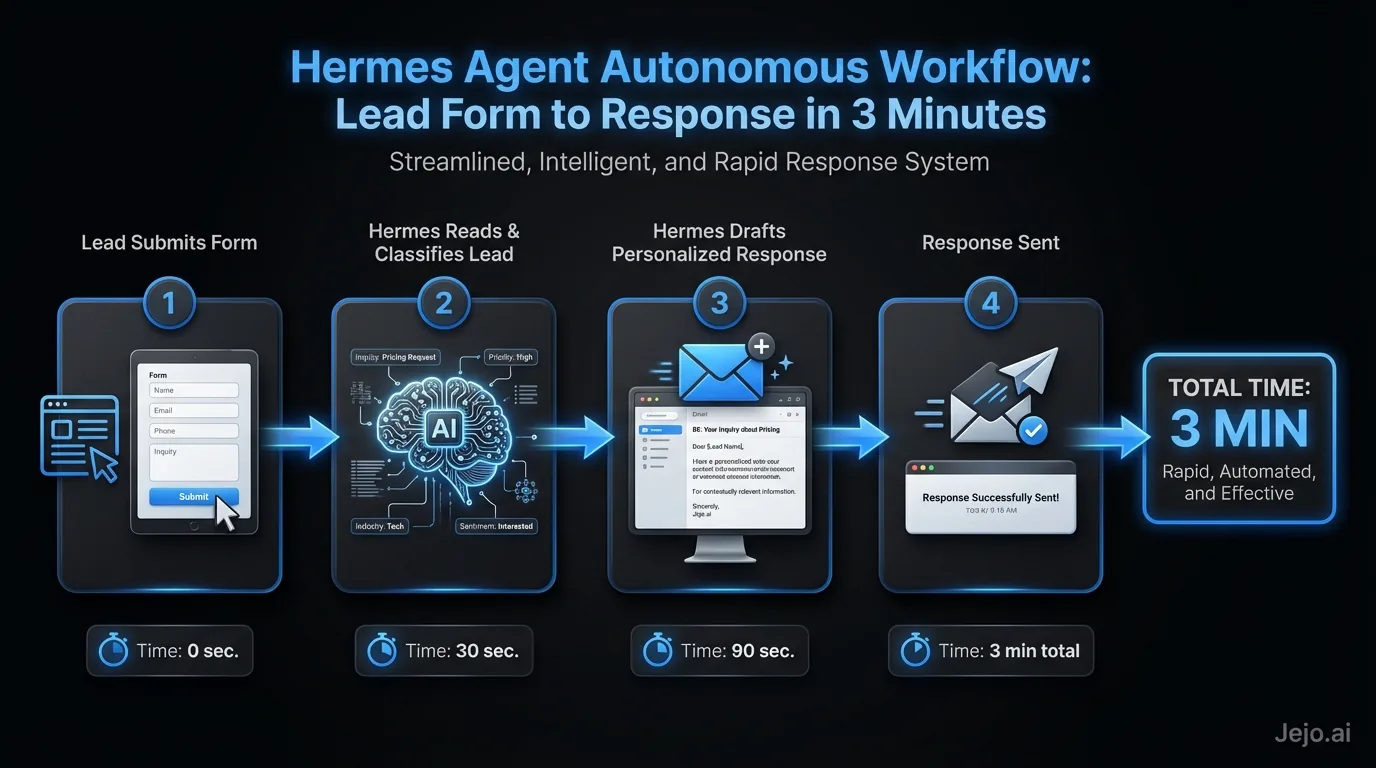
A new lead submits your contact form at 10:47 PM on a Wednesday. Hermes reads the inquiry. Checks their company against your CRM. Identifies they match your ideal client profile. Drafts a reply using your voice, references a relevant case study, includes 2 available meeting slots from your calendar, and sends it. Total elapsed time: 3 minutes. You were asleep.
That's one task. Hermes handles dozens of these across your business every day.
The word "autonomous" matters. ChatGPT waits for you to type. Hermes watches, decides, and acts. The difference between a tool and an employee.
For the full picture of how AI agents work in small business, see the AI for small business guide. For how agents compare to chatbots, virtual assistant for small business breaks down the operational differences.
What Hermes Agent Does for Small Business
Hermes Agent handles the operational work that eats 3 to 4 hours of your day. The tasks that are too repetitive for you but too context-dependent for basic automation.
Lead response and follow-upSpeed wins deals. The average small business takes 47 hours to respond to a new lead. Hermes responds in under 5 minutes. Harvard Business Review research found companies that respond within an hour are 7x more likely to have a meaningful conversation with a decision maker than those that wait even 2 hours. At 47 hours, you've already lost.
Hermes qualifies leads, sends personalized responses, books calls, and follows up on unanswered threads. All without a prompt from you.
Email operations According to McKinsey, the average worker spends 28% of their workweek reading and answering email. For a business owner pulling 50-hour weeks, that's 14 hours. Hermes triages your inbox by urgency, drafts responses in your voice, updates your CRM, and escalates only the 10% that requires your direct input. Client communicationHermes tracks project milestones, sends status updates, flags overdue deliverables, and handles routine client requests. Your clients get faster responses. You spend less time on back-and-forth.
Scheduling and coordinationMeeting scheduling alone costs most business owners 30 to 45 minutes per day. Hermes manages availability, sends calendar links, handles rescheduling, and confirms appointments. No human in the loop.
Data and reportingHermes pulls data from your tools, builds summaries, and flags trends. Weekly revenue snapshot at 7 AM Monday? Done. Client retention dropping below 80%? Flagged before you notice.
| Task Category | Time Spent (Manual) | Time With Hermes | Weekly Hours Saved |
|---|---|---|---|
| Email triage and response | 15-20 hrs/wk | 2-3 hrs/wk (review only) | 13-17 hrs |
| Lead follow-up | 5-8 hrs/wk | 30 min/wk (approvals) | 4.5-7.5 hrs |
| Scheduling | 3-4 hrs/wk | 15 min/wk | 2.75-3.75 hrs |
| Client updates | 3-5 hrs/wk | 30 min/wk | 2.5-4.5 hrs |
| Reporting | 2-3 hrs/wk | 10 min/wk | 1.8-2.8 hrs |
| Total | 28-40 hrs/wk | 3.5-4.5 hrs/wk | 24.5-35.5 hrs |
That's a second full-time employee's worth of output for a fraction of the cost.
How Hermes Agent Differs From Chatbots and AI Assistants
The market is flooded with products calling themselves "agents" that are really chatbots with better marketing. Hermes is different. Here's how.
The 3-Question Agent Test:- Does it act without you? Chatbots wait for input. Hermes monitors your systems and acts on triggers, goals, and deadlines. It works while you sleep.
- Does it know your business? ChatGPT starts fresh every session. Hermes retains your client history, communication style, pricing, and preferences across every interaction.
- Does it improve over time? A chatbot gives the same quality answer on day 1 and day 100. Hermes learns from your corrections and feedback. Month 2 is noticeably better than month 1.
| Capability | Chatbot | ChatGPT | Hermes Agent |
|---|---|---|---|
| Acts without prompts | No | No | Yes |
| Persistent business memory | No | No (per session) | Yes |
| Accesses your tools (email, CRM, calendar) | No | Limited | Yes |
| Multi-step workflow execution | No | Partially | Yes |
| Learns from your feedback | No | No | Yes |
| Works at 3 AM | No | Only if you're typing | Yes |
| Proactive monitoring | No | No | Yes |
If you've tried ChatGPT and found yourself spending more time prompting than working, that's the assistant trap. Hermes doesn't need prompts. It needs goals. Set them once, refine as needed, and let it run.
How Hermes Agent Works
Think of Hermes Agent like a new hire who learns by watching you work.
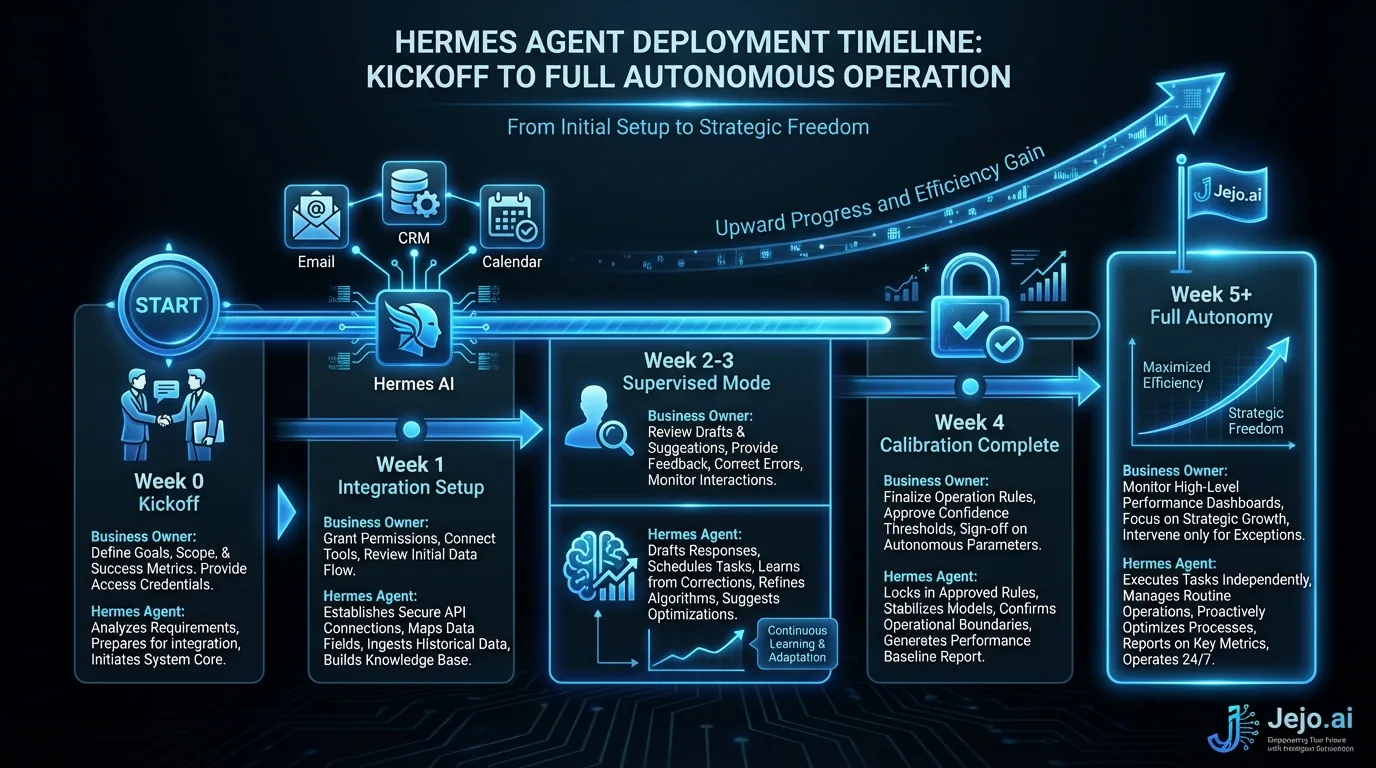
Week 1: Observation and first tasks. Hermes connects to your email, calendar, and CRM. It watches how you respond to leads, how you schedule meetings, what language you use with clients. Then it starts handling the simplest tasks: sorting email by priority, drafting standard responses, logging new contacts. Weeks 2 to 4: Calibration. You review its work for 15 to 20 minutes per day. When a draft doesn't match your voice, you correct it. When it miscategorizes a lead, you reclassify. Every correction teaches. By week 4, the agent matches your style and judgment on routine tasks at 90%+ accuracy. Month 2 onward: Autonomous operation. Hermes runs independently. Your daily involvement drops to 5 minutes: reviewing flagged items and approving edge cases. The agent handles 25 to 35 hours of operational work per week without your input.The key distinction: you manage goals, not tasks. You don't tell Hermes "send an email to John about the project update." You tell it "keep all active clients updated on project milestones weekly." Hermes figures out who needs what, when, and how.
What it connects to:- Email (Gmail, Outlook, any IMAP)
- CRM (HubSpot, Pipedrive, or even a spreadsheet)
- Calendar (Google Calendar, Calendly)
- Project management (Asana, Trello, Notion)
- Communication (Slack, Teams)
Each tool connection takes minutes to set up with a managed deployment. No coding required.
| Phase | Timeline | Your Daily Time | Agent Capability |
|---|---|---|---|
| Deployment | 0-48 hours | 30 min kickoff | Not yet live |
| Calibration | Weeks 1-4 | 15-20 min | Growing, 70-90% accuracy |
| Autonomous | Month 2+ | 5 min | Full scope, 93%+ accuracy |
| Optimized | Month 3+ | 5 min | Proactive, expanding tasks |
For a detailed walkthrough of the first 30 days, see Hermes Agent setup.
The Business Case: Why Business Owners Are Switching
The math is straightforward.
The cost of a human employee:- Salary: $45,000 to $65,000/yr for an operations coordinator
- Benefits, taxes, overhead: add 25-35%
- Total loaded cost: $56,000 to $87,000/yr ($4,700 to $7,300/mo)
- Availability: 40 hrs/wk, minus PTO, sick days, onboarding ramp
- Turnover risk: average operations coordinator stays 2.3 years before leaving
- Managed deployment through Jejo.ai: $750/mo
- Availability: 24/7/365
- No benefits. No PTO. No turnover. No training lag
- Fully operational within 30 days
That's $9,000/yr vs $56,000 to $87,000/yr for comparable operational output. An 84% cost reduction on the low end.
But cost isn't the whole story. The real value is speed and consistency. A human coordinator responds in 2 to 4 hours during business hours. Hermes responds in minutes, any hour. For service businesses where speed-to-lead drives revenue, that gap is worth more than the salary savings.
A virtual assistant costs $1,500 to $3,000/mo and covers 20 to 30 hours per week. Hermes covers 168 hours per week at $750/mo. See virtual assistant for small business and the full hiring comparison for the detailed numbers.
The compounding advantage of starting early. An agent that's been running for 6 months has 6 months of learned preferences, client context, and operational patterns. That institutional knowledge compounds. An agent started today will be noticeably more capable in 3 months than a new agent started then. Early deployment builds a moat against competitors who wait.A Day in the Life With Hermes Agent Running
What does a business day actually look like when Hermes is operational? Here's a realistic picture from month 3 of deployment.
6:58 AM. You open the agent's briefing. Five new inquiries came in overnight. Three were fully handled: qualified, responded to, and logged. One requires your input on pricing (outside standard parameters). One is a follow-up from a prospect who replied but asked a question your agent flagged as needing your judgment. 7:08 AM. You handle both flagged items in about 8 minutes combined. 9:15 AM. A client emails with a question about their project timeline. Hermes drafts a response using the current project data from your PM tool, sends it, and logs the interaction. You're in a meeting and don't see any of it. 11:30 AM. Hermes sends the weekly update emails to your 11 active clients. Each is personalized based on their project status. Three clients reply with questions. Hermes handles two autonomously. The third raises a billing issue it flags for you. 2:00 PM. A lead you met at a networking event 3 weeks ago and entered into your CRM is on a follow-up sequence. Hermes sends the third touchpoint email with a case study and a direct calendar link. The lead books a call 20 minutes later. End of day. You check the daily summary: 23 tasks completed by Hermes, 2 escalated to you (both resolved in under 10 minutes total), 4 new leads responded to, 0 missed follow-ups, 11 client updates sent.Your total interaction with the agent: 18 minutes.
Who Hermes Agent Works Best For
Hermes Agent works best for small businesses with 1 to 20 people where the owner is still doing operational work they should have delegated a year ago.
Best fit:- Service businesses (consulting, agencies, professional services) with regular client communication
- Business owners doing 3 to 5 jobs: selling, delivering, managing, invoicing, and following up
- Teams that have tried VAs or freelancers and found the management overhead nearly as bad as doing it themselves
- Businesses with $200K to $2M in revenue where hiring a full-time operations person doesn't pencil out yet
- Business owners who want nights and weekends back
- Businesses that need physical presence (retail, restaurants, construction)
- Companies with strict compliance requirements that prohibit AI-assisted communication
- Businesses with fewer than 5 client interactions per week (the ROI doesn't justify the setup)
- Businesses looking for a one-time fix with no ongoing involvement in calibration
For a broader view of where AI fits in small business operations, see AI for small business.
Where Hermes Agent Fits in the AI Agent Landscape
The AI agent market is moving fast. Two years ago, the category barely existed. Now every SaaS company claims to have "agents." Most of them are chatbots with a rebrand. Gartner forecasts that by 2028, 15% of day-to-day work decisions will be made autonomously through agentic AI systems.
The platforms worth paying attention to are the ones that pass the 3-Question Agent Test. Hermes Agent is one. OpenClaw is another. Paperclip AI takes a different approach focused on document workflows.
Each platform has a different strength:
- Hermes Agent: Business operations. Email, leads, scheduling, CRM, client communication. Built for non-technical business owners who want an operational employee
- OpenClaw: Technical and research workflows. Analysis, content pipelines, complex multi-step reasoning. Better for teams with technical comfort
- Paperclip AI: Document processing and workflow automation. Strong in data-heavy environments
The question isn't "which platform is best." It's "which platform matches my work." For most service businesses with 1 to 20 people, Hermes Agent covers the tasks that consume the most time. See Hermes Agent vs OpenClaw for a detailed side-by-side comparison.
Search interest confirms the shift. Business owners are moving from "what is ChatGPT" to "AI agent for my business." The demand signal is clear. OpenClaw went from 10 monthly searches to 90,500 in 8 weeks, a pattern that Hermes is replicating as the category matures. The businesses that deploy agents early build a compounding advantage: the agent gets better every week while competitors are still doing everything manually.
| Platform | Primary Use | Technical Skill Required | Best Business Type |
|---|---|---|---|
| Hermes Agent | Operations | None (managed) | Service businesses, 1-20 people |
| OpenClaw | Research + technical | Low to moderate | Technical teams, content orgs |
| Paperclip AI | Document automation | Low | Data-heavy workflows |
| ChatGPT | On-demand writing assistant | None | Individual productivity |
How to Get Started With Hermes Agent
You have two paths.
Path 1: Self-deploy Hermes Agent. You set up the platform yourself, connect your tools, configure your workflows, and manage the system. This works if you have technical experience and time to maintain it. Most business owners don't have either in sufficient quantity. Path 2: Managed deployment through Jejo.ai. We deploy Hermes Agent for your business, configure it to your workflows, train it on your voice and processes, and manage it ongoing. You get the AI employee. We handle the infrastructure. Setup takes 30 minutes of your time on a kickoff call. The agent is operational within 48 hours.Most business owners choose Path 2 because their time is better spent on revenue-generating work, not configuring AI systems. See how onboarding works or compare the cost to hiring.
What to expect in the first 30 days:- Days 1-2: Kickoff call, deployment configuration
- Days 3-7: First tasks live, initial feedback loop
- Weeks 2-4: Calibration, accuracy climbing from 70% to 90%+
- Month 2: Autonomous operation begins, daily involvement drops to 5 minutes
The demand for Hermes Agent is growing fast. Early adopters get the steepest learning curve advantage because the agent improves with every interaction. A business that deploys today has a 6-month head start on a competitor who waits until this becomes standard.
FAQ
What is Hermes Agent?
Hermes Agent is an autonomous AI platform that handles business operations without requiring prompts or constant supervision. It connects to your email, CRM, calendar, and other business tools to execute tasks, respond to leads, manage follow-ups, and handle admin work 24/7.
How is Hermes Agent different from ChatGPT?
ChatGPT waits for you to type a prompt, generates text, and forgets everything when you close the tab. Hermes Agent acts autonomously on goals you define, retains your business context permanently, connects to your actual business tools, and works while you sleep. ChatGPT is a writing assistant. Hermes is an operational employee.
How much does Hermes Agent cost?
Self-deployed Hermes Agent requires technical setup and ongoing maintenance. A managed deployment through Jejo.ai runs $750/mo and includes setup, configuration, training, and ongoing management. Compare that to $4,700 to $7,300/mo for a full-time operations coordinator. See Hermes Agent pricing for the full breakdown.
Do I need technical skills to use Hermes Agent?
Not with a managed deployment. Jejo.ai handles the technical setup, tool connections, and ongoing management. Your involvement is a 30-minute kickoff call and periodic feedback during the first 4 weeks as the agent learns your preferences.
How long does it take to set up Hermes Agent?
With a managed deployment through Jejo.ai, the agent is operational within 48 hours of your kickoff call. The first 4 weeks are an active learning period where the agent calibrates to your business. By month 2, it runs with minimal oversight. See Hermes Agent setup for the full timeline.
What happens if the agent makes a mistake?
Hermes Agent is configured with escalation rules that route edge cases and uncertain situations to you for review. Mistakes on standard tasks decrease rapidly after week 2 as the agent learns from corrections. By month 2, most business owners rarely see errors on the tasks the agent handles routinely. Unusual situations continue to be flagged correctly.
Is Hermes Agent better than OpenClaw?
For most small service businesses, Hermes Agent is the better starting point. It's built specifically for business operations (email, CRM, scheduling, lead response) and deploys faster with less technical complexity. OpenClaw has a larger skill marketplace and more customization depth, which matters for technical teams or complex multi-tool workflows. If you're a solo operator or small team that wants results in 30 days without managing infrastructure, Hermes wins. See the full breakdown in Hermes Agent vs OpenClaw.
Is Hermes Agent worth it if my revenue is under $200K?
The ROI math still works at lower revenue, but the $750/mo feels like a higher percentage of revenue. A business doing $100K/yr with the owner spending 20 hours/week on admin is still reclaiming significant time. The question is whether that time converts to revenue. For growing businesses actively seeking new clients, Hermes often accelerates the path to $200K rather than waiting until you get there.
What kind of businesses see the fastest ROI with Hermes Agent?
The fastest ROI comes from businesses where lead response speed directly drives revenue and where the owner is the primary person handling email. A solo consultant or small agency owner spending 15+ hours per week on email and follow-up will see measurable time savings in week 1 and positive ROI by the end of month 1. The second fastest ROI comes from businesses with high repeat-client communication volume, where the consistency and speed of Hermes's client updates improves retention without adding any overhead.