Quick answer
- What this covers: 4 types of AI for small business.
- Who it’s for: Small business owners and solo founders.
- What it costs: $20-$40/month.
AI for small business is the difference between a 4.5-hour non-billable day and a 1.25-hour one. Most business owners try every tool with no real result, or skip AI entirely because the space is too noisy. There are four types of AI for small business, and only one category operates without your daily input. This guide maps all four, shows which one produces the most ROI (return on investment), and routes you to the right deep-dive based on where your biggest time drain lives.
Key takeaways:
- Business owners using AI agents recover 10-15 hours/week. At $100/hr effective rate, that is $1,000/week in reclaimed capacity
- There are 4 types of AI: chat tools, productivity tools, automations, and agents. Only agents operate without you
- Most AI failures come from starting with complex tools before simple daily habits are established
- A managed AI agent costs $9,000-$12,000/yr vs. $85,000-$130,000/yr for equivalent human staffing
- The 4-Type AI Stack (chat tools, productivity tools, automations, agents) maps which type fits which use case
In this article:
- What Kind of AI Help Do You Need?
- The 4 Types of AI for Small Business That Actually Matter
- What a Day Looks Like With AI vs Without
- Common AI Adoption Mistakes for Small Business Owners
- The Right AI Stack for a Business Under $1M Revenue
- The Business Case for AI for Small Business in 2026
- The Alternative: One Agent Instead of Ten Tools
- FAQ
What Kind of AI Help Do You Need?
Start here. The right AI approach depends on where your biggest time drain lives.
| If your biggest problem is... | The right AI approach | Guide to read |
|---|---|---|
| Not knowing which AI tools to use | Tool comparison and category overview | Best AI tools for small business |
| You want an employee-like assistant, not just a tool | AI agents for small business | AI agents for small business |
| Confused whether you need a chatbot or something more | Chatbot vs agent comparison | Chatbot vs AI agent |
| You want to use ChatGPT for business but do not know how | Practical ChatGPT guide | ChatGPT for small business owners |
| You want automations running without you | Business automation with AI | AI automation for small business |
| You want to build AI without writing code | No-code tools for building agents | No-code AI agent builder |
| You want AI for personal productivity (not just business) | Personal AI agent options | Best AI agents for personal use |
Pick the row that matches your situation. Read that article. Come back here when you need the next layer.
The 4 Types of AI for Small Business That Actually Matter
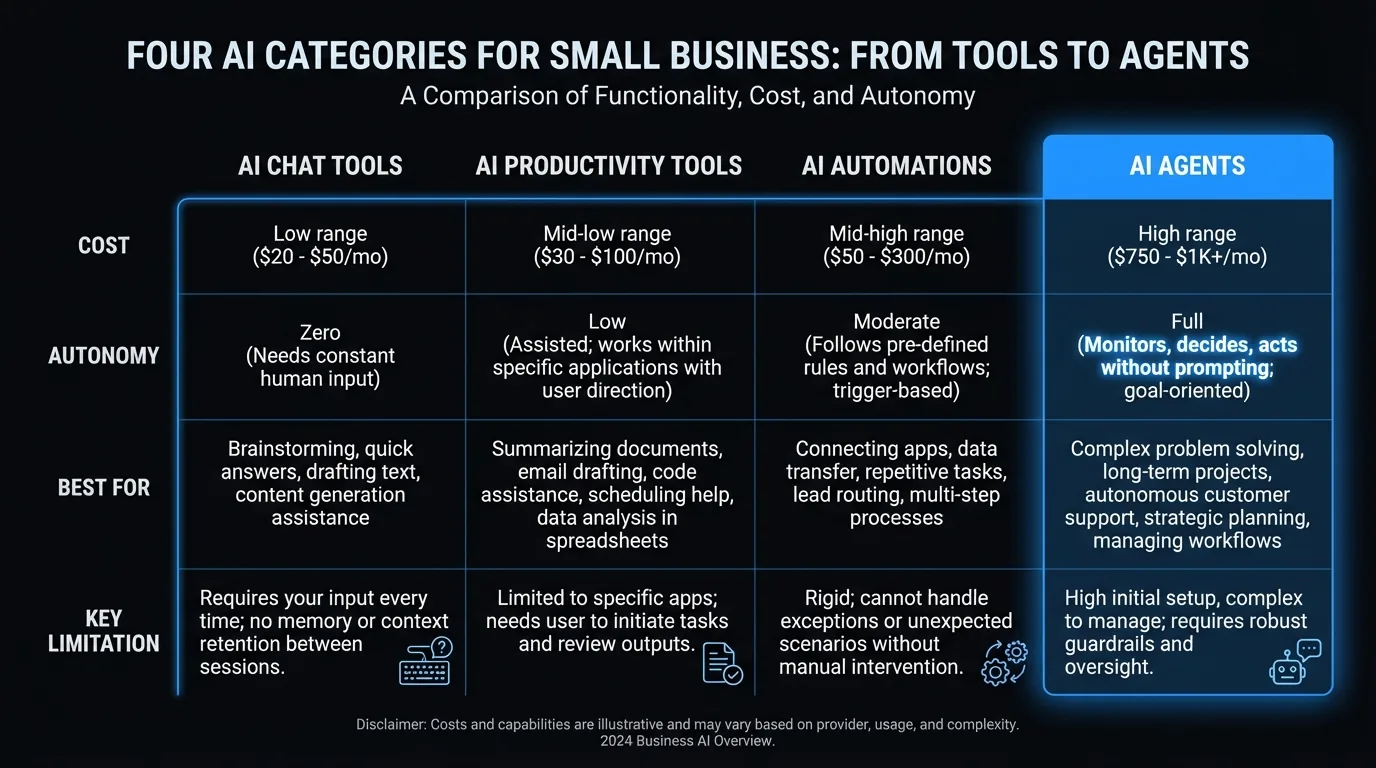
Not all AI is the same. The 4-Type AI Stack maps the categories clearly: each type has a different level of autonomy, a different cost, and a different use case. Here is the simplest breakdown.
1. AI Chat Tools
Tools like ChatGPT, Claude, and Gemini. You type a prompt. They respond. You take the output and do something with it.
Best for: drafting, research, summarizing, answering specific questions on demand.
Limitation: every use requires your active involvement. The tool does nothing without you. You are still in the loop on every task.
2. AI Productivity Tools
Software with AI built in: email clients that suggest replies, writing tools that auto-complete, spreadsheets that generate formulas. These augment tools you already use.
Best for: reducing friction in tasks you are already doing.
Limitation: narrow scope. An AI feature in your email client only helps with email.
3. AI Automations
Workflow tools like Zapier with AI steps, or simple "if this, then that" automations with AI in the middle. Triggers an action when something happens: a new form submission sends a drafted reply, a new invoice generates a PDF.
Best for: removing repetitive handoffs between tools.
Limitation: brittle. They break when inputs change. They do not adapt. And they require you to build and maintain the workflows.
4. AI Agents
Not a tool you prompt. Not a workflow you configure. An agent operates like an employee with a job description: it monitors, decides, acts, and reports back without being asked each time.
An AI agent handles email, follows up with leads, creates and schedules content, tracks your competition, and sends you a weekly summary. It does not wait for input. It does the job.
This is the category that produces the largest business impact for small business owners.
With the caveat that agents require the most setup. An AI agent that has not been briefed on your business context, your clients, and your decision rules behaves like a new employee who does not know the job yet. The setup investment is real: most of it is documentation, explaining your processes clearly enough that the agent can follow them. The payoff is real too, but it does not happen on day one.
AI for small business covers four categories in The 4-Type AI Stack. Chat tools run $20-$40/month and require your input for every task. Productivity tools are AI built into software you already use. Automations run $50-$200/month, are trigger-based, and break when inputs change. AI agents run $750-$1,000/month and operate autonomously toward goals. Business owners using managed AI agents recover 10-15 hours per week. At a $100/hr effective rate, that is $1,000-$1,500 per week in reclaimed capacity. Based on patterns we've seen, businesses that deploy AI in operations consistently report 20-30% productivity gains in the first year.Who This Is For
Different categories fit different situations.
AI chat tools are for everyone. Every business owner should be using ChatGPT, Claude, or a similar model for at least drafting and research. If you are not, you are spending hours on tasks that take minutes. AI productivity tools are for people who live in a specific tool (email, Notion, a CRM (customer tracking system)) and want friction reduced within it. The ROI is incremental but accumulates. AI automations are for business owners who are technical enough to build and maintain them, or who have someone to maintain them. Good for businesses with high-volume, predictable workflows. AI agents are for business owners who want results without managing tools. The agent is set up once with your business context, voice, and priorities. After that, it operates. You review outcomes, not activities. This is the model that replaces a $200K/yr staffing bill with $12K/yr.Deep Guides in This Pillar
Each article below covers one specific aspect of AI for small business in depth.
Best AI Tools for Small Business in 2026A ranked comparison of the top AI tools across categories: writing, research, automation, operations, and customer service. With pricing, use cases, and what to skip.
AI Agents for Small Business: What They Are and What They CostThe full breakdown on AI agents specifically: what they do, how they differ from chatbots and automation tools, what they cost, and when they make sense for a small business.
Chatbot vs AI Agent: What's the Difference?Chatbots answer questions on your website. AI agents execute work on your behalf. This article explains the distinction clearly, with practical examples showing which is appropriate for which use case.
ChatGPT for Small Business Owners: What It Can and Can't DoA realistic, no-hype guide to using ChatGPT in your business. What it excels at, where it falls short, and the prompting habits that make it actually useful.
AI Automation for Small Business: What's Actually PossibleA practical guide to AI-powered automation: what can be automated today, what cannot, and how to prioritize which workflows to automate first.
No-Code AI Agent Builder: What It Means for Business OwnersFor business owners who want to build AI workflows without writing code. What no-code AI tools exist, what they can do, and what you still need technical help for.
Best AI Agents for Personal Use in 2026AI agents are not just for business. This guide covers the best options for personal productivity: scheduling, research, email management, and learning.
What a Day Looks Like With AI vs Without
The difference is not theoretical. Here is the same Tuesday for two owners running identical 4-person marketing agencies.
Without AI:8:30 AM: Check email. 23 unread. 40 minutes reading and responding to the ones that cannot wait.
10:00 AM: A client wants a competitive analysis by Thursday. 90 minutes manually researching competitors, pulling data from different tabs, writing a summary from scratch.
2:00 PM: Draft status updates for 3 active clients. 45 minutes because notes are scattered across emails, Slack, and a Google Doc nobody updates.
4:30 PM: One prospect from last week has not responded to the proposal. Mental note to follow up. Does not happen.
Total non-billable time: 4.5 hours.
With AI:8:30 AM: Review the agent's inbox triage summary. 6 items flagged for attention. The other 17 were handled: information requests auto-answered, scheduling sorted, routine approvals processed. 15 minutes.
10:00 AM: Brief Perplexity AI on the competitor research task. Sourced summary ready in 20 minutes. Add strategic analysis: 30 minutes total.
2:00 PM: Client status updates drafted by the agent from project notes, staged for review. Review and approve: 10 minutes.
4:30 PM: Proposal follow-up went out automatically on Day 5. The prospect replied at 11 AM. The agent flagged it and staged a response.
Total non-billable time: 1.25 hours.
The difference: 3.25 hours recovered on a single Tuesday. That is 15+ hours per week, or roughly 750 hours per year. At even $100/hr effective rate, that is $75,000 in recovered capacity. The tools cost $9,000 to $12,000/yr.
One agency owner tracked non-billable hours for a week before and after deploying an AI agent. Before: 21 hours. Six weeks later: 7 hours. Same client load.
Want to see your specific time savings? Track your non-billable hours for one week, then book a quick call. We'll map out exactly which hours an AI agent would recover in your business.
The difference between using AI and not using AI for small business is measurable in daily hours. A 4-person marketing agency without AI spends 4.5 hours per day on non-billable tasks: inbox management (40 min), manual research (90 min), status updates from scattered notes (45 min), and missed follow-ups. With an AI agent and supporting tools, the same workload takes 1.25 hours. That is 15+ hours per week recovered, or 750+ hours per year worth $75,000 at a $100/hr rate, against a tool cost of $9,000-$12,000/yr.
Common AI Adoption Mistakes for Small Business Owners
Trying too many tools at once.The first AI tool produces obvious ROI. By the fourth tool added in two weeks, you are spending more time managing tools than they save. The pattern that works: pick one tool, use it for 30 days until it is a habit, evaluate the next highest-value addition. Build a stack incrementally, not all at once.
Using AI for the wrong tasks first.Most business owners start with ChatGPT for writing. Fine start. But writing assistance is a 20-minute-per-day win. The 2-hour-per-day wins are inbox management, follow-up, scheduling, and reporting. Start with your highest time-cost tasks, not the most obvious ones.
Expecting AI to work out of the box without setup.A generic AI chat tool asked to "help with client emails" produces generic client emails. The tools that save hours per day have been briefed: given your voice, your clients' names, your standard language, your pricing. Most tools need 2 to 3 hours of initial setup. That is the difference between "this is useless" and "this saves me 2 hours a day."
Even well-briefed tools produce outputs that need your judgment applied before they are finished. Treat every AI output as a capable first draft that still needs your expertise. The time savings are in the drafting step. The quality is still your responsibility.
Using one tool once and stopping.AI tools compound. An owner who adds Perplexity for research, then Claude for proposals, then an agent for follow-up is building a system where each piece connects. An owner who uses ChatGPT once a week to rewrite a marketing email is not getting business impact. The ROI comes from making AI part of the workflow, not testing it occasionally.
After working with dozens of small business owners on their AI stack, the pattern is consistent: the owners who get real ROI are the ones who started with one specific recurring task and built the habit before adding complexity. The failure mode is almost always tool sprawl before a single tool is truly embedded.
The Right AI Stack for a Business Under $1M Revenue
Businesses under $1M have limited budget and limited time to manage tools. The wrong move is building a complex stack of 8 tools that all need maintenance.
Layer 1: AI chat tool ($20-$40/month)Claude or ChatGPT. Use it every day for email drafting, research, and summarization. Build the habit before adding anything else. 90% of small business owners who try AI and give up do so because they started with a complex tool before a basic daily habit was established.
Layer 2: Scheduling automation ($0-$12/month) Calendly or Cal.com. Stop doing scheduling manually. This recovers 1 to 2 hours per week and is the easiest, fastest win in any business productivity stack. Layer 3: Meeting notes ($10-$20/month)Fireflies.ai or Otter.ai. Every meeting transcribed and summarized. Post-call admin drops from 30 minutes to 5 minutes. Five client calls per week: 2.5 hours recovered.
Layer 4: Business-specific AI agent ($750-$1,000/month)An AI agent trained on your business handles email, follow-up, content distribution, and reporting. This is the layer that replaces a part-time hire. Add it after Layers 1-3 are habits. Adding agent-level complexity before basic AI workflows are established leads to underutilization.
Total Layer 1-3 cost: $30 to $72/month. If the agent in Layer 4 recovers 10 hours per week and your effective rate is $100/hr, that is $1,000/week in recovered capacity against a $750 to $1,000/month cost. It pays for itself in the first week of each month.
The Business Case for AI for Small Business in 2026
The businesses that are pulling ahead right now are not bigger. They are better leveraged.
A 5-person business using AI agents for marketing, operations, and customer follow-up is outperforming a 15-person business relying on human execution for every task. The AI handles volume and consistency. The humans handle judgment and relationships.
The cost comparison:
| Staffing model | Annual cost | What you get |
|---|---|---|
| Traditional (VA + marketing coordinator + ops support) | $85,000-$130,000/yr | 3 people, limited hours, turnover risk |
| AI agent (fully deployed) | $9,000-$12,000/yr | 24/7 execution, no turnover, compound learning |
| Hybrid (AI agent + 1 senior hire) | $55,000-$75,000/yr | Best of both: agent handles volume, human handles judgment |
For most businesses under $2M in revenue, the AI agent model or hybrid is the only one that makes financial sense.
The AI-only model works well for operational and marketing functions. It does not work for roles requiring specialized professional judgment, in-person service delivery, or complex client relationships. Most businesses end up in a hybrid model whether or not they planned it: an agent handling volume and consistency, a human handling judgment and relationships. That is the right division of labor, not a compromise.
The Alternative: One Agent Instead of Ten Tools
Each layer of the AI stack solves a piece. A chat tool helps you draft. An automation handles a specific trigger. But when the email arrives at 11 PM, the lead needs qualifying, the proposal needs follow-up, and the weekly report needs drafting from three sources, no single tool coordinates all of it without you.
There is a category beyond the four types described above. Not a tool you use. A managed service that does the work.
Jejo.ai deploys a business-trained AI agent that handles the full operational layer: inbox triage, lead follow-up, scheduling, client reporting, and content distribution. The agent is onboarded with 10 hours of your business context. After that, it operates with your voice, your priorities, and your decision rules. At $9,000 to $12,000/yr, it replaces what would cost $85,000 to $130,000/yr in equivalent human staffing. No tool management. No prompting. No maintenance. See what's included.
Who This Is For
- Small business owners and solo operators who want to recover billable hours from administrative work without managing a large tech stack
- Businesses under $2M revenue where the AI agent model is the most financially efficient path to operational capacity
- Owners already using basic AI tools (ChatGPT, Notion) who want to understand what the next layer looks like
Who This Is NOT For
- Businesses that are not yet running any AI tools and need basic orientation before evaluating agents (start with the best AI tools guide)
- Technical builders looking to develop custom AI infrastructure (these guides are for operators, not engineers)
- Enterprise teams with dedicated IT and AI governance requirements (the tools here are optimized for 1-20 person businesses)
The Bottom Line
Business owners using AI agents recover 10-15 hours per week, worth $1,000/week or more at a $100/hr effective rate, against a $9,000-$12,000/yr tool cost. The 4-Type AI Stack gives you the build order: start with an AI chat tool as a daily habit, then add scheduling automation and meeting notes, then layer in a business-trained agent. Compare the DIY AI approach to a managed agent or see pricing and what's included for a Jejo.ai agent.
FAQ
How much does it cost to implement AI for a small business?
Basic AI tools (ChatGPT, Claude, Notion AI) cost $20-$40/month per seat. AI automation platforms (Zapier, Make) run $50-$200/month depending on volume. A fully managed AI agent for your business, handling email, marketing, and operations, runs $750-$1,000/month ($9,000-$12,000/yr). Compare that to the cost of the hires it replaces.
Do I need to be technical to use AI for my small business?
No. The most impactful AI options for small businesses in 2026 require zero technical background. Chat tools work like texting. Managed AI agents are set up for you. The learning curve is understanding what to ask for, not how to build it.
The one skill that matters more than any technical knowledge: being specific about what you want. "Write me a client email" produces a generic result. "Write a follow-up email to Maria at Coastal Dental, who attended our webinar last Tuesday but has not replied to the proposal I sent Wednesday" produces something usable. The difference between business owners who find AI valuable and those who do not is almost entirely in how specifically they describe the task, not in any technical ability.
What is the first AI tool a small business owner should use?
Start with an AI chat tool (ChatGPT or Claude). Use it every day for one week on tasks you currently do manually: drafting emails, summarizing documents, researching vendors. Once you feel the time savings, you will have a clear sense of where AI fits in your work. Then evaluate agents and automations.
The fastest way to build the habit: pick one recurring task you do every day (client email responses, meeting prep notes, weekly summaries) and commit to using the AI tool for that task for 5 days straight. Do not try to use it for everything at once. A single consistent use case produces the habit that makes everything else possible. Most business owners who fail with AI tools jumped to complex use cases before simple ones were second nature.
Ready to see how AI agents work for your specific business?
Not sure whether you need tools, automations, or a full agent? Compare the DIY AI approach to a managed agent to see exactly what you get with each. Or see pricing and what's included for a Jejo.ai AI agent.