Quick answer
- What this covers: Small business marketing ideas ranked by ROI for solo operators.
- Who it’s for: Small business owners and solo founders.
Most small business marketing ideas assume you have a team, a budget, and time to spare. You have none of those. This guide covers only the tactics that generate real clients when you are the marketer, the salesperson, and the delivery person all at once. No ad budget required.
For a broader overview of marketing a small business without a team, the hub page maps out the full strategy. This article goes deep on specific ideas.
Key takeaways:
- Email marketing returns $36 for every $1 spent, yet most small businesses email their list twice a year
- A referral system generates 1 to 4 qualified introductions per month for nearly zero cost
- One focused platform beats three mediocre ones every time
- An AI agent handles the consistency layer so the tactics on this list actually run
- The 1-Channel Rule: master one platform completely before adding a second. Focus beats presence every time.
In this article:
- The Marketing Ideas That Actually Move the Needle
- Small Business Marketing Ideas That Waste Your Time
- The Small Business Marketing Ideas Stack: Build It in Order
- How AI Agents Change the Math
- The Real Cost of Each Marketing Channel
- Common Mistakes in Small Business Marketing
- The Bottom Line
- FAQ
The Marketing Ideas That Actually Move the Needle
The 8 small business marketing ideas ranked by ROI (return on investment): (1) Email to your existing list at $36 per $1 spent, (2) Google Business Profile at zero cost, (3) a systematic referral ask at the 30-day mark post-engagement, (4) one focused social platform for 90 days, (5) content around one problem you solve, (6) partnerships with non-competing businesses, (7) short-form video in batches, and (8) direct personalized outreach to 10 ideal prospects per week. Email and referrals are consistently the highest-ROI channels for businesses under $1M in revenue.1. Email to Your Existing List (First, Always)
Your cheapest customer is the one you already have. Your second cheapest is someone who already knows you.
Email marketing for small business returns $36 for every $1 spent on average. No other channel comes close. Yet most small business owners email their list twice a year when they remember.The tactic: send one short, useful email per week. Not a newsletter. One thing. A tip, a result you got for a client, a question worth thinking about. 150 to 300 words. Every single week.
What makes this work without a team: once you have a template and a habit, each email takes 20 to 30 minutes. You do not need a copywriter. You need consistency.
For the full playbook, see the guide on email marketing for small business.
2. Google Business Profile (Free, High-Intent Traffic)
If you serve local clients or have a physical location, Google Business Profile is the highest-ROI free marketing tool available to small businesses. Businesses with complete profiles get 7x more clicks than incomplete ones.
The tactic: fill every field completely. Post one update per week (same as your email, just repurposed). Respond to every review within 24 hours. Add photos monthly.
What makes this work without a team: each of these tasks takes under 15 minutes once the profile is set up. The returns compound over time. A business with 50 reviews and fresh weekly posts dominates local search without running ads.
3. One Platform for Social (Not Three)
Every marketing guide tells you to "be everywhere." Ignore it. The 1-Channel Rule: master one platform completely before adding a second. Being mediocre on three platforms is worse than being excellent on one.
Pick the one platform where your customers already spend time. For B2B (business-to-business): LinkedIn. For local services: Facebook or Instagram. For younger consumers: Instagram or TikTok. Go deep on that one for 90 days before touching another.
| Platform | Best for | Posting frequency | Time per post |
|---|---|---|---|
| B2B, professional services | 3-5x per week | 15-20 min | |
| Visual products, local, lifestyle | 4-5x per week | 20-30 min | |
| Local business, 35+ age group | 3-4x per week | 10-15 min | |
| TikTok | Under-35 consumer, high reach potential | 5-7x per week | 30-45 min |
For a deeper breakdown, see social media strategy for small business.
4. Referral System (Not Referral Hope)
Most small businesses get referrals randomly and celebrate when they happen. Few build a system that generates them predictably.
The tactic: 30 days after every completed project or purchase, send a one-sentence ask. "If you know anyone who could use what I helped you with, I would genuinely appreciate an introduction." Then stop talking. No long email, no incentive required for existing fans.
The data: 83% of satisfied customers are willing to refer. Only 29% do without being asked. The gap is not attitude. It is that no one asked.
In our experience, the referral ask is the single highest-ROI marketing activity for service businesses. The system that makes it happen automatically is the only reason it ever runs consistently.
Building a referral system is one of the core functions a small business AI agent can automate: tracking when each client hits the 30-day mark, sending the ask, and logging responses.
Email + Referrals: The Small Business Marketing Foundation. Email returns $36 for every $1 spent; referral systems generate 1 to 4 qualified introductions per month at near-zero cost. Together they produce the highest ROI of any channel for service businesses under $1M in revenue. Both require consistency, not budget.
5. Content Marketing Around One Problem You Solve
Content marketing has one job for a small business: be the answer when someone searches for your problem.
Do not create content about your business. Create content about the problem your best clients had before they found you. If you are a bookkeeper, write about what happens when small businesses do their own taxes wrong. If you are a marketing consultant, write about why ad campaigns fail.
Each piece answers one specific question. Short is fine. 500 to 800 words that fully answer one question beats a 3,000-word general guide that answers nothing completely.
See the full guide on content marketing for small business for the long-game strategy.
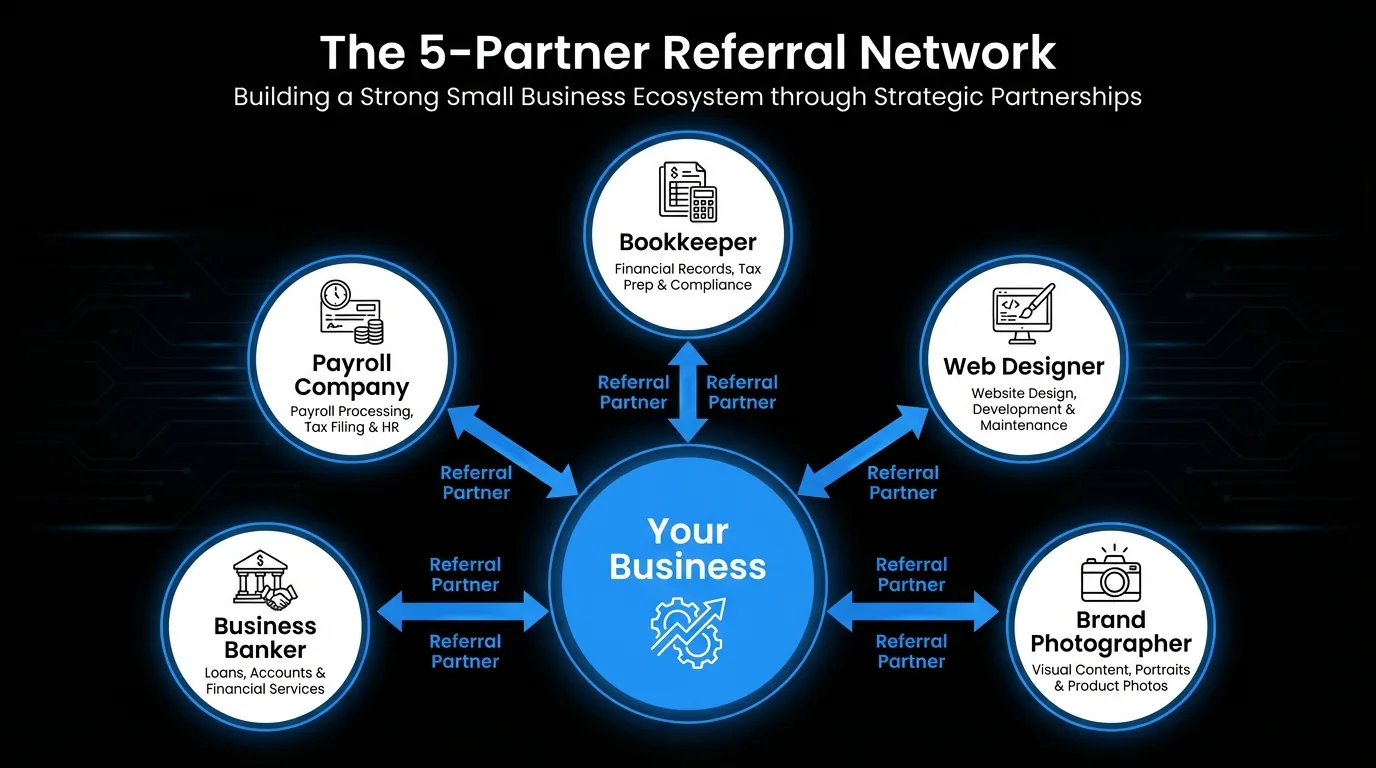
6. Partnerships With Non-Competing Businesses
Your best leads come from people who already know and trust someone in your network. A partnership with a complementary business puts you in front of warm, qualified prospects with zero ad spend.
The math: one well-placed recommendation from a trusted partner is worth 50 cold outreach attempts.Examples by business type:
- Bookkeeper partners with a business banker and a payroll company
- Marketing consultant partners with a web designer and a brand photographer
- Real estate agent partners with a mortgage broker, an inspector, and a contractor
- Business coach partners with an accountant and an HR consultant
The tactic: identify 5 businesses that serve your same client profile but do not compete. Reach out personally. Propose a simple "I'll refer you, you refer me" arrangement. Meet quarterly for coffee to stay top of mind.
7. Video (Short Form, One Topic Per Video)
Short-form video has the highest organic reach of any content format in 2026. A 60-second video on a topic your customers search for can reach 10,000 to 100,000 people with zero ad spend on TikTok or Instagram Reels.
The constraint for small business owners: production. You do not need high production value. Your phone, decent lighting, and one clear point per video is enough.
What makes this work without a team: batch record 8 to 10 videos in one 90-minute session. Schedule them for the next two weeks. Each video covers one specific question your customers ask frequently. That session covers your social content for two weeks.
8. Direct Outreach (The One No One Does Because It Feels Uncomfortable)
The highest-converting marketing channel for most service businesses is personal, direct outreach. Not cold email blasts. Not LinkedIn InMail templates. Personalized, specific messages to people you can genuinely help.
The tactic: identify 10 businesses per week that fit your ideal customer profile. Send a one-paragraph message. Reference something specific about their business. Explain one thing you notice that you could help with. Do not pitch. Offer to share a useful observation.
Response rates for genuine, personalized outreach run 15 to 30%. Cold blast campaigns run under 1%.Most business owners do not do this because it takes thought. That is exactly why it works.
Small Business Marketing Ideas That Waste Your Time
Being direct about what to skip saves you months:
Running ads before you have organic traction. Ads amplify what is already working. If your message is not converting organically, ads will accelerate losing money. Starting a podcast. Podcasts take 6 to 18 months to build a meaningful audience. That timeline does not work for most small businesses needing revenue in the next 90 days. Trying to go viral. Viral posts are accidents. Build systems that create consistent low-volume reach instead. SEO as your primary channel before month 6. SEO compounds over time, but new sites take 3 to 12 months to rank. It is a long-term investment alongside faster channels, not a replacement for them.Three honest limits to the tactics in this guide:
Email ROI only holds if you have a list. The $36-per-$1 return assumes an existing, engaged audience. Building a list from scratch takes 6 to 12 months before email becomes a meaningful channel. Until then, direct outreach and referrals are faster. Referral systems only accelerate what is already working. A systematic referral ask sent to clients who received mediocre work will generate negative word-of-mouth as reliably as positive. Fix delivery first. The 1-Channel Rule depends on picking the right channel. Ninety days on LinkedIn is wasted effort if your clients are local tradespeople who never open it. Match the platform to where your actual best clients spend time, not where marketing guides say to be.The Small Business Marketing Ideas Stack: Build It in Order
Build this in order:
| Phase | Focus | Time investment |
|---|---|---|
| Month 1 | Google Business Profile + referral system setup | 3 hrs one-time |
| Month 2 | Weekly email habit + one social platform | 2-3 hrs/week |
| Month 3 | Content (2 blog posts per month) | 3-4 hrs/month |
| Month 4 | Partnerships (outreach to 5 businesses) | 2 hrs one-time |
| Month 5+ | Direct outreach + video batching | 2 hrs/week |
At full implementation, this stack takes 4 to 6 hours per week. Not 40.
How AI Agents Change the Math
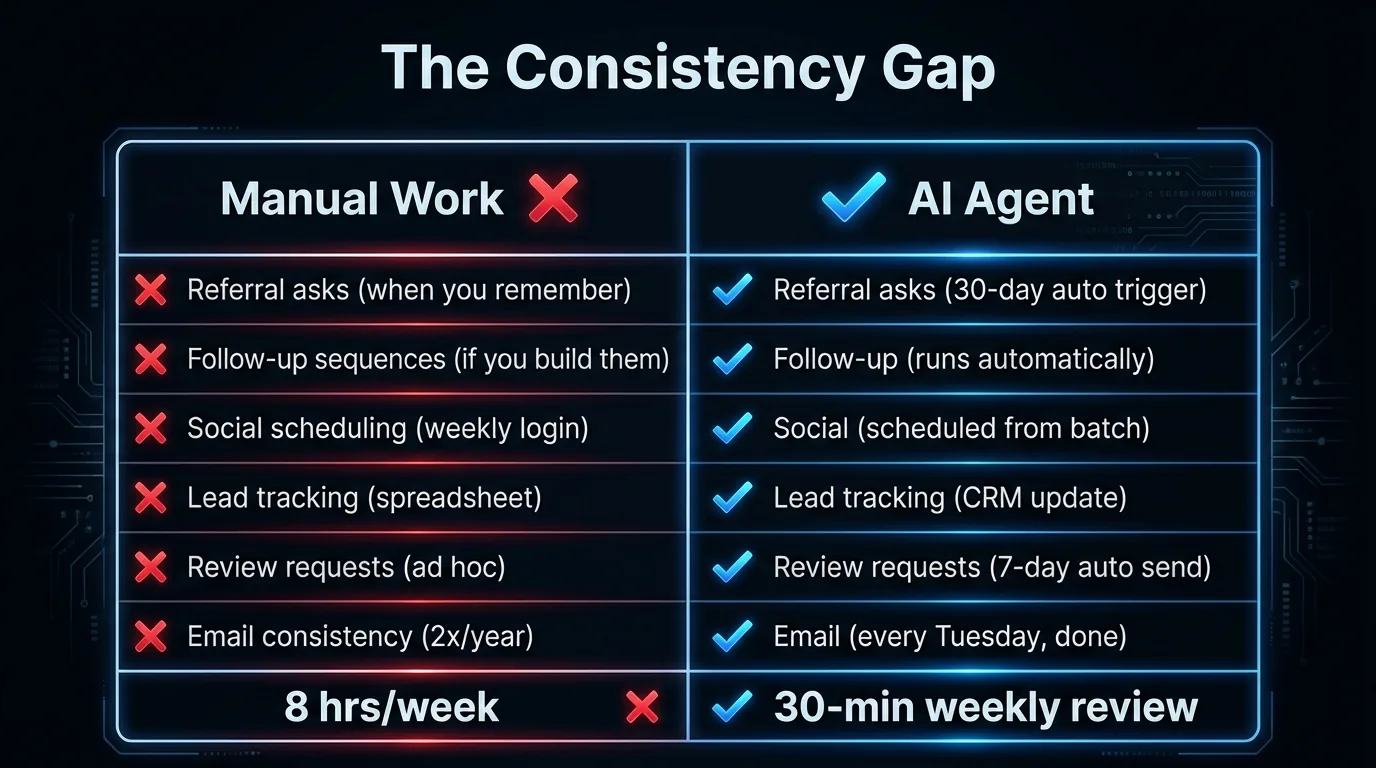
The hardest part of small business marketing is not knowing what to do. It is doing it consistently, week after week, without a team to hold the system together.
An AI agent changes this. Not by creating the marketing for you, but by handling the operational layer: scheduling follow-up messages, sending referral asks at the right time, tracking which leads engaged with which content, and alerting you when someone needs a personal touch.
For how this works in practice, see marketing agency automation and the full breakdown on AI agents for marketing.
Jejo.ai's AI agent handles the consistency layer of your marketing for $750/mo. Compare that to a part-time marketing coordinator at $1,500 to $2,500/mo, and the economics are clear.
What a Working Small Business Marketing Week Actually Looks Like
Marcus runs a financial planning practice in Denver. Before building his marketing stack, he spent about 30 minutes per day scattered across different marketing tasks: sometimes emailing clients, sometimes posting on LinkedIn, sometimes thinking about what to post. None of it was consistent. His referral rate was flat. His Google Business Profile had 6 reviews.
After implementing the marketing stack in this article, his week looks like this:
Monday (20 minutes): schedule the week's LinkedIn post from a batch he wrote Sunday. Review the automated email that went to this week's referral-window clients.
Wednesday (10 minutes): reply to any Google Business Profile reviews. Check email open rates from Tuesday's send.
Sunday (90 minutes): write 4 LinkedIn posts for the next two weeks. Write next week's email. Done.
Total weekly marketing time: about 2 hours. Within 90 days, Marcus had 31 Google reviews (up from 6), a weekly email open rate of 41%, and 4 warm referral introductions from the systematic ask sequence. New clients attributed to this system in month 3: 2, at $8,000 total in new annual recurring revenue.
One bookkeeper in Manchester ran the same system over a single quarter. She went from 4 Google reviews to 29, and her monthly referral introductions climbed from zero to 3. Client list of 12, no paid advertising, no social media manager.
Carlos owns a landscaping company in Phoenix with 18 residential clients. His Google Business Profile had 9 reviews and no weekly posts. He implemented three tactics from this guide: a 30-day referral text to every completed job client, before-and-after photos on Instagram twice a week, and a commitment to respond to every Google review within 24 hours. Over 90 days, his Google reviews climbed from 9 to 34, Instagram generated 3 direct inquiries (2 converted at $1,200 each for seasonal cleanups), and the referral sequence produced 5 warm introductions. New revenue directly attributable to the system: $6,400. Total weekly time investment: under 2 hours.
What 90 Days of Consistent Small Business Marketing Produces. A service business running weekly email, Google Business Profile maintenance, and a systematic 30-day referral ask for one quarter produces measurable results without paid advertising. Typical outcomes: 3x to 7x increase in Google reviews, 30 to 45% email open rates, 1 to 4 monthly referral introductions, and 2 to 4 new clients attributable to the system. Total time required: 2 to 4 hours per week.
The Real Cost of Each Marketing Channel
Most marketing guides give you tactics without the actual time and money numbers. Here is the real breakdown for a solo service business.
| Channel | Monthly cash cost | Monthly time cost | Leads generated (typical) | Cost per lead |
|---|---|---|---|---|
| Google Business Profile | $0 | 2-3 hrs | 3-8 local leads | Near zero |
| Weekly email (existing list) | $15-30 (tool) | 2-4 hrs | 0-2 (re-engagement) | Very low |
| One social platform | $0-15 (scheduler) | 4-6 hrs | 1-5 per month | $3-15 |
| Referral system | $0 | 1 hr setup, 15 min/mo | 1-4 per month | Near zero |
| Content (2 blog posts/mo) | $0-100 | 4-8 hrs | 2-6 per month (after 6 months) | Low, compounding |
| Direct outreach (10/week) | $0 | 2-3 hrs | 1-3 per month | Low |
| Google Search ads | $500-2,000/mo | 3-5 hrs | 5-20 per month | $50-200 |
Common Mistakes in Small Business Marketing
Posting without a clear message. The most common marketing mistake: creating content with no defined audience and no next step. A LinkedIn post that entertains but does not prompt any action has zero commercial value. Every piece of content should answer one question for one type of person and make it easy for that person to do something. Emailing only when selling. Small business owners often email their list only when they have something to promote. After 3 to 6 months of silence, open rates drop below 15% and reactivation is expensive. Consistency matters more than quality. An average email every week beats a perfect email every 6 weeks. Asking for referrals at the wrong moment. The most common referral mistake: asking right after a sale. At that point, the client has not yet experienced your value. The right window is 30 to 60 days after delivery, when they have seen results and the experience is still fresh. Breaking The 1-Channel Rule. Most small business owners spread across 3 platforms before mastering any of them. Consistent quality on 1 platform builds a real audience. Pick the one platform where your best 5 clients already spend time and commit to it for 90 days before adding another. Treating every marketing channel as equally urgent. SEO takes 3 to 12 months. Podcasts take 6 to 18 months. Ads work immediately but require a proven message first. If you need clients in the next 60 days, direct outreach and referral asks are the only tactics with that timeline. Match the tactic to the timeframe.What the Solution Actually Looks Like
The marketing tactics in this guide work. Most small business owners who implement them see results within 60 to 90 days. The problem is not the tactics. It is the consistency layer.
Email goes out when you remember. Referral asks fire in a burst of motivation and then stop. The Google Business Profile gets ignored for two months. Content creation falls off when a client emergency comes up. The strategy is right. The execution collapses because there is no one holding it together.
The strategy is right. The execution is what breaks. Most business owners know what marketing to run. What they lack is the system that makes it happen every week without fail. Book a strategy call to map which parts of your marketing stack an AI agent would hold together.
That is what an AI agent handles. Not the strategy. The execution layer. At $750/mo, Jejo.ai sends the referral asks at the right 30-day window, schedules your social content from the batch you wrote, tracks which leads engaged with your email, and alerts you when someone needs a personal touch.
Compare that to a part-time marketing coordinator at $1,500 to $2,500/mo who needs management, takes sick days, and requires onboarding. The agent handles the consistency layer at a fraction of the cost, 24/7, from day one.
See what's included in a Jejo.ai agent or book a strategy call to map the marketing workflows it would handle.Who This Is For (and Who It's Not)
This is for you if:- You are running a service business solo or with a small team and doing all marketing yourself
- You know the tactics but execution keeps collapsing because there is no one holding the system together
- You want measurable results from marketing in the next 60 to 90 days, not 12 months
- You already have a dedicated marketing coordinator or agency managing your channels
- Your business gets more leads than it can handle and growth is not the current constraint
- You are looking for viral shortcuts rather than a compounding system built on consistency
The Bottom Line
The eight small business marketing ideas in this guide, run consistently for 90 days, produce more results than most businesses see from a year of scattered effort. Email, referrals, and Google Business Profile alone recover $8,000 to $30,000 in new annual revenue for a typical service business. If you want the execution layer handled so the tactics actually run, see how a Jejo.ai agent holds the marketing system together.
FAQ
What is the best marketing idea for a small business with no budget?
The highest-ROI free tactics are: Google Business Profile optimization, weekly email to your existing list, personal referral asks 30 days after every client engagement, and one social platform with consistent posting. Start with the first two before adding channels.
How much should a small business spend on marketing?
The standard benchmark is 5 to 10% of revenue. A business doing $200,000/yr should budget $10,000 to $20,000 for marketing. However, the right number depends on how competitive your market is and how aggressive your growth goals are.What marketing channel has the best ROI for small business?
Email marketing returns $36 for every $1 spent. Referrals have near-zero cost per acquisition. Google Business Profile is free and drives high-intent local traffic. For paid channels, Google Search ads outperform social media ads for most service businesses because of purchase intent.How do I market my business when I have no time?
Build systems before you need them: a referral ask sequence, a weekly email template, a content calendar with 8 weeks of topics mapped out. Then batch the execution. Two focused hours per week beats scattered 20-minute sessions every time.
Stop Collecting Marketing Ideas You Never Execute
The list of things you should be doing is not the problem. The execution gap is. Most small business owners know what to do: email their list, ask for referrals, post consistently, batch their content. The system never holds because there's no one to hold it together. An AI agent handles the operational layer so the ideas on this list actually happen. See how an AI agent compares to a marketing agency on cost and output.
Book a strategy call to see what an AI agent would handle in your business. Or see the plans to compare options.