Quick answer
- What this covers: Content marketing for small business that actually compounds: one article per week, repurposed across 5 channels, in 3-5 hours.
- Who it’s for: Small business owners and solo founders.
One article per week. That's the whole content marketing for small business system. It compounds for years and costs almost nothing to run. Most businesses quit at month 4, right before the traffic starts to build.
This guide is about building a content marketing system for small businesses that runs on 3-5 hours per week, not a content team.
Key takeaways:
- Content marketing typically takes 6-12 months to produce visible traffic: the businesses that succeed are consistent, not talented
- One article per week, repurposed across 5 channels, is sustainable on 3-5 hours per week
- The 3-Hour Content System turns one article into a full week of content: 2-3 hours of writing, under 1 hour of distribution across 5 channels
- AI drafting cuts article production from 4-6 hours to 1-2 hours without sacrificing quality
- An AI agent at $750/month handles keyword research, drafting, optimization, and scheduling, same output as a 2-3 person content team
In this article:
- Why Content Marketing Works for Small Business
- The Content Marketing System That Works for Small Business
- What Type of Content Actually Works for Small Business
- The Role of AI in Small Business Content Marketing
- The Biggest Content Marketing Mistakes Small Businesses Make
- How Much Does Content Marketing Cost for Small Business?
- Building Your First 90 Days of Content Marketing
- Content Marketing by Business Type
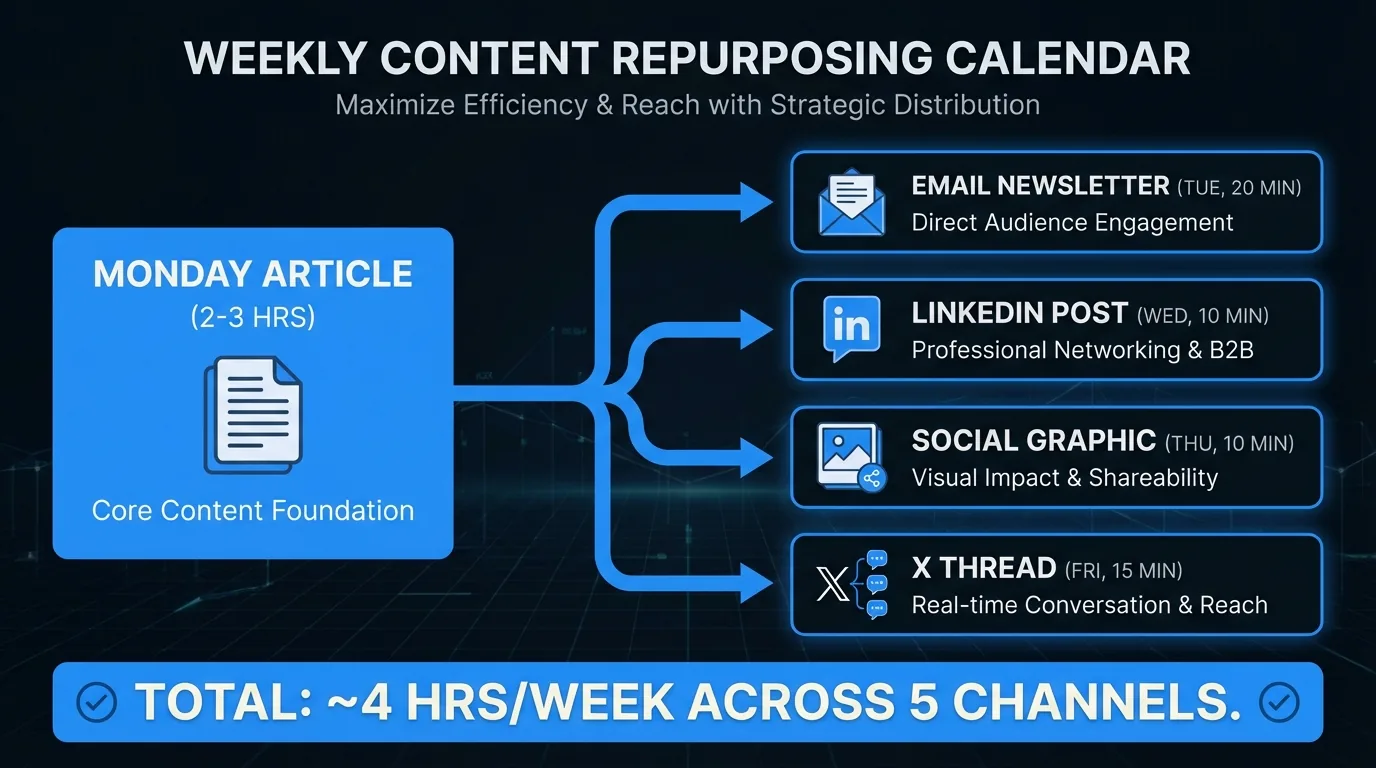 ' in blue #2997ff. Right: four output channels connected by arrows: Email Newsletter (Tue, 20 min), LinkedIn Post (Wed, 10 min), Social Graphic (Thu, 10 min), X Thread (Fri, 15 min). Bottom row: 'Total: ~4 hrs/week across 5 channels.' Clean professional layout. 16:9 infographic, clean professional.)
Why Content Marketing Works for Small Business
How does content marketing work for small business? Content marketing for small business works by creating useful articles, videos, and emails that attract potential customers through search. Unlike paid ads, it doesn't stop working when you stop paying. Most small businesses see meaningful traffic within 6-12 months and the investment compounds for years after.Content marketing compounds. An article published today can drive traffic for 5 years. A paid ad stops working the day you stop paying for it.
For small businesses, this asymmetry is the entire argument:
| Channel | Cost per month | Stops when you stop? | Compounds over time? |
|---|---|---|---|
| Paid ads (Google/Meta) | $500-$5,000 | Yes, immediately | No |
| Content marketing | $0-$200 (tools) | No | Yes, significantly |
| Agency retainer | $2,000-$5,000 | Yes, when contract ends | Partially |
| AI agent | $750-$1,000/mo | Continues without you | Yes |
The compound effect is real but slow. Content marketing typically takes 6-12 months to show meaningful traffic. That's why most small businesses give up. They don't have the patience or the system to stay consistent for a year.
The businesses that succeed are not the ones with the best writers. They're the ones with the most consistent publishing schedule.Content marketing ROI (return on investment) for small business: Businesses publishing one article per week consistently generate 4-6x more organic traffic in year 2 than year 1. Paid ads cost $500-$5,000/month with zero residual value when spending stops. Content costs $0-$200/month in tools plus 3-5 hours of owner time per week, with compounding returns for years.
The Content Marketing System That Works for Small Business
Forget the content marketing advice written for brands with a team. This system is built for one person.
The Core Asset: One Article Per Week
The 3-Hour Content System runs on one article per week. That article is the engine. Everything else is derived from it. One long-form article per week (1,500-2,500 words) is the only original content you create:- Pick a keyword with search volume and low keyword difficulty (KD under 20 for a new site. KD is a 0-100 score measuring how hard it is to rank)
- Write the article or AI-draft and edit it
- Publish it to the blog
Time required: 2-3 hours per article with AI assistance. The article is the only thing you're creating from scratch.
Repurpose, Don't Create
Every article becomes 5-7 pieces of other content without writing anything new:
- Email newsletter: The article's intro section + a link to read the full post. Takes 20 minutes. For the full email marketing for small business playbook, including list building and automated sequences, read the dedicated guide.
- LinkedIn post: Pull the most provocative insight from the article. 150-200 words. Takes 10 minutes.
- Short-form video script: Turn the article's 3 main points into a 60-second talking head script. Takes 10 minutes.
- Social post for Instagram/Facebook: A graphic with the article's key stat or quote.
- X/Twitter thread: Article broken into 5-7 individual points. Takes 15 minutes.
The Publishing Calendar
| Day | Content | Time required |
|---|---|---|
| Monday | Write/edit article | 2-3 hours |
| Tuesday | Publish article + send email newsletter | 30 min |
| Wednesday | LinkedIn post from article | 10 min |
| Thursday | Social post (graphic) | 10 min |
| Friday | X thread from article | 15 min |
| Total | Full week of content | ~4 hours |
This works. The constraint is the Monday article. If you skip Monday, the whole week collapses.
What Type of Content Actually Works for Small Business
Not all content is equal. Three content types consistently outperform in small business contexts:
Educational content (how-to, guides, comparisons): This drives search traffic. People search for answers. If your article answers the question better than the top results, you rank. Long-term traffic engine. POV content (your take on industry trends, common mistakes, contrarian views): This builds authority and audience. People share it. It generates inbound inquiries from the right buyers. Social proof content (case studies, client results, before/after): This converts readers into leads. The educational content brings people in. The social proof content closes them.Most small businesses only produce one of these. The businesses that consistently generate clients from content use all three.
The Role of AI in Small Business Content Marketing
AI has changed the economics of content marketing for small businesses in three specific ways:
1. First draft in 30-45 minutes. An article that used to take 4-6 hours of writing now takes 30-45 minutes of AI drafting plus 1-2 hours of human editing. The editing is where the voice goes in, the specifics get added, and the generic gets replaced with actual experience. 2. Repurposing without extra writing. AI turns a 2,000-word article into a LinkedIn post, email newsletter, and social captions in 20 minutes. Without AI, this repurposing takes 90 minutes to 2 hours. 3. SEO research without a specialist. Keyword research, content brief creation, and on-page optimization guidance used to require an SEO consultant. AI tools handle this for $20-$100/month.The result: a small business can produce the volume of content output that used to require a 2-3 person content team. Not at the same quality on every piece. But consistent, on-brand, and SEO-optimized.
One freelance copywriter tripled her publishing output using AI drafts and human editing. She went from one article every two weeks to one every 5 days without adding a single hour to her workweek.
For a deeper look at how AI agents handle content and marketing automation for small businesses, read AI agents for marketing.
The Biggest Content Marketing Mistakes Small Businesses Make
Posting inconsistently. Three articles in January, nothing in February, two in March. Search engines and audiences both penalize inconsistency. A consistent schedule beats exceptional sporadic content every time. Writing for everyone. Content that speaks to a specific person converts better than content that tries to appeal broadly. "Small business marketing tips" is broad. "Content marketing for a 5-person consulting firm with no marketing budget" is specific. Write for the second one. Publishing and abandoning. Most traffic growth comes from updating and improving existing content, not just publishing new content. Set a quarterly audit: which articles dropped in ranking? Update them. Which got traffic but low conversions? Improve the CTA. Starting with social, not search. Social media content disappears in 24-48 hours. Search content lasts years. Small businesses with limited time should prioritize search-driven content first, then use social media for small business to amplify it once the content engine is running. Treating AI output as final. The article that ranks is the one that has specific data, real examples, direct voice, and actual experience woven in. AI drafts the structure. Humans make it valuable.Consistent but not seeing traction yet? That's normal at months 3-6. The businesses that break through are the ones that don't go quiet at month 4. Book a strategy call to audit what's working and where to focus next.
How Much Does Content Marketing Cost for Small Business?
This depends on whether you're doing it yourself, using AI tools, or hiring help.
| Approach | Monthly cost | Time per week | Traffic timeline |
|---|---|---|---|
| Fully DIY, no tools | $0 | 8-12 hours | 9-12 months |
| AI-assisted (Claude/ChatGPT + Ahrefs) | $50-$150 | 3-5 hours | 6-9 months |
| Freelance writer (1 article/week) | $800-$2,000 | 2-3 hours (editing) | 9-12 months |
| Content agency | $2,000-$5,000 | 1-2 hours (approvals) | 9-12 months |
| AI agent (full execution) | $750-$1,000 | 30-60 min (review) | 6-9 months |
The AI agent option is compelling for businesses where the owner's time is the real bottleneck. The agent handles keyword selection, briefs, drafting, optimization, and scheduling. The owner reviews and approves. The publishing machine runs. For businesses not yet ready to go deep on content, the small business marketing ideas guide covers faster-ROI tactics to run alongside it.
Jejo.ai content marketing for small business in action.Content marketing cost vs output: A freelance writer at $800-$2,000/month still requires 2-3 hours of briefing and editing from the owner. A content agency at $2,000-$5,000/month requires approvals on every piece. An AI agent at $750-$1,000/month covers research, drafting, optimization, and scheduling with 30-60 minutes of weekly review.
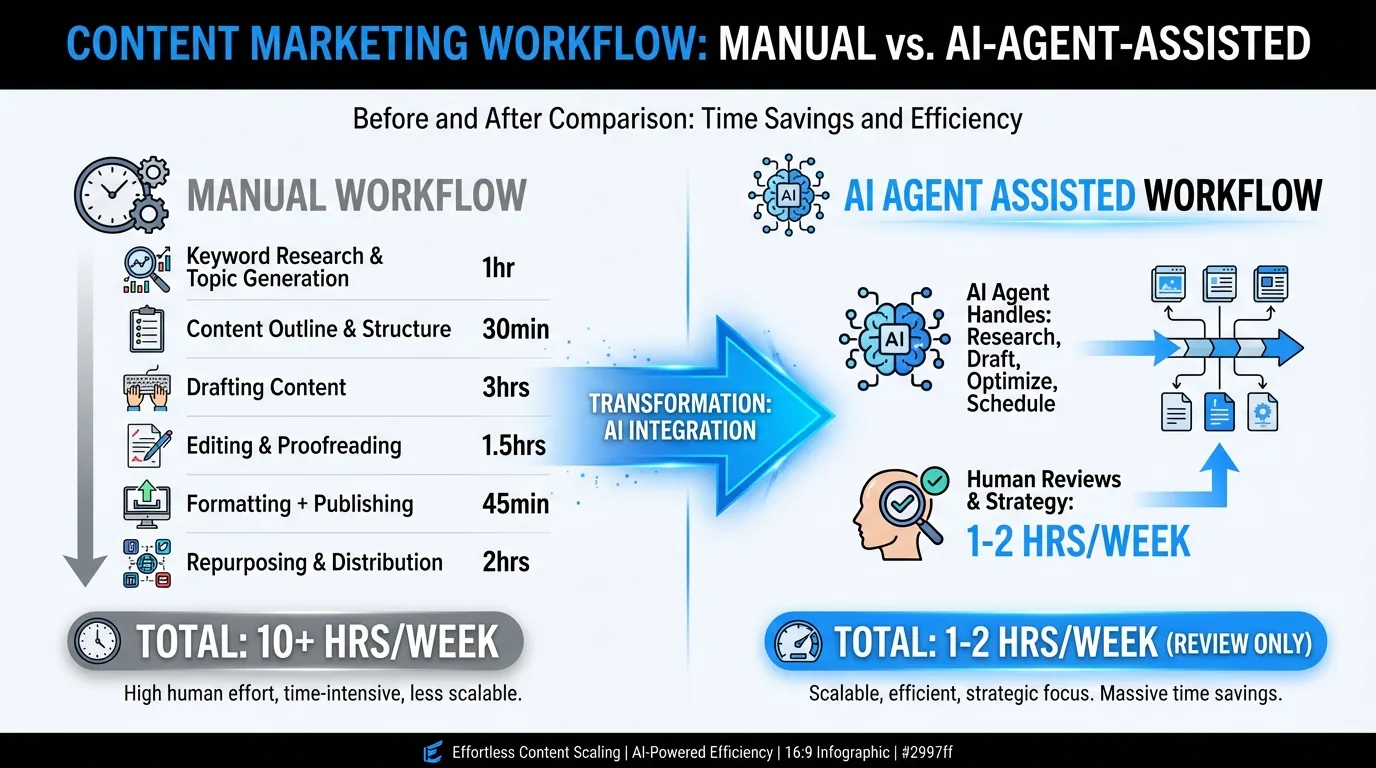 , Outline (30min), Draft (3hrs), Edit (1.5hrs), Format + Publish (45min), Repurpose (2hrs). Total: 10+ hrs/week. Right column 'AI Agent Workflow' in blue #2997ff: Agent handles research, draft, optimize, schedule. Human reviews: 1-2 hrs/week. Large arrow pointing left to right. 16:9 infographic, clean professional.)
What Content Marketing Won't Deliver
Honest expectations before you commit to 90 days.
Content marketing takes 6-12 months to show results. Most businesses quit at month 3. The traffic doesn't build evenly. Months 1-4 look flat. Month 5-6 you see the first signals. Month 7 onward is when it compounds. The businesses that succeed are not more talented. They outlasted the plateau. AI-drafted content without real editing won't rank. Google increasingly rewards depth, specificity, and firsthand expertise. An AI draft is a starting point. The article that ranks has your specific examples, real client data, and concrete observations woven in. Plan 60-90 minutes of editing per article minimum. Cutting that corners the SEO value, not the publishing schedule. Content marketing works better for some businesses than others. Service businesses whose buyers research before reaching out see strong ROI. Impulse-driven local businesses, high-referral professional services, and very niche B2B with tiny audiences often find other channels faster. Run 90 days. Measure DMs and inbound inquiries, not just traffic. If neither moves, reconsider before committing to year two.Building Your First 90 Days of Content Marketing
The first 90 days is the hardest. Traffic is low, motivation drops. Most businesses quit here. Here's the system to get through it:
Days 1-30: Foundation- Identify 12 keywords (one per week for 3 months) with KD under 15
- Write and publish 4 articles
- Set up Google Search Console to track indexing and rankings
- Send 2 email newsletters to existing contacts
- Publish 4 more articles
- Start one social channel (LinkedIn if B2B (business-to-business), Instagram if B2C)
- Repurpose each article into 2 social posts and 1 email
- Check Search Console for indexing and early ranking signals
- Which articles got impressions fastest? Write more on those topics.
- Which articles are ranking on page 2? Update them to push to page 1.
- Which email subject lines got the best open rates? Use those patterns.
- Is the schedule sustainable? Adjust if not.
By day 90, you'll have 12 articles indexed, 3-6 email newsletters sent, and enough data to know which topics resonate. That's the 3-Hour Content System working at scale. Traffic starts compounding from here.
What This Looks Like in Practice
Marcus runs a 4-person HR consulting firm in Chicago. Before he built a content system, every client came from a referral or a conference. He spent 3 months trying to get consistent with LinkedIn and a newsletter. Nothing stuck.
In January 2026, he committed to one article per week for 90 days. His process: Monday morning, 90 minutes on a first draft using Claude. Tuesday afternoon, 45 minutes editing, adding specific examples from client work (anonymized), and adjusting the voice. Wednesday, the article published automatically via his CMS (content management system) and a 4-paragraph excerpt went to his 340-person email list.
In our experience, the businesses that succeed at content commit to a schedule before they feel ready. Marcus's results were not exceptional. They were what happens when you maintain a basic system for 90 days.
His process was exactly the 3-Hour Content System: 90 minutes drafting on Monday, 45 minutes editing on Tuesday, then automated publishing and email.
By day 90, he had 12 articles indexed. Six were ranking on page 2 for terms like "HR policy template for small business" and "when to hire an HR consultant." Two had climbed to page 1. His email list grew from 340 to 510 subscribers from organic traffic alone.
Four inbound inquiries in Q1 traced directly to specific articles. Two became clients. Combined contract value: $28,000. His content investment over 90 days: about $300 in tools and 5 hours per week of his time.
Content Marketing by Business Type
The core system works across industries. The specifics vary.
Consulting and professional services. Buyers research extensively before making contact. Long-form educational content (2,000+ words) targeting specific pain points drives the most qualified traffic. An HR consultant writing "How to Create an Employee Handbook for a 10-Person Company" attracts exactly the business owners who need HR help. The content qualifies the lead before they ever reach out. Local service businesses. Shorter, location-specific content outperforms general guides. A plumber in Denver writing "Most Common Pipe Issues in Denver Homes Built Before 1970" gets local traffic from people with immediate problems. Keyword volume is lower, but intent is high. These searchers are ready to call. E-commerce and retail. Product-adjacent content performs best. A kitchen supply store writing "How to Season a Cast Iron Pan" attracts people actively shopping for cast iron. The article earns trust and drives category purchases. Start with the questions your customers ask most often. Answer them better than anyone else on page 1.The format and keyword depth change by business type. The engine stays the same: one article per week, consistent schedule, repurpose across channels. The businesses that fail at content marketing almost always do so from inconsistency, not lack of talent. Pick the format that fits your business and commit to it for 90 days before changing anything.
What the Solution Actually Looks Like
Here's what content marketing looks like when it runs on an AI agent rather than your willpower.
Monday morning, your agent surfaces 3 keyword opportunities based on your niche and flags one to write this week. You pick it. By Monday afternoon, a 1,800-word first draft is ready for your review.
You spend 45 minutes editing for voice and adding specifics from your experience. You approve it.
Tuesday, it publishes automatically. A 4-paragraph email excerpt goes to your list. The LinkedIn post goes out Wednesday. The social graphic Thursday. The X thread Friday.
You didn't write 5 pieces of content this week. You made one decision and did one editing session.
The creative direction and voice are yours. The production and distribution run automatically.
Jejo.ai agents handle the full content operation at $750/month: keyword research, drafting, on-page optimization, scheduling, and repurposing across channels. Compare that against a freelance writer at $800-$2,000/month who still needs briefing and editing from you. The output is comparable. The management load is not.Backed by a 30-day guarantee. That's $12,000/year for a content system that doesn't go dark when you get busy.
Who This Is For
This guide is for you if:- You can commit 3-5 hours per week consistently for at least 90 days
- Your buyers research online before making a decision (B2B, professional services, consulting)
- You want a marketing channel that compounds in value and doesn't disappear when you stop spending
- You need leads this month, not in 6-12 months
- You cannot commit to a consistent publishing schedule for 90+ days
- Your customers find you entirely through referrals and search traffic is not part of the model
The Bottom Line
Content marketing for small business takes 6-12 months to produce visible results, then compounds for years with minimal ongoing spend. Businesses publishing one article per week and repurposing it across email and social consistently generate more qualified leads at a lower cost than paid ads over a 12-month horizon. Jejo.ai agents handle keyword research, drafting, optimization, and scheduling at $750/month with a 30-day guarantee.FAQ
How does content marketing work for small business?
Content marketing for small business works by creating useful content (articles, videos, emails) that attracts potential customers searching for answers. The key is targeting low-competition keywords, publishing consistently, and repurposing content across channels. Most small businesses see meaningful traffic within 6-12 months and continue growing for years after.
How many articles per week should a small business publish?
One high-quality article per week is the right pace for most small businesses. It's sustainable, produces consistent SEO signals, and generates enough content to repurpose across email and social. Two articles per week accelerates results if the quality stays high. Publishing more than you can maintain at quality level is worse than a slower, consistent pace.
How long does it take for content marketing to drive results?
Expect 6-12 months before significant organic traffic. Low-competition keywords (KD under 10) can rank within 6-8 weeks. Competitive terms take 6-12 months. The businesses that succeed are the ones that treat the first 6 months as an investment, not an immediate return. Traffic compounds after that.
Can a small business do content marketing without a writer?
Yes. AI tools like ChatGPT and Claude handle first drafts. The business owner edits for voice, adds specific examples, and ensures accuracy. With 2-3 hours per week and the right AI tools, a small business can produce one strong article per week without hiring a writer.
What content marketing metrics matter most for small business?
Organic traffic from Google Search Console, email list growth, and leads from content (ask new leads "how did you find us?"). Vanity metrics like social media likes matter less than whether content is driving new contacts into your pipeline. Track those three and optimize toward what's producing inbound leads.
Stop Doing Content Marketing Alone
Running a content marketing system solo means you're both the strategist and the production department, and one skipped Monday wrecks the whole week. Jejo.ai handles keyword research, drafting, optimization, and publishing on a consistent schedule for $750/month. Compare that to a freelance writer at $800-$2,000/month who still needs briefing, editing, and management from you. See how an AI agent compares to a marketing agency on cost and output.
Book a strategy call to see what an AI agent would handle in your business. Or see the plans to compare options.