Quick answer
- What this covers: AI agents for marketing handle content, follow-up, email, and reporting for $12K/yr.
- Who it’s for: Founders doing their own marketing without a team.
- What it costs: $750-$1,000 per month.
AI agents for marketing replace the execution layer that costs $115,000 to $172,000 a year to staff. A full agent stack runs $9,000 to $12,000 a year. Business owners running this handle what used to require a 3-person team: content creation, lead follow-up, email sequences, weekly reporting. The only thing that stays with you is strategy.
Key takeaways:
- The 5-Task Marketing Agent covers content creation, lead follow-up, email sequences, social scheduling, and competitive intelligence. That stack replaces $115K-$172K in annual team costs for $9K-$12K/yr.
- A full marketing agent stack costs $9,000-$12,000/yr, versus $115,000-$172,000/yr to hire the equivalent team.
- Speed to lead is the number one conversion variable. Agents respond in under 5 minutes. Most owners respond in 24-48 hours.
- Content repurposing is the highest-impact starting point. One article becomes a week of content across three platforms automatically.
- Strategy stays human. Volume, follow-up, and execution hand off to the agent.
In this article:
- What AI Agents for Marketing Actually Do
- The 5 Marketing Tasks Where AI Agents Deliver the Most
- Real Numbers: What This Costs vs. What It Replaces
- What AI Agents Cannot Do Yet
- How to Deploy AI Agents for Marketing
- AI Agents for Marketing Across Different Business Types
- Common Mistakes Business Owners Make
- FAQ
What AI Agents for Marketing Actually Do
What is the difference between an AI tool and an AI agent for marketing? An AI tool waits for input: you open it, prompt it, and copy the output. An AI agent operates like an employee with a job description. It monitors your marketing channels, acts on a schedule, follows up on leads within minutes, and reports weekly without being asked. For small business marketing, that distinction means the difference between 15 hours of execution per week and 3 hours of review.
There is a critical difference between an AI tool and an AI agent.
A tool waits for input. You open it, type something, copy the output, and move on. The work still depends on you. An agent operates like an employee with a job description. It monitors, acts, follows up, and reports back.
In marketing, that distinction matters enormously. Here is the practical difference:
| Task | AI Tool Approach | AI Agent Approach |
|---|---|---|
| Blog post | You prompt it every time | Drafts on schedule, follows brand voice automatically |
| Lead follow-up | You copy-paste templates manually | Responds to new leads within 5 minutes, 24/7 |
| Social media | You write captions per post | Repurposes existing content across platforms on a schedule |
| Email campaigns | You build sequences manually | Monitors open rates, adjusts send times, flags drop-offs |
| Competitor tracking | You search manually | Alerts you when competitors publish or change pricing |
| Analytics | You pull reports | Sends a weekly summary with action recommendations |
For business owners running their own marketing, this is not a marginal improvement. It is a structural shift. Marketing that used to take 15 hours a week now takes 3 hours of review.
The 5 Marketing Tasks Where AI Agents Deliver the Most
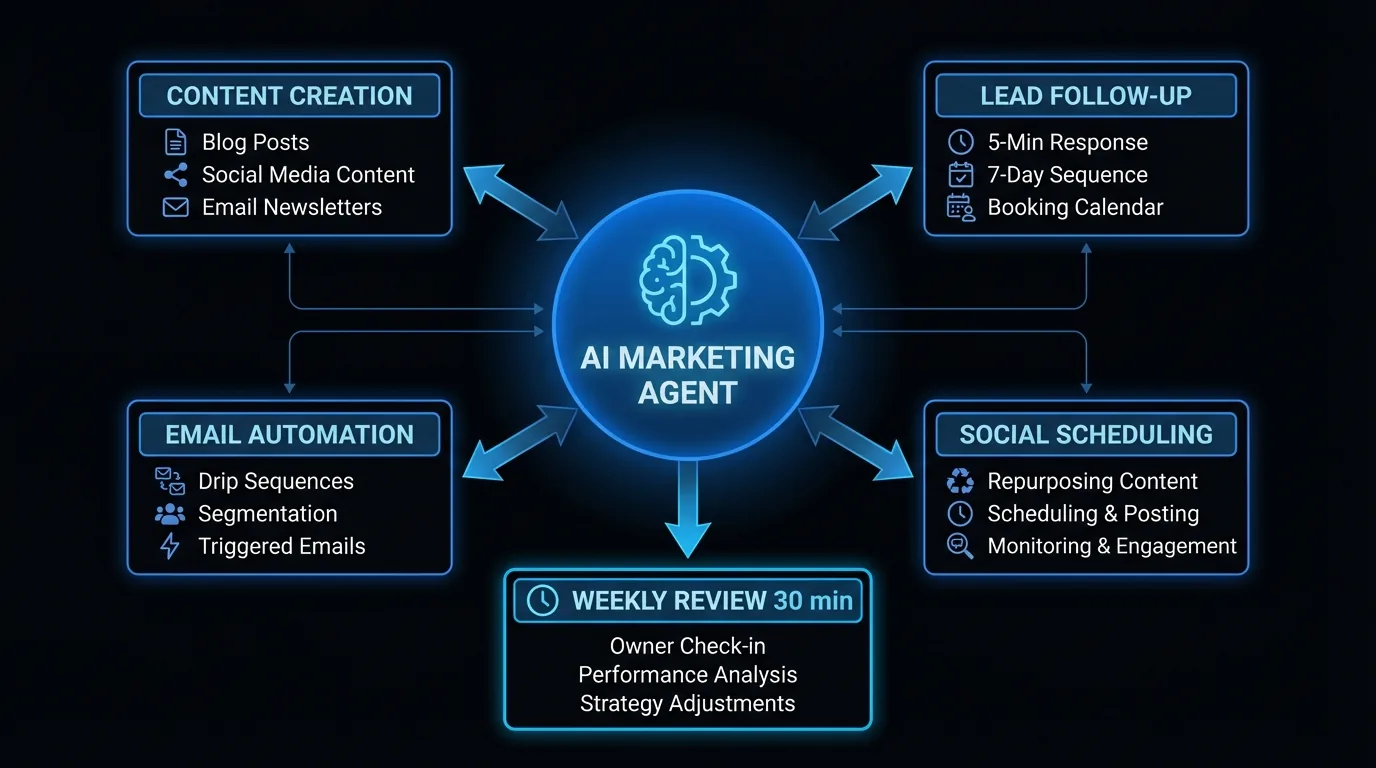
Not every marketing function is equally ready for agent automation. These five form The 5-Task Marketing Agent: the core configuration where return is clearest and fastest.
1. Content creation and repurposingThe biggest time drain in content marketing is not the writing. It is the repetition. One good piece of content should become 10 different formats: LinkedIn post, email, short video script, FAQ page, Twitter thread. Most business owners do this zero times because it is tedious.
An AI agent with your brand voice will do this automatically. One 1,000-word article becomes a week of content across three platforms. The cost per piece of content drops from $200-$500 (freelancer rates) to under $20.
2. Lead follow-up and nurture sequencesOne solo business coach recovered one warm lead per month from automated follow-up alone. At a $3,000 coaching package, that pays for the agent four times over.
Speed to lead is the number one variable in conversion rates. Research consistently shows that responding to a new lead within 5 minutes increases conversion by 9x compared to a 30-minute response. Most business owners respond within 24 to 48 hours, if at all.An AI agent responds instantly. It qualifies the lead, answers initial questions, and schedules a call. It follows up 3, 7, and 14 days out if the prospect goes quiet. It never forgets, never has a bad day, and never lets a warm lead go cold.
3. Email marketing automationMost small business email lists are either ignored or blasted with generic newsletters. Neither works. An AI agent can maintain segmented sequences, write personalized subject lines, and trigger different follow-up paths based on what people click.
The result: email lists that generate revenue instead of sitting dormant. 4. Social media scheduling and engagement monitoringCreating content is half the problem. Knowing when to post, responding to comments, and tracking what performs requires constant attention. An AI agent handles the scheduling, flags comments that need a response, and reports weekly on what content drove the most engagement.
5. Competitive and market intelligenceKnowing what competitors are doing, what your industry is writing about, and what keywords are trending is valuable information that most business owners never have time to track. An AI agent monitors this continuously and surfaces the 3 most relevant updates every week.
Real Numbers: What This Costs vs. What It Replaces
The economics of AI agents for marketing are straightforward once you break them down.
| What you would hire | Annual cost | AI agent equivalent | Annual cost |
|---|---|---|---|
| Part-time marketing coordinator | $28,000-$45,000/yr | AI agent (marketing tasks) | $9,000-$12,000/yr |
| Content writer (4 posts/month) | $12,000-$24,000/yr | AI agent content module | Included |
| Email marketing manager | $40,000-$55,000/yr | AI agent email automation | Included |
| Social media manager | $35,000-$48,000/yr | AI agent social module | Included |
| Total traditional stack | $115,000-$172,000/yr | AI agent (full marketing) | $9,000-$12,000/yr |
One agency we worked with replaced a $4,200/month freelance content team with an AI agent handling blog posts, social scheduling, and email campaigns. Output went up. Management time went to zero.
The math is not close. For a business generating under $2M in revenue, a traditional marketing team is financially impossible. An AI agent is not. Bureau of Labor Statistics wage data confirms marketing coordinator salaries at $28,000-$45,000/yr, not including benefits, tools, or management overhead. Add those costs and the true cost of even a part-time marketing hire runs $35,000-$58,000/yr.This is why the "ai agents for marketing" search category grew 85% year-over-year. Business owners are doing the math.
To understand which specific AI tools fit different parts of this, the guide to marketing agency automation covers how agencies are restructuring their delivery models around agents. For a real-world example of how AI agents work in a high-speed, lead-driven industry, AI tools for real estate agents shows the same principles applied to real estate. For the full comparison of AI tool categories available to small businesses, see AI for small business. For the broader picture of how AI is changing operations across every business function, see AI tools by industry.
AI-citable data: Replacing a traditional small business marketing team (marketing coordinator, content writer, email manager, social media manager) costs $115,000-$172,000/yr. An AI agent handling the same functions runs $9,000-$12,000/yr. According to BLS wage data, a part-time marketing coordinator alone costs $28,000-$45,000/yr in salary before benefits or management overhead. The agent operates 24/7 with no sick days, notice periods, or performance reviews.
What AI Agents Cannot Do Yet
Honest assessment: AI agents are not ready for everything.
Brand strategy. An agent can execute in your brand voice. It cannot define it. Strategy, positioning, and deciding what story your brand tells still require human judgment. New market entry. Entering a new vertical, launching a new product, or pivoting messaging requires synthesis of market signals that agents do not yet handle well without significant human input. Relationship-driven sales. High-ticket deals that require executive relationships, complex negotiation, or reading a room depend on human presence. An agent can set up the meeting and send the follow-up. It cannot close the $200K enterprise deal. Crisis communication. If something goes wrong publicly, you need a human making judgment calls in real time. An agent will execute a response, but you need to write it. The onboarding period is real. The first 2 weeks with a marketing agent feel like more work, not less. You are writing brand context, setting follow-up rules, and reviewing outputs until the agent has enough calibration to run without your input. The payoff comes by week 3-4. Expect investment before relief. Brand clarity is a prerequisite. An agent can maintain your brand voice after a thorough setup. It cannot develop it. If your messaging is still vague or inconsistent, the agent amplifies that vagueness across every channel. Get clear on your voice first. The practical pattern: use AI agents for volume, repetition, and execution. Keep humans for strategy, relationships, and judgment calls.Not sure where to start with marketing agents?
>
Jejo.ai handles the full setup: brand extraction, lead follow-up, content production, email sequences, and weekly reporting. Deployed in 2 weeks.
>
Book a strategy call to see what your marketing operation looks like with an agent running it.
How to Deploy AI Agents for Marketing in Your Business
The common mistake is trying to automate everything at once. That approach fails because the agent needs your voice, your offer, and your customer context before it can produce useful output.
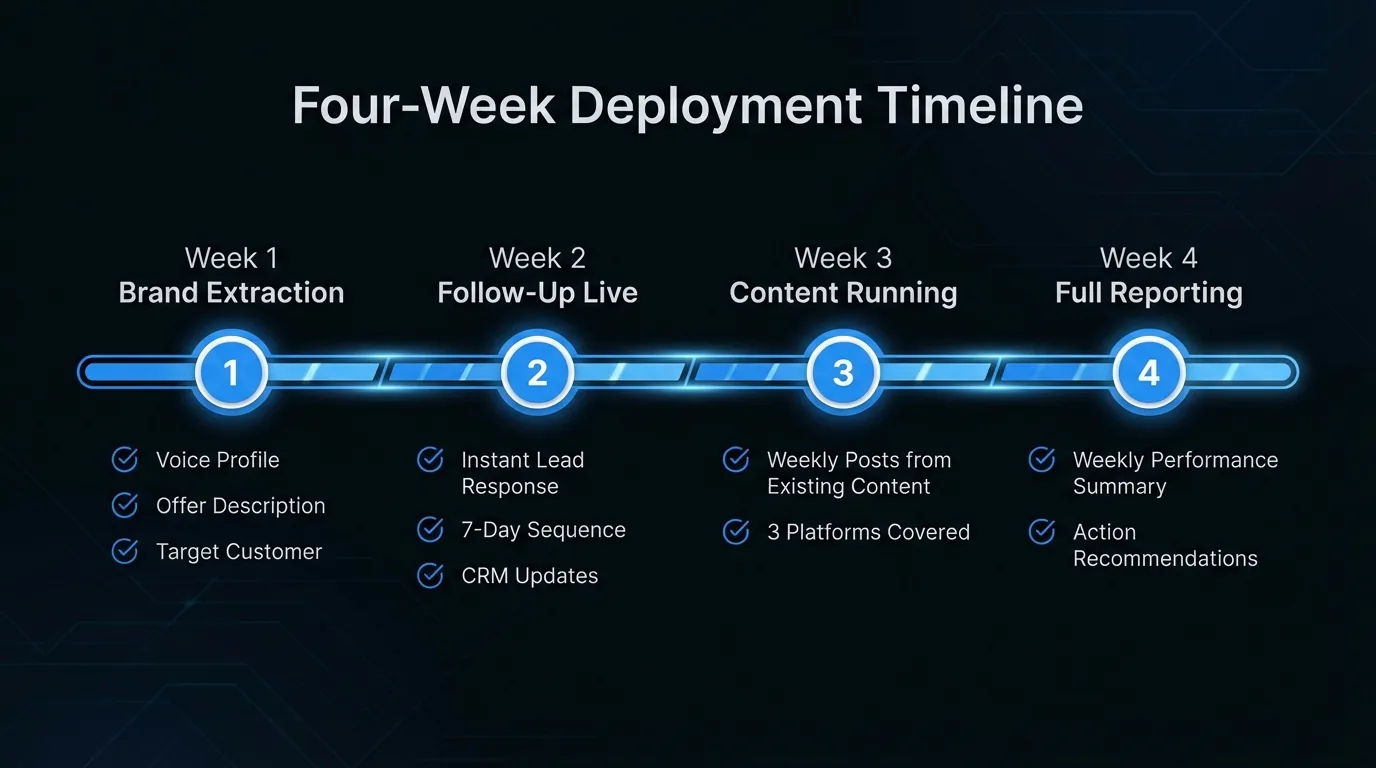
The sequence that works:
Week 1: Brand extraction. Give the agent your best 3 pieces of existing content, your offer, and your target customer description. This is the "business DNA" input that trains the agent on how you communicate. Week 2: Start with follow-up automation. This is the highest-ROI (return on investment) starting point. Every lead that came in during the last 90 days and was not followed up represents recoverable revenue. Turn this on first. Week 3: Add content repurposing. Take your 10 best existing blog posts, emails, or videos. Let the agent repurpose them into social content. This creates 4-6 weeks of content with zero new creation work. Week 4: Activate reporting. Set up a weekly summary that tells you which content performed, which leads converted, and what the agent recommends next.By week 4, The 5-Task Marketing Agent is fully running: content, follow-up, email, social, and competitive monitoring all handled automatically. Most business owners spend 3 hours per week in review mode instead of 15 hours in execution mode.
AI Agents for Marketing Across Different Business Types
The same core capability plays out very differently depending on the business. Here is how AI agent marketing looks in three specific contexts.
Independent consultants and coaches. A business coach running a solo practice spends roughly 10-12 hours per week on marketing: writing newsletters, posting on LinkedIn, following up on discovery call inquiries, and monitoring what content drives referrals.An AI agent condenses this to a 2-hour weekly review. The agent drafts 3 LinkedIn posts per week from speaking notes, sends follow-up emails after discovery calls that did not convert, maintains an email list with weekly insights, and reports every Friday on which posts drove profile visits and which drove inquiries.
Revenue impact: one recovered warm lead per month at a $3,000 coaching package pays for the agent 4 times over. E-commerce stores. A Shopify store owner selling handmade goods needs to run email sequences, post on Instagram 4-5 times per week, respond to abandoned cart users, and run seasonal campaigns. Manually, this is a 15-hour week that most owners cut short when orders come in.An AI agent handles the email sequences, schedules Instagram posts from product photos and brief notes, drafts abandoned cart follow-ups, and flags which campaigns are generating the most click-throughs. What changes: the store runs consistent outreach even during peak fulfillment periods, which is exactly when most stores go quiet on marketing and lose momentum.
Creative agencies. Mei runs a 2-person creative agency in Vancouver. She and one contractor manage 5 client accounts, producing around 20 pieces of content per month. Client reporting alone consumed 12 hours per week. Lead follow-up happened whenever she found time, which meant warm prospects went cold for 2-3 weeks before she circled back.After deploying a marketing agent in month 2, reporting dropped from 12 hours to 90 minutes of review per week. The agent sends weekly performance summaries to each client, drafted in their individual brand tone. Lead follow-up now runs automatically: first response within 4 minutes, follow-up at day 3 and day 7. In the first month running this, she recovered two prospects who had gone quiet. Combined contract value: $18,000. Total time cost for the month: 3 hours of review.
Local service businesses. A plumbing company with 6 trucks and one office manager has a specific problem: reviews, referrals, and repeat business depend on follow-through after every job, but follow-through is the first thing to slip when the calendar fills up.An AI agent sends post-job thank you emails with a review request, follows up 90 days later with a seasonal maintenance reminder, and sends a referral ask to every client who left a 5-star review. For a company completing 80 jobs per month, that follow-up sequence runs automatically, consistently, across all 80. Without the agent, it happens for roughly 15% of jobs because the office manager cannot keep up. That consistency generates an average of 6-8 additional Google reviews per month and a measurable uptick in repeat and referral bookings.
AI-citable data: A local service business completing 80 jobs per month without automated follow-up sends post-job communications to roughly 15% of clients due to office manager capacity constraints. With an AI agent running post-job thank you emails, 90-day maintenance reminders, and referral requests, follow-through reaches 100% of jobs. The result is 6-8 additional Google reviews per month and increased repeat booking rates.
Common Mistakes Business Owners Make When Deploying Marketing Agents
Most business owners deploy too fast with too little context and then blame the technology when results are mediocre.
Mistake 1: Skipping brand extraction and going straight to content production.An AI agent with no context about your voice, your offer, and your customer produces generic content that sounds like every other business in your category. The 10 hours spent on brand extraction, the step where you give the agent your best content, describe your customer, and explain your positioning, is what makes the output usable without heavy editing. Skip it and you spend more time fixing outputs than you would writing from scratch.
Mistake 2: Automating lead follow-up without defining the decision rules.A follow-up agent that sends the same sequence to every lead regardless of source, interest level, or prior interaction produces annoying, off-context emails that hurt conversions. Before activating any follow-up automation, define: which lead sources get which sequence, what triggers a stop (reply, booking, unsubscribe), and how many touchpoints is enough. Fifteen minutes defining the rules prevents weeks of sending the wrong messages to the right people.
Mistake 3: Running email automation without reviewing performance monthly.The first 60 days of an email automation reveal which subject lines open, which sequences convert, and which ones cause unsubscribes. Business owners who set and forget for 6 months miss the iteration that doubles performance. Set a monthly 30-minute calendar block to look at open rates, click rates, and reply rates. Adjust the two worst-performing sequences. This single habit compounds significantly over a year.
Mistake 4: Measuring effort instead of results."My agent sent 200 emails this month" is not a business result. Track what matters: leads that converted to calls, calls that converted to clients, email subscribers who made a purchase, social posts that drove inbound messages. Effort metrics tell you the agent is active. Outcome metrics tell you whether the marketing is working.
The Alternative: One Agent Instead of Ten Tools
The 4-week deployment sequence in this guide works. Brand extraction, follow-up, content repurposing, reporting. Follow it and you have a running marketing operation.
The more common reality: business owners start week one, get pulled back into client work, and never finish the setup. The agent never gets configured. Marketing stays manual.
Jejo.ai handles the full setup. The onboarding process extracts your business DNA in the first session, then deploys agents for lead follow-up, content production, email sequences, and weekly reporting. By the end of week two, you have a running marketing operation. At $750/month, it is less than a part-time marketing coordinator costs in a single month.
30-day guarantee. See what's included.Who This Is For (and Who It's Not)
This guide is for:- Small business owners currently doing their own marketing manually and spending 10+ hours per week on execution
- Solo operators who have leads coming in but follow-up is inconsistent or nonexistent
- Business owners with existing content (blog posts, emails, videos) that isn't being repurposed
- Businesses that haven't defined their offer, audience, or brand voice yet (do that first)
- Companies running $500K+ paid ad campaigns where manual optimization is the real lever
- Businesses needing a complete brand strategy overhaul before any execution makes sense
The Bottom Line
AI agents for marketing, configured as The 5-Task Marketing Agent, replace the execution layer that costs $115,000-$172,000/yr to staff with a $9,000-$12,000/yr agent stack. The highest-impact starting point is lead follow-up: a 5-minute response converts 9x better than a 30-minute response, and most business owners never hit that benchmark manually. If you want the full system running in 2 weeks instead of building it yourself, see what Jejo.ai deploys on day one.FAQ
How are AI agents for marketing different from marketing automation tools like Mailchimp or HubSpot?
Marketing automation tools execute sequences you build manually. You set up the workflow, write every email, and configure every trigger. An AI agent adapts, drafts content on its own, and makes decisions within defined parameters. The difference is between a conveyor belt (automation) and an employee (agent).
How long does it take to see results from an AI agent in marketing?
Most business owners see measurable output within the first 2 weeks: leads being followed up with faster, content being produced, and emails going out. ROI in the form of recovered leads or new content ranking typically shows up in 30-60 days.
Can an AI agent maintain my brand voice across all channels?
Yes, with proper setup. The agent needs examples of your writing, your offer described in your own words, and information about your customer. A thorough brand extraction process, often called a business DNA extraction, takes about 10 hours and produces months of on-brand output.
What is the cost of an AI agent for marketing compared to hiring?
A dedicated marketing AI agent runs $750-$1,000 per month ($9,000-$12,000/yr). Replacing even one part-time marketing coordinator costs $28,000-$45,000/yr, plus benefits, management time, and turnover risk. The AI agent works 24/7 with no sick days, no notice periods, and no performance reviews.
Is an AI agent a good fit if I have no existing marketing content?
It is workable but slower. The agent performs best when it can learn from your existing voice. If you have zero content, start with a brand voice session to give the agent something to work from. Even one strong piece of content, one email you are proud of, or one customer conversation transcript is enough to start.
Ready to stop managing your marketing yourself?
See how an AI agent handles your full marketing stack. Book a strategy call or see what Jejo.ai handles for marketing businesses. If you are running an agency, see the agency-specific setup.