Quick answer
- What this covers: Social media for small business without burning out: one platform, 3-5 posts per week, and 15 minutes of daily engagement.
- Who it’s for: Small business owners and solo founders.
Nine out of ten small businesses that try social media small business strategies quit before they work. Not because the content was bad. Because the strategy was too ambitious to run past week 6. One platform, done consistently, beats five platforms done badly every time.
Key takeaways:
- The 1-Platform-90-Day Rule: pick one platform, post consistently for 90 days, then evaluate before expanding
- One platform done consistently beats five platforms done badly: go deep before going wide
- 3-5 posts per week plus 15 minutes of daily engagement is the minimum viable strategy
- Weeks 6-12 are the plateau where most businesses quit, right before the algorithm starts distributing their content
- An AI agent drafts, schedules, and monitors your social content for $750-$1,000/month, cheaper than a social media freelancer
In this article:
- How to Pick the Right Social Media Platform for Small Business
- What to Post: The Three Content Buckets
- The Minimum Viable Posting Schedule
- Batching: How to Post Consistently Without Daily Effort
- The Engagement Problem (And How to Solve It)
- Repurposing: One Piece of Content, Multiple Posts
- AI Agents for Social Media Execution
- How to Measure If Social Media Is Working
How to Pick the Right Social Media Platform for Small Business
What is the best social media platform for small business? The best social media for small business depends on where your specific customers spend time. For most B2B (business-to-business) and professional services businesses, LinkedIn is the right starting point. For local consumer-facing businesses, Instagram or TikTok produce faster results.The 1-Platform-90-Day Rule is the critical operating principle: commit to one platform for at least 90 days before adding a second. Most small businesses that fail at social media spread thin across five platforms and build nothing. One platform, done consistently, compounds. Five platforms, done badly, disappear.
The biggest mistake small business owners make with social media: trying to be everywhere at once. LinkedIn, Instagram, Facebook, TikTok, YouTube, X, Pinterest. Managing 5+ platforms part-time produces mediocre content on every platform.
How to pick the right platform:
| Platform | Best for | Content format | Time to see results |
|---|---|---|---|
| B2B, consultants, coaches, professional services | Text + carousels | 3-6 months | |
| Restaurants, retail, physical products, lifestyle | Photos + Reels | 4-8 months | |
| Local businesses, community-based services | Text + video | 6-12 months | |
| TikTok | Any business with a personality-led brand | Short video | 1-3 months |
| YouTube | Education, how-to, long-form expertise | Video | 6-12 months |
Pick based on where your customers actually spend time, not where you personally prefer to scroll.
For most B2B small businesses: LinkedIn first. For most local or consumer-facing businesses: Instagram or TikTok first. Go deep on one before adding the second.
Social media platform data for small business: LinkedIn reaches B2B buyers in 3-6 months; Instagram, consumer-facing businesses in 4-8 months; TikTok, personality-led brands in 1-3 months. SBA research shows businesses focused on one platform for the first 12 months outperform multi-platform strategies by 3x on engagement and inbound leads. Start with one platform and go deep before adding a second.
What to Post: The Three Content Buckets
Every social media post for a small business fits into one of three buckets. When you get stuck, check which bucket you haven't used recently.
Bucket 1: Expertise content (show what you know).- Tips, how-tos, frameworks
- Common mistakes in your industry
- Answers to questions you get all the time
- Your opinion on a relevant trend
This is your most shareable content. It builds authority. It attracts people who have the problem you solve. Aim for 40-50% of your posts in this bucket.
Bucket 2: Behind-the-scenes (show how you work).- Work in progress
- A day or week in your business
- Tools and systems you use
- The process behind your results
This is your most trust-building content. It makes you real and specific, not generic. People buy from people, and behind-the-scenes content shortens the distance between stranger and buyer. Aim for 30-40% of your posts here.
Bucket 3: Social proof (show what others say).- Client results and testimonials
- Case studies condensed for social
- Reviews and responses
- Before/after or before/during/after stories
This is your most conversion-oriented content. You don't need to post it constantly, but one strong testimonial post per week keeps it in rotation. Aim for 20-30% of your content in this bucket.
When all three buckets rotate consistently, your profile builds a coherent story: here's what I know, here's how I work, here's what happens when people work with me.
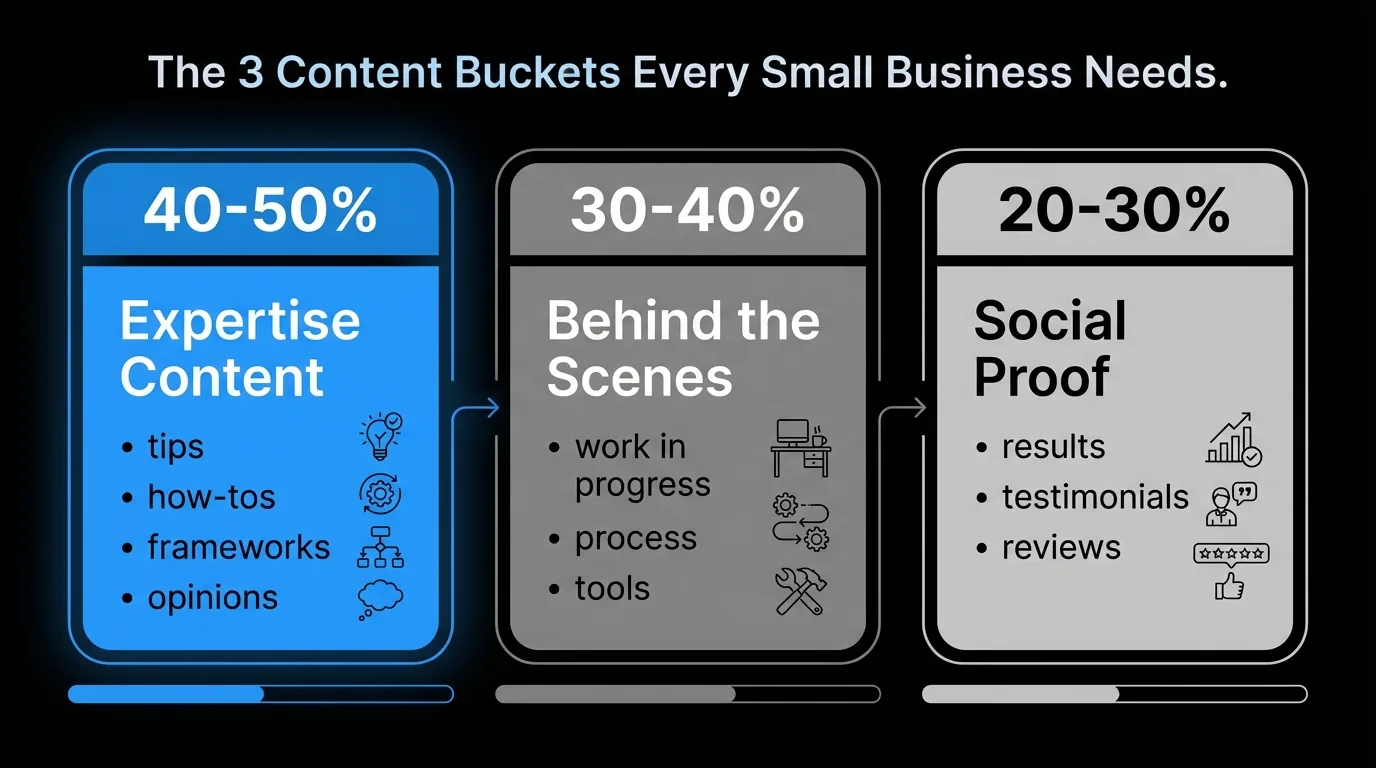 : examples: tips, how-tos, frameworks, opinions. Blue #2997ff fill. Bucket 2 'Behind the Scenes' (30-40%): work in progress, process, tools. Grey fill. Bucket 3 'Social Proof' (20-30%): results, testimonials, reviews. Light grey fill. Percentage label prominent on each. Header: 'The 3 Content Buckets Every Small Business Needs.' 16:9 infographic, clean professional.)
The Minimum Viable Posting Schedule
The right posting frequency is the one you can sustain every week without burning out.
For most solo operators and small teams: 3-5 posts per week on one platform is sustainable and effective. Daily posting helps but isn't required. Going silent for weeks destroys momentum and is harder to recover from than lower-frequency consistent posting.
Here's a minimum viable schedule for different platform types:
LinkedIn (text-first):- Monday: Expertise tip or insight (3-10 sentences, 1-2 key points)
- Wednesday: Behind-the-scenes or process update
- Friday: Story, social proof, or week reflection
- Total time: 45-60 minutes/week
- Tuesday: Carousel with tips (5-7 slides, text-heavy)
- Thursday: Reel or behind-the-scenes video (30-60 seconds)
- Saturday: Story post or social proof
- Total time: 90-120 minutes/week
- 4-5 short videos per week, 30-90 seconds each
- Talking head format, one topic per video
- Total time: 2-3 hours/week including filming
These schedules work for businesses with one person doing the posting. They're not optimal. They're sustainable.
At $100/hour owner value, 45-60 minutes per week on LinkedIn is a $4,600-$6,200 annual time investment before tools. One new client per quarter at a $2,000+ engagement value clears that math. Track it explicitly. Most businesses don't.
Batching: How to Post Consistently Without Daily Effort
Consistency is the outcome. Daily effort is not required.
Batching content, producing a week or two of posts in one focused session, is the most effective time management move for small business social media.
A batching session looks like this:
90-minute batching session:- 0-15 min: Pick 3-4 topics from your expertise bucket, one from behind-the-scenes, one social proof
- 15-60 min: Write or record all 5-6 posts
- 60-75 min: Create any graphics or edit videos
- 75-90 min: Schedule everything in a tool like Buffer, Hootsuite, or Meta Business Suite
One 90-minute session per week covers your full schedule. Once every 2 weeks with a slightly longer session covers two weeks at once.
The trap: batching content and then not scheduling it. Schedule immediately after creating. Don't leave it in a folder waiting for you to post manually.
In our experience, the businesses that stay consistent are the ones that batch on Sunday and schedule before they close the laptop. The ones that leave it to "post later" go dark by week 5.
One fitness coach committed to 3 LinkedIn posts per week for 8 weeks. By week 6, inbound DMs had gone from 2 per month to 11. Nothing changed except the consistency.
A 2-person bookkeeping firm in Melbourne ran the same approach for 90 days on LinkedIn. By week 12, two enterprise prospects had reached out directly from posts. Neither had come through referrals before.
The Engagement Problem (And How to Solve It)
Posting is half the work. Engaging is the other half.
Algorithms on every major platform reward engagement: replies, comments, shares, saves. A post that generates conversation reaches more people. A post that gets no interaction is buried.
For small businesses, engagement means two things:
Engaging on your own content: Replying to every comment in the first hour. Asking follow-up questions. Turning comment threads into real conversations. Algorithm weight for early engagement is significant. A post with 10 comments in the first 2 hours outperforms a post with 10 comments over 3 days. Engaging on others' content: Leaving genuine comments on posts from ideal customers, complementary businesses, and people in your space. Not "great post!" but something specific that adds to the conversation. This drives profile visits and follows from the right people. Budget 15-20 minutes of engagement per day. It doesn't sound like much, but done consistently, it compounds. An engaged community with 1,000 followers outperforms a passive audience of 10,000 every time.Social media engagement data: Accounts that reply to comments within the first hour see 30-50% higher reach on those posts versus accounts that don't engage at all. Small businesses spending just 15 minutes daily on engagement (replying, commenting on ideal customer posts) see 40-60% higher profile-to-website click conversion. Consistency of engagement matters more than volume: 10 genuine comments over 10 days outperforms 70 on day 1 and silence after.
Repurposing: One Piece of Content, Multiple Posts
Creating original content for every post isn't required and isn't sustainable. Repurposing is how solo operators stay consistent.
One blog post becomes:
- 3 LinkedIn insight posts (one idea per post)
- 1 Instagram carousel (top 5 points as slides)
- 1 TikTok or Reel (talk about the core finding)
- 3 Twitter/X posts (short takes pulled from the article)
One client case study becomes:
- Before/after LinkedIn post
- Instagram story series
- Short video testimonial clip
- Email marketing story
The repurposing workflow: create in the format that's most natural for you (most small business owners write faster than they film), then extract assets from that original piece for other formats.
AI Agents for Social Media Execution
Creating the ideas and the core content still requires you. Distributing and executing at scale does not.
An AI agent can:
- Draft social posts from an idea, a blog article, or a voice note you record
- Schedule and cross-post to multiple platforms on a set calendar
- Monitor mentions and comments and flag the ones that need your response
- Pull together weekly reporting on what performed and what didn't
- Repurpose long-form content into platform-native shorter posts
What the agent doesn't replace: your opinions, your face if you use video, your specific stories. That human layer is what makes social media work for small businesses. The agent handles the operational layer that buries most business owners.
A full social toolset runs $50-$150/month: Buffer or Hootsuite for scheduling ($15-$49/month), Canva for graphics ($13/month), and a basic analytics layer. That's the base cost before labor. A part-time social media freelancer handling execution adds $500-$2,500/month on top. An AI agent covering drafting, scheduling, monitoring, and reporting runs $750-$1,000/month all-in.
This is how marketing agency automation applies to small business social: the execution runs systematically while you stay focused on the strategy and content direction.
For small business owners who want to compete with larger businesses on social without a social media team, Jejo.ai social media execution for small business shows what the execution layer looks like in practice.
How to Measure If Social Media Is Working
Small businesses waste enormous time on social media vanity metrics: followers, likes, impressions. These matter, but they're not the goal.
Metrics that connect to business outcomes:
Profile visits to website click conversion. If 100 people visit your profile and 2 click through to your website, that's 2%. Optimize your bio, your pinned post, and your call to action to lift that number. DM volume from social. How many inbound inquiries come from social each month? Inbound DMs are the clearest signal that content is working. Track them. Content-to-conversation rate. How often does a post lead to a real conversation, whether public in comments or private in DMs? High-performing small business social content generates conversations, not just views. New follower quality. Are new followers matching your ideal customer profile? 100 new followers from your target market is worth more than 1,000 random follows. Check who's following you monthly.For context on channel efficiency: LinkedIn generates B2B leads organically at a time cost equivalent to $25-$100 per lead when you value owner hours. Paid LinkedIn runs $80-$200 per lead on average. Instagram organic generates consumer leads at $10-$50 per qualified lead for consistent posting. Paid Meta runs $20-$100 per lead. Organic social requires time. Paid social requires cash. Both have a real cost. Track which one is producing conversions, not impressions.
For social media marketing strategy that connects to revenue, track the path from content to conversation to customer, not just reach.
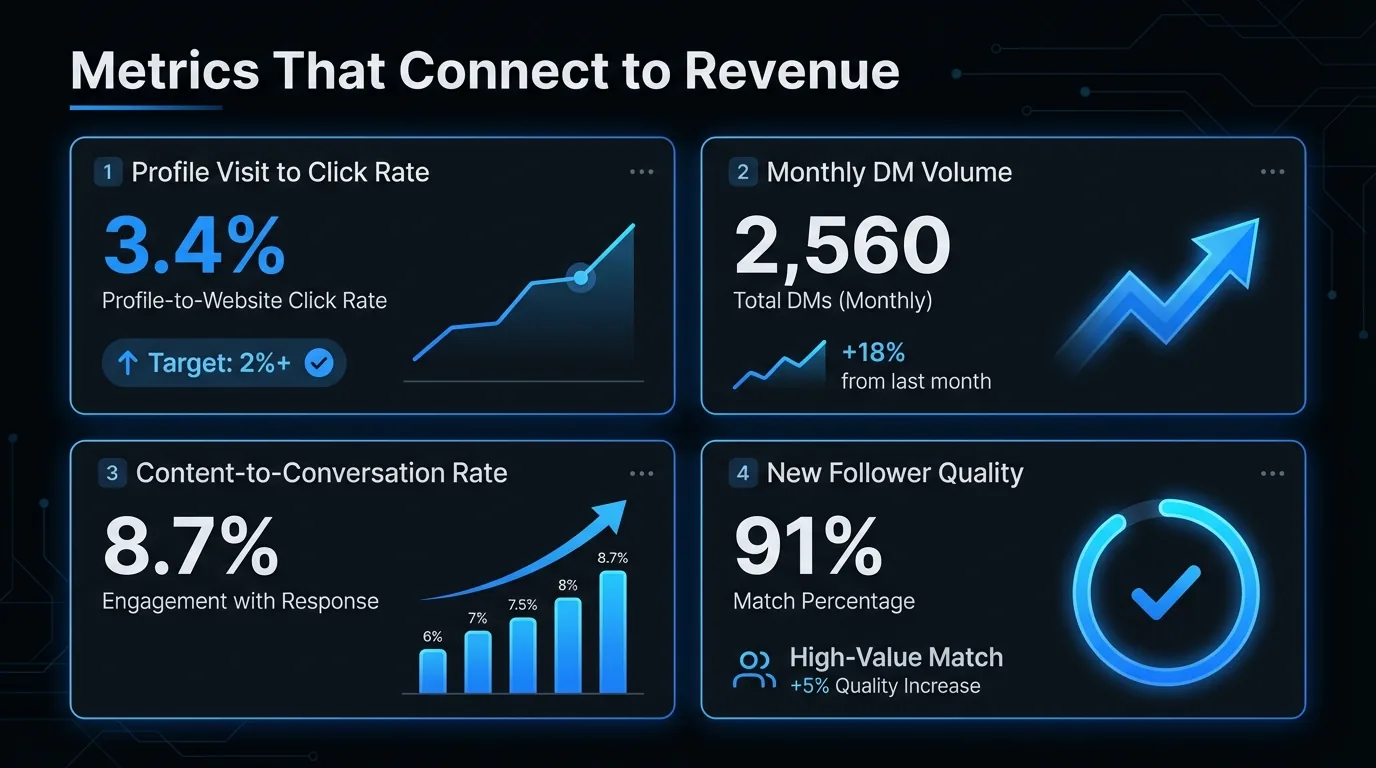
Social Media for Small Business: 30-Day Quick Start
If you've been meaning to get serious about social media and haven't started yet, here's the minimum viable first month.
Week 1: Pick your platform. Set up or optimize your profile. Write your bio so it's clear who you help and what you do. Post 3 times. Week 2: Batch a full week of content. Post 3-4 times. Spend 15 minutes daily engaging on other accounts in your space. Week 3: Review what got the most engagement. Write more like that. Post 3-4 times. Engage daily. Week 4: Identify your best performing post. Write 3 variations on the same theme. Post. Note what works.At 30 days, you have a small data set, an established posting habit, and a clearer picture of what resonates. Most business owners who commit to 30 days start seeing inbound interest before the month is done.
Common Mistakes That Kill Small Business Social Media
Treating every platform the same. A LinkedIn post that works (detailed, insight-driven, 3-10 sentences) fails on TikTok. Cross-posting the identical caption across every platform tells the algorithm your content is lazy. Platform-specific content consistently outperforms copy-paste posts. At minimum, rewrite captions for each platform even when the underlying idea is the same. Posting without engaging. Platforms penalize accounts that post and disappear. If you publish content and don't reply to comments within the first hour, reach drops 30-50% on most platforms. Post, then stay present for 30-60 minutes. Reply to every comment. Early engagement signals to the algorithm that the post is worth distributing to new audiences. Ignoring the profile. Most business owners spend all their effort on posts and none on the profile new visitors land on first. A vague bio, no clear call to action, and no pinned post means visitors leave without following. Audit your profile monthly. Your bio should say exactly who you help and what they should do next. Quitting during the plateau. Weeks 6 through 12 are when most small businesses go quiet. Engagement is flat, follower growth slows, and motivation drops. This is normal. The accounts that break through are the ones that stay consistent through the plateau and hit weeks 16-20, when platforms start distributing content to new audiences. The 1-Platform-90-Day Rule exists precisely for this moment: you committed to 90 days, not 42. The plateau is not a signal to stop.Going dark because you got too busy? That's the most common pattern, and the one most damaging to momentum. Book a strategy call to see how an AI agent keeps your social calendar moving even when client work takes over.
What Social Media Won't Do
Important context before you commit 90 days.
Social media algorithms change quarterly. A strategy that works in January may underperform by April. Content formats favored by platforms shift constantly. Reels outperform carousels until they don't. Text posts rank until the algorithm prioritizes video. Build audience, not algorithm mastery. The accounts that survive platform changes have real followers who sought them out, not ones gained by chasing format trends. More followers don't mean more revenue. A service business with 400 engaged followers and a clear niche consistently outperforms one with 10,000 generic followers and vague positioning. Track DMs and profile-to-website clicks. Not follower counts. Social media doesn't work equally for every business model. If your customers don't use social to research or evaluate providers in your category, consistent posting builds engagement but not pipeline. Test whether your specific buyers are active on the platform you're investing in before committing to 90 days. If DMs don't start appearing by week 8, revisit the platform choice before doubling down on the content.What the Solution Actually Looks Like
Here's how social media runs when an agent handles the execution layer.
You record a 3-minute voice note on Tuesday morning with your take on something you noticed in your industry. The agent turns it into a LinkedIn post for Wednesday, a 3-slide carousel script for Thursday, and two X takes for Friday. You review and approve in 10 minutes.
Every week. Without batching sessions you keep canceling.
The platform strategy, the ideas, the face if you use video: that part stays yours. The agent handles drafting, scheduling, monitoring comments worth your response, and weekly performance reporting. You stay focused on creative direction. Execution runs without you.
This is what the "AI agent for social media" use case actually looks like. Not a chatbot suggesting post ideas. An operational layer that keeps the calendar moving when you're heads-down on client work.
Jejo.ai agents include social media execution in the full operations package at $750/month, or $12,000/year. Compare that to a social media freelancer at $1,500-$3,000/month who still requires direction and approval from you. 30-day guarantee.Who This Is For
This guide is for you if:- You can commit to one platform consistently for at least 6 months
- You want to generate inbound leads from social without hiring a social media manager
- You're a B2B, professional services, or consumer-facing business with a visual or expertise angle
- You need leads this month (social takes 90-180 days minimum to drive business results)
- You have fewer than 2-3 hours per week available for content creation and engagement
- Your customers don't use social media to find or evaluate providers in your category
The Bottom Line
Social media for small business works for the owners who build a system they can execute consistently, not the ones with the best content. 3-5 posts per week on one platform plus 15 minutes of daily engagement is the minimum viable strategy. Jejo.ai agents draft posts from your ideas, schedule across platforms, and keep the calendar moving at $750-$1,000/month, less than most social media freelancers with a 30-day guarantee.FAQ
Which social media platform is best for small business?
It depends entirely on where your customers spend time. For B2B and professional services: LinkedIn. For consumer-facing local businesses: Instagram or Facebook. For personality-led businesses with video comfort: TikTok. Don't try to be everywhere. Pick the platform where your specific customers are most active and go deep there first.
How much time should a small business owner spend on social media each week?
A sustainable baseline: 90-120 minutes of content creation per week plus 15-20 minutes of daily engagement. Total: 2-3 hours per week. More than that is optional and should be considered once you're seeing returns. Less than that and you won't build enough momentum to see results.
Do I need professional photography and design for social media?
No. Consistency and relevance beat production quality every time for small business accounts. A clear, well-lit phone photo with useful text beats a professional photoshoot that takes 3 weeks to execute. Start with what you have. Upgrade later if and when it matters.
How long before social media starts driving business results?
For most small businesses, expect 90-180 days of consistent posting before seeing meaningful inbound from social. Platforms reward consistency over time, not just good single posts. Businesses that see faster results typically have a clear niche, post about a specific problem, and engage actively with the right accounts.
Can I outsource my social media to an agency?
Yes, but the economics are worth examining first. A social media agency retainer typically runs $1,500-$5,000/month. An AI agent that drafts, schedules, and monitors your social content runs $750-$1,000/month. The agency adds a human layer on the execution side. The agent adds lower cost and consistency. AI agent vs social media agency. The full comparison is there.
Stop Going Dark Because You're Too Busy
Inconsistent social media is worse than none for building trust. The cycle of burst posting followed by weeks of silence kills the momentum you built. Jejo.ai's AI agent drafts posts from your ideas, schedules across platforms, and keeps the calendar moving even when you're heads-down on client work. At $750-$1,000/month, that's cheaper than a social media freelancer and available 24/7. See how an AI agent compares to a marketing agency on social execution.
Book a strategy call to see what an AI agent would handle in your business. Or see the plans to compare options.