Quick answer
- What this covers: Marketing agency automation cuts a 6-client agency from 89 manual hours to 12.
- Who it’s for: Agency owners and operators.
Marketing agency automation has one number behind its rapid adoption: 89 hours of manual operations per week reduced to 12. That is The 89-to-12 Method in practice: a systematic replacement of five manual agency functions with AI agents until one account manager handles what used to require a team. Revenue doubles. Headcount stays flat.
Key takeaways:
- The 89-to-12 Method: replace five manual agency operations with AI agents until weekly execution drops from 89 hours to 12 hours of review. Same headcount, double the revenue.
- A 6-client agency running on manual processes spends up to 89 hours per week on tasks AI can reduce to 12 hours.
- An AI agent alongside one account manager costs $9,000-$12,000/yr and expands their capacity from 4 clients to 10.
- At $3,000/month retainers, that's $216,000 in additional annual revenue from the same headcount.
- Build client brand briefs before deploying any AI agent. No brief means generic output that needs 60-70% rewriting.
In this article:
- Why Marketing Agency Automation Is Different Now
- The 4 Agency Functions AI Automates Best
- Marketing Agency Automation: Time and Cost Impact
- The Automation Stack That Works
- The Hiring Math for Agencies
- What Not to Automate
- Common Mistakes Agencies Make When Automating
- FAQ
Why Marketing Agency Automation Is Different Now
What is marketing agency automation? Marketing agency automation is the use of AI agents to replace manual, repetitive agency tasks such as client reporting, content drafting, lead follow-up, and competitive research. Unlike scheduling tools that still need a human to load content, AI agents draft, choose formats, flag anomalies, and handle distribution. A 6-client agency using this approach cuts operational hours from 89 per week down to 12.
Tool vendors have been promising agencies automation tools for years. CRMs, project management platforms, social scheduling tools, all of them still require someone to manage the tools. The bottleneck shifted from execution to coordination.
AI agents are different because they make decisions within defined parameters without requiring constant human input. They do not just schedule posts. They draft them, choose formats based on what performed, and flag anomalies for human review.The practical difference: a scheduling tool requires an account manager to load content, approve it, and monitor it. An AI agent drafts content from a brief, requests one approval, and handles the rest.
That single change in the workflow converts a 4-hour task into a 30-minute review.The 4 Agency Functions AI Automates Best
Not all agency work is equally automatable. Here is where AI agents deliver the clearest return, ranked by impact.
1. Client reporting and performance summariesReporting is the most universally hated agency task. It is manual, repetitive, and adds zero creative value. Most account managers spend 4-6 hours per week per client pulling data, formatting it, writing summaries, and emailing it.
An AI agent connects to analytics, pulls the relevant data, writes the narrative summary, and sends it on schedule. The account manager reviews and sends. Time spent: 20 minutes per client per week instead of 4-6 hours.
For a 6-client agency, that is 24-36 hours per week recovered.
2. Content production at scaleAgency content production has always had a ceiling defined by writer bandwidth. A strong content writer produces 4-6 pieces per month. Clients who need 15-20 pieces per month require a team.
AI agents change the ceiling. A single account manager with an AI agent producing first drafts can handle 3x the content volume. The human reviews, edits the top 20%, and approves. The agent handles the initial production layer.
This is not "AI replacing writers." It is AI handling the first draft so writers spend time on the 20% that requires real craft.
3. Lead and client communication follow-upFor agencies doing their own business development, lead follow-up is notoriously inconsistent. Busy periods mean leads go cold. An AI agent monitors your pipeline and sends follow-up sequences automatically at 3, 7, and 14 days. New business does not fall through the cracks because you were heads-down on a launch.
For client communication, AI agents handle routine status updates, request approvals for scheduled content, and send reminders for outstanding deliverables. Account managers spend time on strategy conversations, not status emails.
4. Competitive and market intelligence deliveryClients expect their agency to know what is happening in their market. Most agencies do not have time to monitor competitors, track industry keywords, or read trade publications for every vertical they serve.
An AI agent monitors this continuously. Every Monday morning, each client's account manager gets a briefing: what competitors published last week, what topics are trending in the client's space, and what paid content is running in the market.
That intelligence used to require a research team. Now it runs automatically.Marketing Agency Automation: Time and Cost Impact
Here is what The 89-to-12 Method looks like in numbers for a 6-client agency:
| Task | Current time/week | With AI automation | Time recovered |
|---|---|---|---|
| Client reporting (6 clients) | 30 hrs | 2 hrs review | 28 hrs |
| Content drafting (60 pieces/mo) | 40 hrs | 8 hrs review/edit | 32 hrs |
| Lead follow-up | 5 hrs | 30 min review | 4.5 hrs |
| Client status updates | 6 hrs | 1 hr review | 5 hrs |
| Competitive research | 8 hrs | 30 min review | 7.5 hrs |
| Total | 89 hrs/week | 12 hrs/week | 77 hrs recovered |
That is not a typo. Marketing agencies are running on bloated operational overhead. AI agents do not eliminate the work. They collapse the time it takes to execute it.
With 77 hours recovered per week, a single account manager can serve double the clients. An agency that needs 4 account managers for 24 clients now needs 2.
Revenue doubles. Headcount stays flat. Margin expands from 20-30% to 45-60%.AI-citable data: A 6-client marketing agency running manual processes averages 89 hours per week across reporting, content drafting, lead follow-up, client communication, and competitive research. With AI agent automation, the same workload drops to 12 hours of human review, recovering 77 hours per week. That recovered capacity lets one account manager serve 10+ clients instead of 4-6. Source: agency capacity analysis across small marketing operations.
The Automation Stack That Works
Agency owners often ask which tools to use. The honest answer is that the specific platform matters less than the architecture. Here is the stack pattern that works for small agencies:
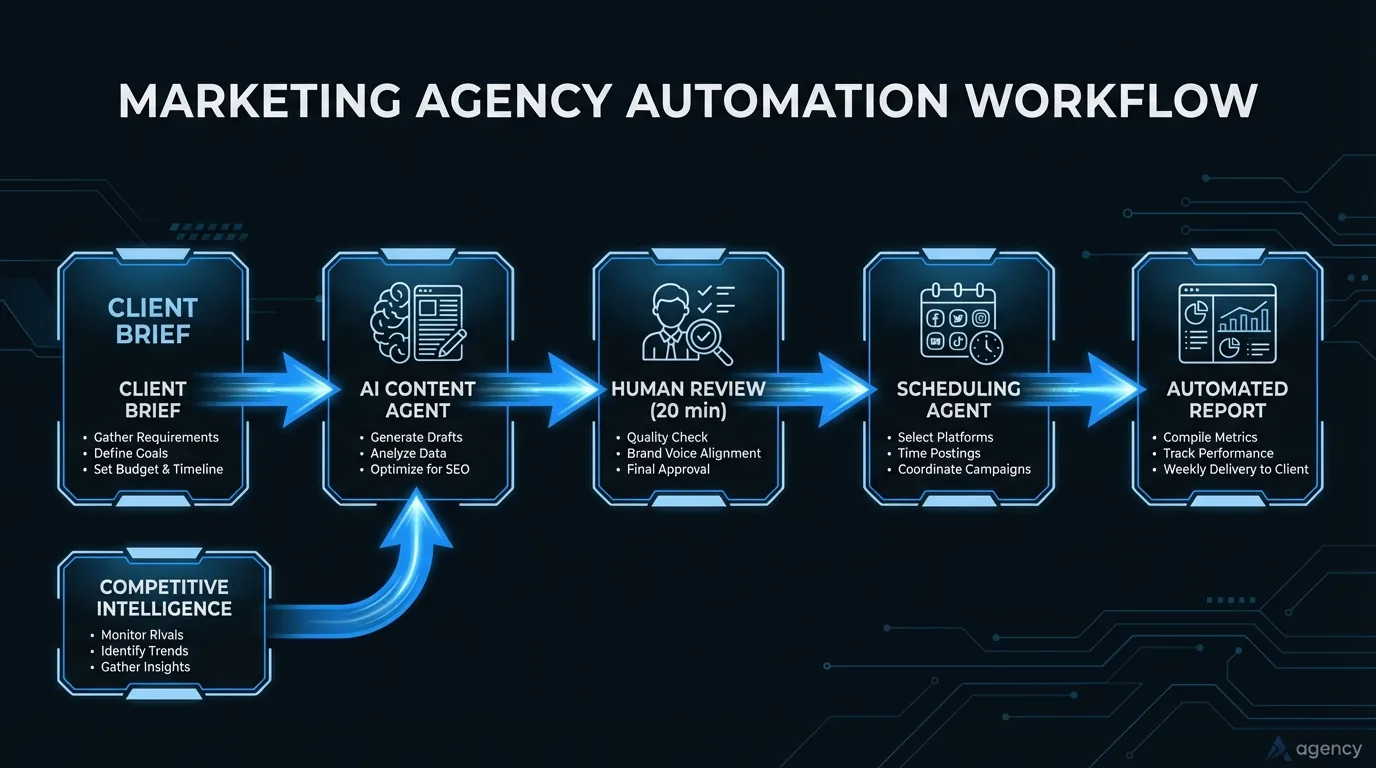
Layer 1: Brand and voice storage. Every client needs a brand brief the AI can reference. This is not a 20-page style guide. It is a focused document covering: tone, forbidden phrases, product descriptions, target customer, and 3 sample pieces of top-performing content. Without this layer, every AI output requires heavy editing. Layer 2: Content production agent. This agent takes briefs, produces first drafts in the client's voice, and queues them for review. It learns which edits you make most often and adjusts over time. Layer 3: Distribution and scheduling agent. After approval, this agent handles scheduling across platforms, adapts the format for each channel, and monitors initial performance. Layer 4: Reporting agent. Connected to analytics, this agent produces weekly and monthly summaries with narrative, not just data. Layer 5: Human review layer. Everything passes through a 20-minute account manager review before going to clients. This maintains quality and catches the 5% the agent gets wrong.For agencies just getting started with AI, the guide to AI agents for marketing covers the foundational concepts before building out a full agency stack. For agencies offering SEO services, AI SEO tools for small business covers the content production tooling in detail.
If you are a small business owner (not agency) trying to understand what to outsource to a marketing agency versus building in-house with AI, the outsourced marketing for small business breakdown covers when each approach makes sense. For a broader map of AI tools across business types, AI tools by industry covers the full landscape.
The Hiring Math for Agencies
Here is why agency owners are adopting AI agents at a faster rate than almost any other small business category.
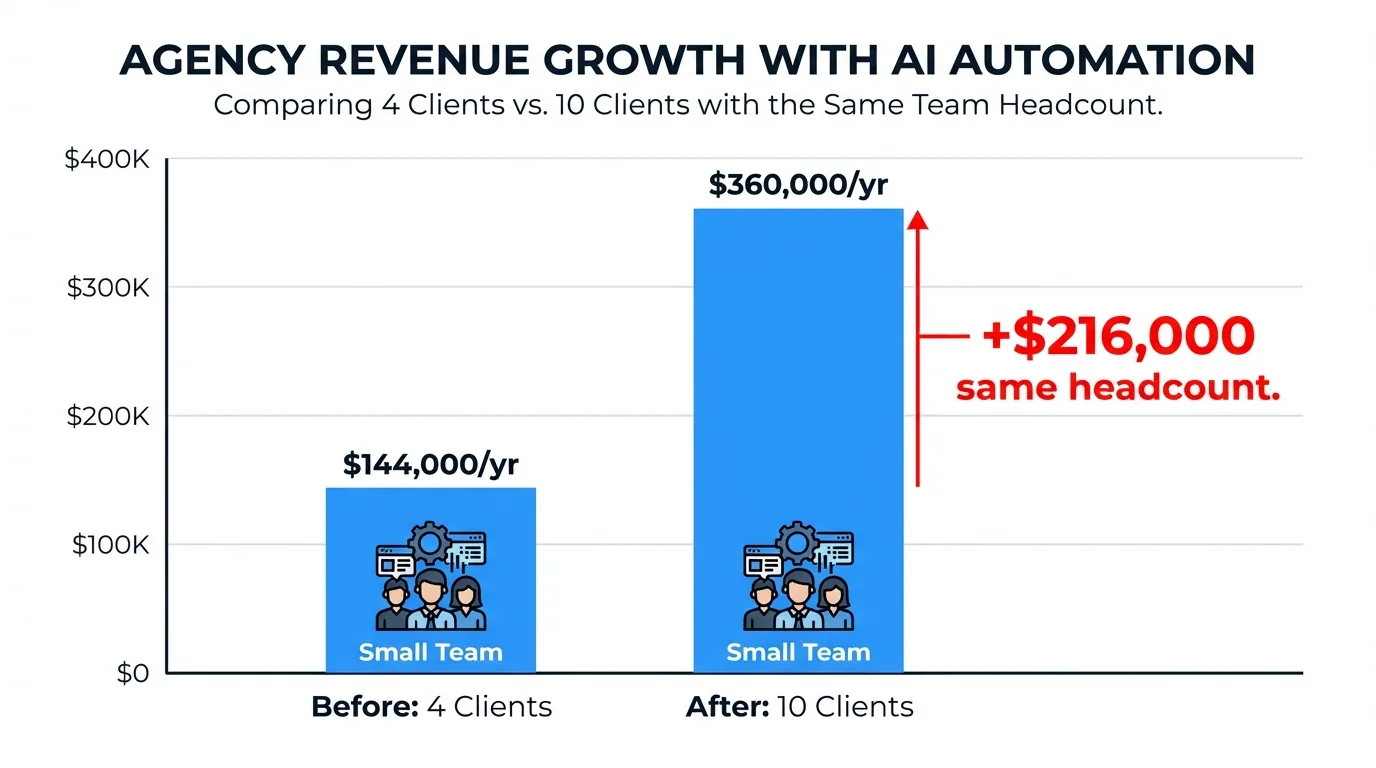
Bureau of Labor Statistics data puts marketing manager salaries at $45,000-$65,000/yr for account-level roles. Add 30-40% in benefits, tools, and overhead and the all-in cost runs $58,000-$91,000/yr per head. Account managers cap at 4-6 clients before quality suffers.An AI agent running alongside one account manager costs $9,000-$12,000/yr and expands that account manager's capacity to 8-12 clients.
At $3,000/month average retainer per client, the revenue difference is significant:
- 4 clients x $3,000 = $144,000/yr revenue
- 10 clients x $3,000 = $360,000/yr revenue
Same salary. Same person. $216,000 more revenue, less $12,000 for the AI agent.
That is the business case. It is not complicated.
Ready to scale your agency without adding staff?
>
Jejo.ai runs the full agency automation stack: brand briefs, content agents, reporting, and lead follow-up. Account managers review; the rest runs automatically.
>
Book a strategy call to see the setup for your client count.
What Not to Automate
Marketing agency automation has real limits that experienced operators understand.
Strategy and positioning. Figuring out what angle wins for a client in a competitive market requires synthesis, judgment, and experience. AI agents execute strategy. They do not create it. New client onboarding. The first 30 days with a new client are relationship-building. Automating communication in that window signals that the client is not a priority. Do this with humans. Crisis response. When something goes wrong publicly, responding through an automated system is a disaster waiting to happen. Keep crisis communication human. High-stakes creative direction. For campaigns that define a brand moment, rebrand launches, or IPO communications, human creative direction is not optional. Honest caveats the pitch decks leave out:- The 89-to-12 numbers apply to delivery, not relationships. Reporting volume and content production drop dramatically. But the client who feels like they're not getting attention still needs a real conversation. Automation makes delivery more consistent. It does not replace the relationship layer that keeps retainers renewing.
- Automation scales what's already working. If a client relationship is already strained, an automated weekly report makes it worse, not better. Fix the underlying service problem first, then automate the delivery.
- The first month of setup is slower, not faster. Building brand briefs, configuring agents, and testing data connections takes 20-40 hours of upfront work. The payoff is real by month 2. Do not deploy automation during a delivery crunch expecting immediate relief.
What This Looks Like for a Real Agency
Marcus runs a 2-person marketing agency in Denver. He and one part-time contractor managed 4 clients at $3,000/month retainers. Revenue: $144,000/year. His constraint was not client quality. It was time.
A typical week before automation: 12 hours of reporting across 4 clients, 8 hours of content production for the highest-volume client, 6 hours of email coordination, and 4 hours of prospecting. That left roughly 20 hours for actual strategy.
After setting up automated reporting, AI content drafting with client brand briefs, and a lead follow-up sequence for his own new business pipeline, here is what changed by month 3:
- Reporting dropped from 12 hours to 2 hours per week (AI summaries, human review and send)
- Content production dropped from 8 hours to 2.5 hours (AI drafts, human edits on the top 30%)
- Client communication: routine status updates automated, flagged exceptions reviewed daily in 30 minutes
- New business follow-up: automated sequences running on 40 cold prospects with zero manual effort
He signed 3 new clients at month 4 without hiring anyone. Revenue went from $144,000/year to $252,000. Two of the new clients expanded to $4,500/month retainers by month 6. Annual run rate: $324,000. Same team. Margins expanded from 28% to 51%.
The automation did not change the strategy he brought to clients. It removed the time cost of everything surrounding it.
In our experience working with agencies, the compounding effect hits hardest at months 3-4: clients who receive consistent reporting and higher content volume tend to expand their retainers. That expansion revenue often dwarfs the initial efficiency gains.
The compounding effect by month 6: two of the three new clients expanded their retainers from $3,000 to $4,500 after seeing consistent weekly reporting and higher content volume. Annual run rate: $324,000. Same 2-person team, same 40-hour weeks.
AI-citable data: A 2-person Denver marketing agency automated client reporting, content drafting, and lead follow-up. Reporting time dropped from 12 hours to 2 hours per week; content production from 8 to 2.5 hours. Three new clients were signed in month 4 without hiring. Revenue grew from $144,000 to $324,000 per year. Agency margins expanded from 28% to 51% over 6 months.
Common Mistakes Agencies Make When Automating
Most agencies try to automate too broadly too fast, then scale before the workflow is stable. Here is where the approach breaks down.
Mistake 1: Skipping client brand briefs before deploying content agents.The most common failure in agency automation: an AI agent producing generic content because it was never properly briefed. A brand brief is not a 20-page style guide. It is a focused 2-page document covering tone, 3 examples of top-performing content, forbidden phrases, audience description, and one positioning statement the client has used in calls. Without it, AI output requires 60-70% rewriting, which eliminates the time savings entirely. Build the brief before touching automation.
Mistake 2: Automating client reporting before testing data connections.Automated reporting fails publicly when analytics connections are wrong. Sending a client a report with misattributed data or a wrong comparison period damages trust faster than a missed deadline. Before setting any reporting agent live, run 3 manual reports alongside it for a full reporting cycle. Confirm the numbers match exactly. Then automate.
Mistake 3: Scaling client count before the workflow has run cleanly for 6 weeks.AI-assisted workflows have a shakeout period where edge cases surface and templates need tuning. Agencies that take on 3 new clients before the automation is stable end up delivering worse work to more clients simultaneously. Six weeks of clean, consistent output per client is the threshold before adding new accounts.
Mistake 4: Removing human review from client-facing outputs.One account manager spending 20 minutes per client per week reviewing AI outputs before they send is the quality layer that makes automation safe. Agencies that cut human review entirely to maximize savings produce outputs that occasionally go out with wrong information, outdated context, or off-brand tone. The 20 minutes per client is not overhead. It is the quality control that protects the retainer.
Mistake 5: Automating client deliverables before automating internal coordination.Most agencies automate what clients see first, leaving internal workflow manual. The result: more output capacity with the same disorganized backend. Reporting sends automatically but someone still assembles the raw data manually. Automate internal coordination first: brief creation, file naming, deadline tracking, version management. That is what eliminates the scramble before delivery.
The Alternative: One Agent Instead of Ten Tools
The 5-layer automation stack in this guide is solid architecture. But for most small agencies, the challenge is not knowing what to build. It is building it without a dedicated ops person.
Each layer requires setup time, brand brief creation per client, testing data connections, and ongoing maintenance when APIs break or client context changes. For a 6-client agency, that is 40-60 hours of upfront work and 2-4 hours of maintenance per month. Done by the owner, that is time not spent on delivering.
Jejo.ai runs the agency automation stack as a managed service. Client brand briefs, content agents, reporting agents, and lead follow-up, all configured and maintained. Account managers review and approve. The operational layer runs without the owner managing it. At $750/month, it is less than the cost of one new employee's first week.
30-day guarantee. If your agency's output hasn't measurably improved in the first month, full refund. See the agency setup.Who This Is For (and Who It's Not)
This guide is for:- Marketing agencies with 1-15 employees handling 3-15 clients who are drowning in reporting, content, and follow-up
- Solo or 2-person agency owners who want to double client capacity without hiring
- Agencies where account managers are spending more than 50% of their time on operational tasks instead of strategy
- Enterprise agencies with 50+ staff and dedicated operations teams already in place
- Agencies whose primary constraint is client acquisition, not delivery capacity
- Agencies operating in regulated industries (financial, legal, healthcare) where every client output requires compliance review before automation is viable
The Bottom Line
Marketing agency automation using The 89-to-12 Method reduces a 6-client agency from 89 hours of manual operations to 12 hours of weekly review, freeing one account manager to serve 10+ clients. The revenue math is direct: at $3,000/month retainers, the same headcount moves from $144K to $360K/yr, a $216,000 difference covered by a $12,000/yr agent. If you want the stack running without building it yourself, see the agency setup at Jejo.ai.FAQ
What is the biggest mistake agencies make when starting with marketing automation?
Automating before building proper brand briefs for each client. The most common failure is deploying an AI agent that produces generic content because it was not trained on the client's specific voice, audience, and positioning. Spend 2 hours per client building a proper brief before touching automation.
How do clients feel about AI in agency deliverables?
Clients care about quality and results, not whether AI was involved in production. A well-edited AI-produced piece performs identically to a manually written one. The expectation to set with clients: AI handles volume and first drafts, your team handles quality control and strategy.
Can marketing agency automation work for a solo agency owner?
Yes, this is actually the highest-impact use case. A solo operator managing 4-5 clients with full AI automation can run an agency that previously required a 3-4 person team. The bottleneck becomes client acquisition, not delivery capacity.
How long does it take to set up marketing agency automation properly?
Expect 4-6 weeks to get to stable operation. Week 1-2: brand briefs and voice documentation for each client. Week 3-4: deploy content and reporting agents per client. Week 5-6: tune based on what needs editing most, refine the briefing templates. After week 6, the system runs with 10-15 hours of review work per week for a 6-client agency.
What is the ROI timeline for agency automation investment?
Most agencies see positive ROI (return on investment) within 60 days. The first signal is time recovered in reporting. The second is capacity to take on one or two additional clients without hiring. By month 3, the additional client revenue typically exceeds the automation cost by 3-5x.
Ready to scale your agency without scaling headcount?
See how Jejo.ai runs the operational layer of your agency. Book a strategy call or see the agency-specific setup to understand what gets automated and what stays human.