Quick answer
- What this covers: Small business marketing help: 3 paths by budget and time.
- Who it’s for: Small business owners and solo founders.
- What it costs: $1,000.
Email marketing returns $36 for every $1 spent. Most small business owners aren't running it consistently. Small business marketing help comes down to one decision: stop treating marketing as something you do when you have time, and start building a system that runs regardless. This guide maps three paths by budget and time, and routes you to the right one.
Key takeaways:
- Email marketing returns $36 for every $1 spent and runs on 2-3 hours per week with the right system
- DIY tools cost $100-$300/month. A managed AI agent handles execution for $750-$1,000/month
- The most common small business marketing failure is inconsistency, not a bad strategy
- A managed AI agent handles follow-up, lead nurturing, and content distribution without babysitting
- The 2-Question Marketing Filter: budget and time determine which of the three paths fits your situation
In this article:
- 30-Second Diagnostic
- The Deep-Dive Guides in This Pillar
- What Consistent Marketing Looks Like in Practice
- The 4 Marketing Mistakes That Keep Small Businesses Stuck
- Marketing Costs: DIY vs Outsourced vs AI-Assisted
- Marketing That Works Differently by Business Type
- FAQ
Marketing Small Business Without Team: 30-Second Diagnostic
Use The 2-Question Marketing Filter: two questions that route you to the right approach in under 30 seconds. Budget and time are the only two variables that determine which path works for you.
Answer these two questions:
What is your monthly marketing budget?- Under $500/mo: DIY and organic tactics first
- $500 to $1,500/mo: AI-assisted marketing, targeted paid
- $1,500 to $5,000/mo: outsourced support or AI agent
- Over $5,000/mo: full agency or in-house hire
- Under 2 hours: you need systems and automation
- 2 to 5 hours: you can run DIY tactics with structure
- 5 to 10 hours: you can execute a real content + email + social strategy
- 10+ hours: you are already treating marketing like a job
| Situation | Best first move | Where to start |
|---|---|---|
| No budget, some time | SEO content + email list | Marketing ideas that work without a team |
| Budget but no time | AI agent or outsourced partner | Outsourced marketing for small business |
| Growing business, want to scale | Systematic content + email + social | Content marketing for small business |
| Considering an agency | Cost comparison first | AI vs. marketing agency |
The Deep-Dive Guides in This Pillar
Marketing Ideas That Work Without a Team
The no-team constraint changes which tactics actually work. This guide covers only high-ROI, low-management approaches: weekly email, Google Business Profile, referral systems, one social platform done well, and direct outreach.
Best for: Business owners who want to do their own marketing efficiently.
Read: Small Business Marketing Ideas That Work Without a TeamEmail Marketing for Small Business
Email returns $36 for every $1 spent. It is the highest-ROI marketing channel for most small businesses, and it is almost entirely under your control. No algorithm, no platform dependency, direct line to people who already know you.
That $36 figure is a median across industries. The actual return depends heavily on list quality. A list of 300 people who know and trust your work performs very differently from 300 cold contacts collected through a giveaway. The ROI is achievable, but it requires a list built on genuine relationships and consistent delivery over 12 months or more.
This guide covers list building, what to send each week, automated sequences, and how to set up a system that runs on 2 to 3 hours per week.
Best for: Any business with an existing customer base or active leads.
Read: Email Marketing for Small Business: Complete GuideContent Marketing for Small Business
Content marketing is the long game: create useful content, earn search traffic, convert readers into leads. For small businesses, the key is narrowing focus. One topic cluster, one audience, done consistently beats trying to cover everything.
This guide explains what to write, how to structure it for search, and how to produce it without a content team.
Best for: Service businesses that want to generate inbound leads over 6 to 18 months.
Read: Content Marketing for Small Business: No Team RequiredSocial Media for Small Business
Social media works when it is specific: one platform, one audience, one clear point of view. This guide cuts through the noise on which platform to pick, what to post, and how to build traction without posting every day.
Includes specific posting strategies by platform and a workflow for batching content to minimize weekly time.
Best for: Business owners who want to build a visible presence and attract referrals.
Read: Social Media for Small Business: Strategy Without a TeamOutsourced Marketing for Small Business
Sometimes the right answer is getting help. This guide covers when outsourcing marketing makes economic sense, what to outsource first, and how to evaluate agencies and freelancers without getting oversold.
Includes a vetting framework and the questions to ask before signing any retainer.
Best for: Business owners who have budget but not time, or who have tried DIY and hit a ceiling.
Read: Outsourced Marketing for Small Business: When It Makes Sense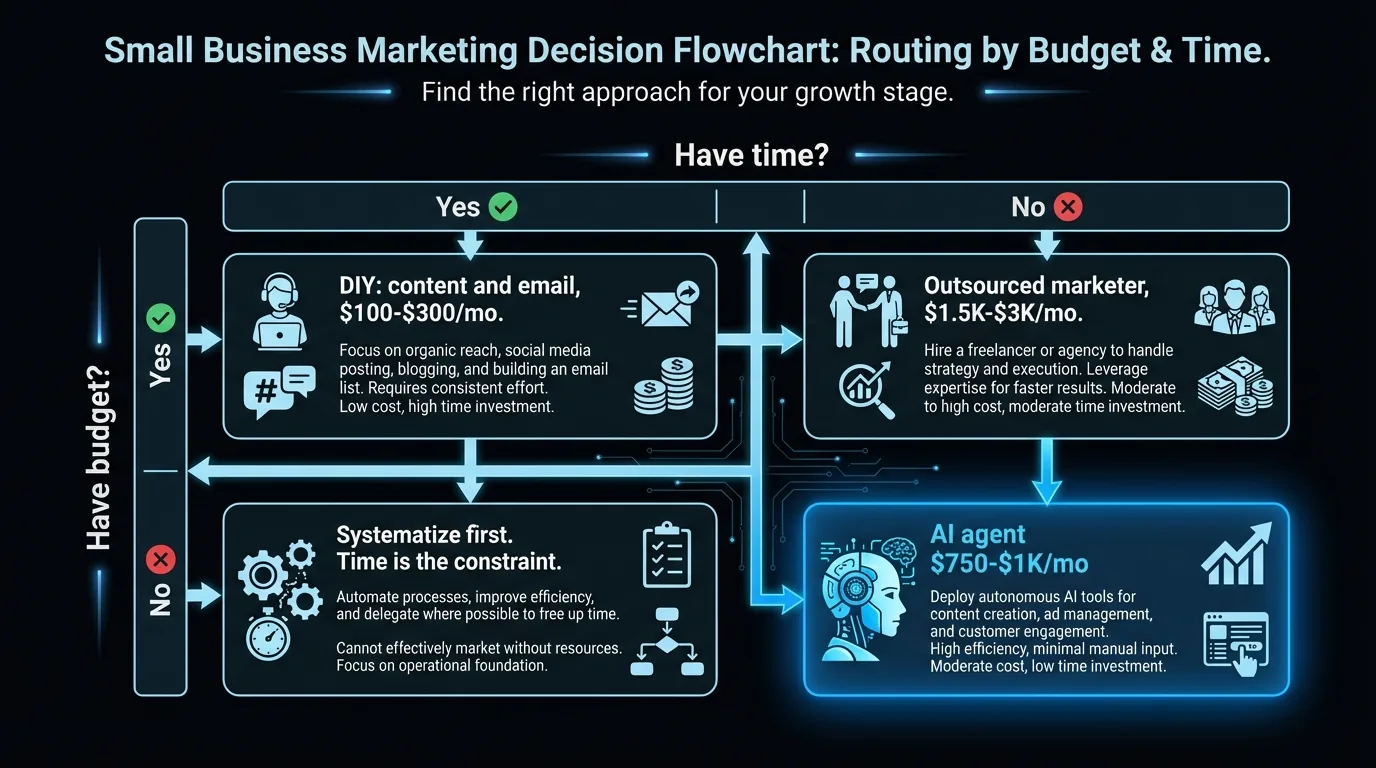
What Consistent Marketing Looks Like in Practice
Elena runs a fitness studio in Portland with 2 part-time instructors and 85 active members. She wants to reach 120 members to justify hiring a third instructor. For the past 18 months, her marketing has run on bursts: she posts on Instagram every day for 2 weeks after a slow month, sends two promotional emails in January, asks for referrals after new clients sign up. The problem is the gap between bursts. When classes are full, marketing stops entirely. By the time membership dips again, momentum is gone and she starts from scratch. She has been stuck between 80 and 95 members for over a year, not because of her offer, but because the marketing only runs when she has time, which is never when she most needs new leads.
Rachel runs a financial planning practice in Seattle. 22 active clients. Wants to grow to 35. Her problem: she markets in bursts. After a slow quarter, she writes 3 emails, posts on LinkedIn every day for a week, and asks for referrals. She gets 2 new clients. Then she gets busy delivering to those clients and marketing drops to zero for 2 months. Repeat.
This boom-and-bust cycle is the most common marketing failure for solo business owners. It is not a discipline problem. It is a systems problem.
Rachel built a minimum marketing system that runs regardless of how busy she is:
- Every Monday: One email to her list of 340 contacts. 20 minutes total. An AI agent drafts a first version from a topic she gives it. She edits for 10 minutes and sends.
- Every quarter: She asks 5 existing clients for a referral using a templated email that takes 3 minutes to personalize. Of her 22 clients, 5 have each referred at least one person.
- Weekly: Her Google Business Profile gets one update automatically. Her AI agent finds a relevant local finance news item and drafts a short post for her review.
Total active marketing time: under 45 minutes per week. Two years after building this system, Rachel has 31 clients. She added 9 clients in 24 months without an agency, without a VA, and without spending more than $900/month on tools.
One financial planning practice we worked with built a 3-channel system (email, LinkedIn, referral) in 6 weeks and added 8 clients in the following quarter. The structure was similar. The pace was faster because it was all they focused on.
The shift is not the tactics. It is from sporadic effort to consistent system. Consistency beats intensity every time.
A copywriter with 280 email subscribers ran the same minimum approach. One email per week for 18 months. By month 18, 60% of new clients cited the weekly email as their first touchpoint with her work.
After working with dozens of service businesses on their marketing systems, the owners who see consistent results are almost never running more tactics. They are running fewer, with a system that keeps going regardless of how busy things get.
The 4 Marketing Mistakes That Keep Small Businesses Stuck
1. Trying to be on every platform.A business owner who maintains a presence on Instagram, LinkedIn, Facebook, and TikTok simultaneously produces weak content on all of them. Algorithm-driven platforms reward consistency and depth. Pick one platform where your clients spend time. Go deep on it for 6 months before adding a second. One platform done well beats four platforms done poorly.
2. Marketing to everyone."Any small business owner who wants to grow" is not a target audience. Narrow positioning feels like leaving money on the table. It does the opposite. A financial planner who positions specifically for dentists who own their practice outperforms a generalist in marketing efficiency by 4 to 6x. Every piece of content, every referral ask, and every ad speaks directly to one person's specific situation.
3. Stopping before it compounds.Content marketing, email, and referral systems take 3 to 6 months before they produce consistent results. Most business owners stop at month 2 because they cannot see the ROI yet. The businesses that win in organic marketing cite the same thing: they kept going when others stopped. The compounding starts slow and then becomes obvious.
One qualification: keeping going only works if the content is genuinely useful to the people you are trying to reach. Publishing mediocre content consistently is not a strategy. Quality is still the filter. The system is what keeps you consistent enough to improve the content over time.
4. Confusing activity with output.Posting daily on LinkedIn is activity. Getting 3 inbound inquiries per month from LinkedIn is output. Track the output metric, not the activity metric. If 6 months of posting produces no inbound inquiries, change the message, the platform, or the offer. Activity without output is not a marketing strategy.
Ready to build a marketing system that runs without you? An AI agent handles follow-up, email drafts, and content distribution on a consistent schedule, every week, regardless of how busy you are. Book a quick call to see what would run automatically in your business.
A Note on AI as Marketing Infrastructure
A category worth understanding: AI agents are not a marketing agency and not a DIY tool. They sit in the middle. They handle the operational layer of marketing: follow-up sequences, lead nurturing, content distribution, and consistency.
The business owner still provides the strategy and the voice. The agent handles the execution volume that no solo operator can maintain week after week.
One honest note on AI writing tools: they produce solid first drafts, but they miss context about your specific clients and what those clients actually care about. Every AI-drafted email or post needs your voice and your specific knowledge layered in before it is ready to send. Business owners who treat raw AI output as finished copy lose the authenticity that makes their marketing work in the first place.
For how this works in practice with marketing specifically, see AI agents for marketing and the marketing agency automation guide.
Marketing Costs: DIY vs Outsourced vs AI-Assisted
Here is the honest cost comparison at the $750 to $3,000 per month range most small businesses operate in:
| Approach | Monthly cost | Active time needed | What you get | Where it breaks |
|---|---|---|---|---|
| DIY (content + email + social) | $100-$300 (tools only) | 8-12 hrs/week | Full control, slow build | Limited by owner's hours |
| Freelance marketer (part-time) | $1,500-$3,000 | 2-3 hrs/week managing | Execution help, variable quality | Hard to manage well at low budgets |
| Agency retainer | $3,000-$8,000 | 3-5 hrs/week managing | Full-service execution | Requires active briefing to avoid generic work |
| AI agent (marketing operations) | $750-$1,000 | 1-2 hrs/week reviewing | 24/7 execution: follow-up, nurture, distribution | Limited to repeatable execution tasks |
The hidden cost in every outsourced option is management time. A freelancer not actively managed delivers inconsistent work. An agency not briefed consistently produces generic work that does not represent the business. AI handles the execution layer: follow-up sequences, content distribution, consistency. The business owner still provides strategy and voice. Part-time marketing freelancers typically charge $1,500 to $3,000 per month depending on specialization and experience level.
Marketing That Works Differently by Business Type
There is no universal playbook. The channels and tactics that work for a service business are different from what works for a local business or a B2B (business-to-business) consultancy.
Coaches and course creatorsThe highest-impact channel is almost always email plus content (YouTube, podcast, or written). Social media builds awareness. Email builds the relationship that converts.
The typical path: content attracts a cold audience. A lead magnet captures their email, an email sequence nurtures over 30 to 90 days, and an offer converts at 1 to 3% of list per launch.
For coaches billing $3,000 to $10,000 per client, the economics are sharp: a list of 500 engaged subscribers typically converts 5 to 15 per launch.
A single email sequence to a list most coaches can build in 12 months can generate $15,000 to $150,000 in revenue.
The mistake coaches make: spending all marketing time on Instagram while neglecting the list. Social platforms own the audience. Your email list is the only marketing asset you fully control.
Local service businesses (plumbers, cleaners, landscapers, contractors)Google Business Profile is the most important marketing asset in this category. 97% of people searching for a local service check Google first. A fully optimized profile with consistent reviews, updated photos, and weekly posts outperforms most paid advertising for local searches.
The second-highest lever: referral systems. A plumber who sends a handwritten thank-you note and a $25 gift card to every customer who refers someone will generate more revenue per dollar spent than any digital campaign. Referrals convert at 3 to 5x the rate of cold leads.
B2B service businesses (consultants, agencies, fractional executives)LinkedIn is the platform. Decision-makers who hire consultants and agencies spend time there, and they make hiring decisions based on demonstrated expertise. Posting 3 times per week on LinkedIn with concrete, opinionated content about your specific area compounds over 12 to 18 months into consistent inbound inquiries.
The constraint: you have to share specific and opinionated content rather than safe and generic content. Generic content gets ignored. Specific content that takes a clear position gets shared.
Who Gets Results Marketing Small Business Without Team
| Business type | Marketing priority | Recommended path |
|---|---|---|
| Service business, 1-5 clients/mo | Referral system + email | DIY, 3-5 hrs/week |
| Retail or local services | Google Business Profile + social | DIY + automation |
| Growing B2B, $250K to $1M revenue | Content + email + paid search | Outsourced or AI-assisted |
| Agency owner | Operations + client reporting automation | Agency automation guide |
What the Solution Actually Looks Like
It is 8 AM on a Tuesday. You have not thought about marketing since Friday. Your agent drafted a weekly email from the topic you flagged two weeks ago. It went out to your list at 7 AM after your 8-minute review. Lead follow-up from the webinar last Thursday ran automatically. Three new contacts are now scheduled for calls. Your Google Business Profile got updated with a relevant news item.
That is a minimum marketing system with a managed AI agent running the execution layer. Not a content calendar you are perpetually behind on. Not a freelancer you need to brief every week. A system that handles the consistent output that turns into leads 6 to 12 months later.
Jejo.ai runs the execution: follow-up sequences, email drafts, content distribution, lead nurturing. At $750/mo, it costs less than a part-time freelance marketer and is available 24 hours a day. You provide the strategy and the final voice. The agent handles everything that requires volume and consistency. See how it compares to other marketing options.
Who This Is For
- Solo operators and small teams who market inconsistently or have let marketing slide during busy periods
- Service businesses billing $100K to $1M per year where inconsistent lead flow is the main growth constraint
- Business owners with $100 to $1,500/month for marketing who want to know which channel to prioritize first
Who This Is NOT For
- Businesses with a dedicated marketing team that needs specialist training rather than a framework for getting started
- Product businesses with high advertising budgets and transactional funnels (e-commerce, retail)
- Businesses under 6 months old without a defined offer or initial client base to draw referrals from
The Bottom Line
The most common small business marketing failure is not a bad strategy. It is inconsistency. The 2-Question Marketing Filter answers the setup question (which path, what budget). Committing to that path for 6 months answers the execution question. Pick one channel, track output (leads generated) not activity (posts published). If execution is the bottleneck, compare AI agents to freelancers and agencies or book a 15-minute call.
FAQ
What is the best marketing help for a small business on a tight budget?
Start with what costs time, not money: Google Business Profile optimization, weekly emails to your existing list, and a simple referral ask to past clients. These three combined generate leads for most service businesses at zero dollar cost.
The email list is the most valuable asset in this set. A list of 200 people who already know and trust you converts better than a social media audience of 2,000 strangers. If you send a useful email every week, a percentage of that list will refer someone, book a call, or buy in any given quarter. The consistency is the strategy. One email per week, every week, compounds over 12 months into a reliable lead source that costs you 20 minutes of time and nothing in cash.
How much does outsourced marketing cost for a small business?
A part-time freelance marketer runs $1,000 to $2,500/mo for 10 to 20 hours per week. A full-service agency runs $2,500 to $8,000/mo for a retainer. Jejo.ai's AI agent handles marketing operations (follow-up, lead nurturing, content distribution) for $750 to $1,000/mo, 24/7.
When should a small business hire a marketing agency?
When you have a proven offer, some revenue, and a specific goal (more leads, more visibility, specific market entry) that requires more execution capacity than you can provide. Agencies require a briefed, managed relationship to work. If you do not have time to manage an agency, explore AI-assisted options first.
The specific signals that you are ready for an agency: you are already generating leads from at least one channel and want to scale that channel, you have a defined budget of at least $3,000/month that you can sustain for 6 months minimum, and you have someone internal (even just you, with 3 to 5 hours per week) to manage the relationship. Agencies without active direction default to generic work. The business owner who does not brief, review, and redirect gets a retainer that produces activity reports, not revenue.
Stop Letting Marketing Fall Through the Cracks
When you're the operator, the salesperson, and the delivery team, marketing is always the first thing to get dropped. An AI agent handles the execution layer: follow-up sequences, content distribution, lead nurturing, and consistency week after week, whether or not you have bandwidth that week. See how an AI agent compares to a marketing agency on cost and what it actually covers.
Book a strategy call to see what an AI agent would handle in your business. Or see the plans to compare options.