Quick answer
- What this covers: Hermes Agent hosting options explained for business owners.
- Who it’s for: People evaluating hermes agent.
Where your AI agent runs matters more than most business owners expect when they start looking at deployments. Hosting determines latency, uptime, maintenance burden, compliance compatibility, and ultimately how much time you spend managing infrastructure vs. managing your business.
This guide covers the three hosting paths for Hermes Agent, what each costs, who each serves, and how to decide without getting lost in technical details you don't need.
Key takeaways:- Managed hosting is the default path for small business. One price, zero infrastructure work, operational within 48 hours
- Cloud self-hosting makes sense for businesses with existing DevOps capacity. Flexible but maintenance-heavy
- On-premise is for regulated industries with strict data residency rules. Highest cost and complexity, specific use cases only
- The hosting decision affects your agent's uptime and your team's time. Pick based on what your business actually needs, not what sounds most sophisticated
- The Three Hosting Paths for Hermes Agent
- Managed Hosting: What You Get for $750/mo
- Cloud Self-Hosting: Flexibility at a Cost
- On-Premise Deployment: When Data Never Leaves
- Hosting Comparison by Business Type
- What Affects Agent Performance Beyond Hosting
- FAQ
The Three Hosting Paths for Hermes Agent
Hermes Agent runs in three environments, each with distinct characteristics.
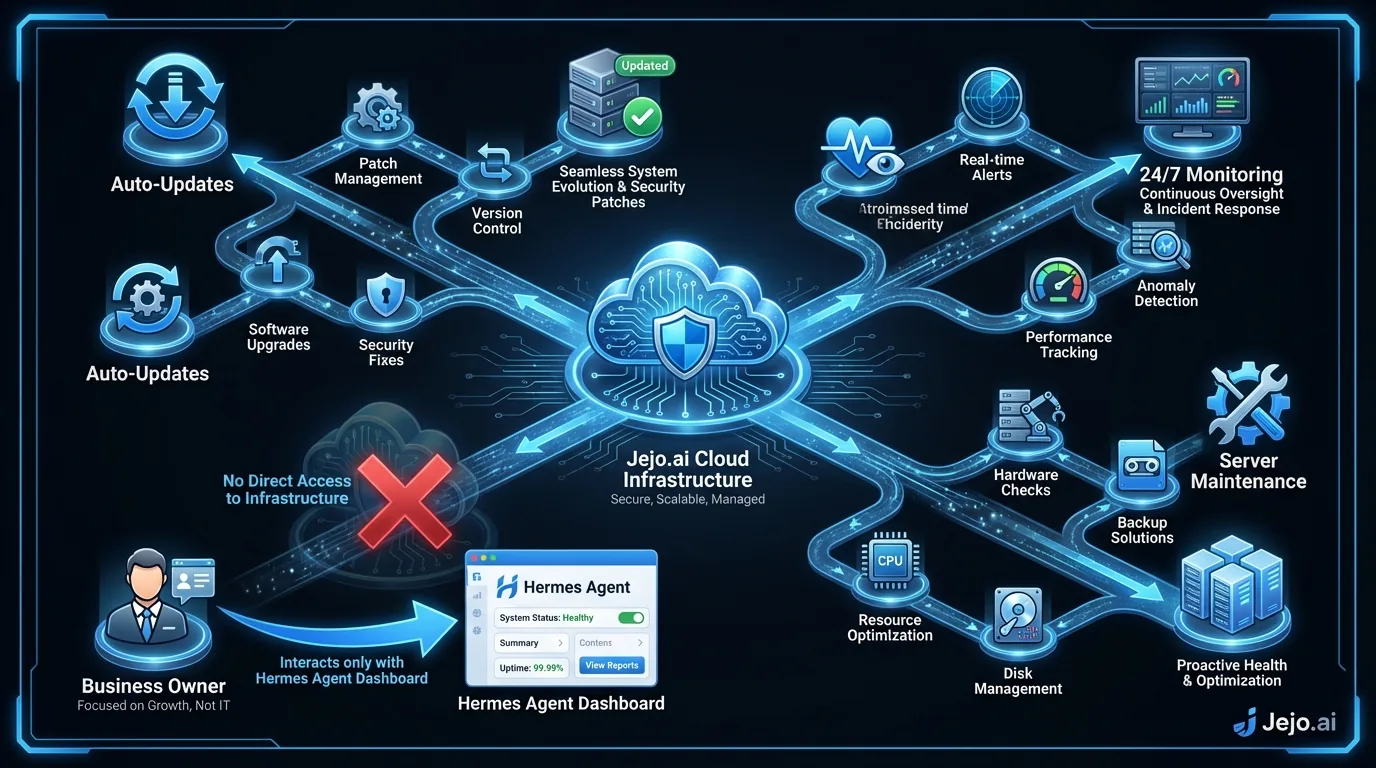
Managed hosting means Jejo.ai runs the infrastructure for you. Your agent lives on Jejo's servers, maintained by their team, with their SLAs, updates, and support. You interact with the agent through the dashboard. No server access required. No DevOps knowledge required. Cloud self-hosting means you run Hermes Agent on a cloud provider you control: AWS, DigitalOcean, Google Cloud, Azure, or similar. You own the server, manage the containers, handle updates, and are responsible for uptime. More flexibility, more responsibility. On-premise deployment means Hermes Agent runs on hardware physically in your location or your company's data center. Maximum data control. Maximum complexity. Reserved for businesses with genuine regulatory requirements around data residency.Most small businesses reading this should stop after the first option. But understanding all three helps you confirm you're making the right choice, not just the default one.
For background on what Hermes Agent does before choosing where to run it, see what is Hermes Agent.
Managed Hosting: What You Get for $750/mo
Managed hosting through Jejo.ai is what "no technical setup required" actually means. Here's the concrete breakdown of what that $750/mo covers.
Infrastructure you don't think about:- Servers running in Jejo's hosting environment with 99.9% uptime SLA
- Automatic failover if a server goes down
- Daily backups of your agent's memory, configuration, and logs
- SSL certificates, maintained and renewed automatically
- Network security and DDoS protection at the infrastructure level
- Version updates applied automatically or with single-click approval
- Integration updates when connected tools (Gmail, HubSpot, Google Calendar) change their APIs
- Security patches at the OS and application layer
- Performance tuning as your usage volume grows
- Account manager for configuration questions and goal setup
- Technical support when integrations fail or behavior seems wrong
- Onboarding support during the first 30 days as the agent calibrates
- Proactive monitoring with alerts if something looks abnormal
That's the managed hosting offer. You pay for operational peace of mind and time you don't spend on servers.
| Managed Hosting: What's Included | Details |
|---|---|
| Uptime SLA | 99.9% |
| Backup frequency | Daily (with point-in-time recovery) |
| Update method | Automatic with change log notification |
| Support access | Account manager + technical support |
| Setup time required from you | 30-minute kickoff call |
| Monthly infrastructure hours from you | 0 |
| LLM API costs | Included in managed price |
The comparison to hiring is stark. A human coordinator needs 2 weeks to onboard, $4,000+ per month fully loaded, and weekends off. The U.S. Bureau of Labor Statistics reports that operations coordinators have a median annual wage of $47,530, which loaded with benefits and overhead reaches $60,000 to $75,000/yr. Managed Hermes Agent is operational in 48 hours, costs $750/mo, and works every night your leads come in after hours.
See the vs hiring comparison for the complete financial breakdown.
Cloud Self-Hosting: Flexibility at a Cost
Cloud self-hosting puts the Hermes Agent Docker container on a cloud server you control. The most common platforms business owners use:
DigitalOcean Droplets. The simplest cloud option. Clean UI, predictable pricing, strong documentation. A production-capable Droplet with 4 GB RAM runs $24/mo. Add a managed database for agent storage at $15/mo and you're at $39/mo in cloud costs before your time. AWS EC2. The industry standard. More configuration options, more complexity. A t3.medium instance (4 GB RAM) runs about $35/mo. AWS has the most mature ecosystem for adding features like auto-scaling and multi-region redundancy if you need them later. Google Cloud Compute Engine or Azure Virtual Machines. Similar pricing and complexity to AWS. Better if you already have accounts and tooling on these platforms. Hetzner (EU-based). Significantly cheaper than US providers for EU-based businesses. A 4 GB server runs about $8/mo. Relevant for businesses with EU data residency concerns. Hetzner is GDPR-compliant with servers physically in Germany and Finland. Under GDPR Article 44, personal data transfers outside the EU require specific legal safeguards, making EU-based hosting the simplest compliance path for European businesses.Raw cloud costs for a self-hosted Hermes Agent: $25 to $80/mo depending on provider and specs. Sounds much cheaper than $750/mo managed. The calculation changes when you add time.
Realistic monthly time commitment for self-hosted cloud maintenance:
- Monitoring container health: 30 min
- Applying updates: 1-2 hrs (monthly)
- Handling integration failures: 2-4 hrs (quarterly, averaged monthly)
- Total average: 2-4 hrs/month ongoing
At an opportunity cost of $150/hr for a business owner, 2 to 4 hours is $300 to $600 of time. Added to $25 to $80 in infrastructure costs: $325 to $680/month. Against $750/mo managed, the gap is $70 to $425/mo. For some businesses with the right technical capacity, that gap justifies self-hosting. For most, it doesn't.
On-Premise Deployment: When Data Never Leaves
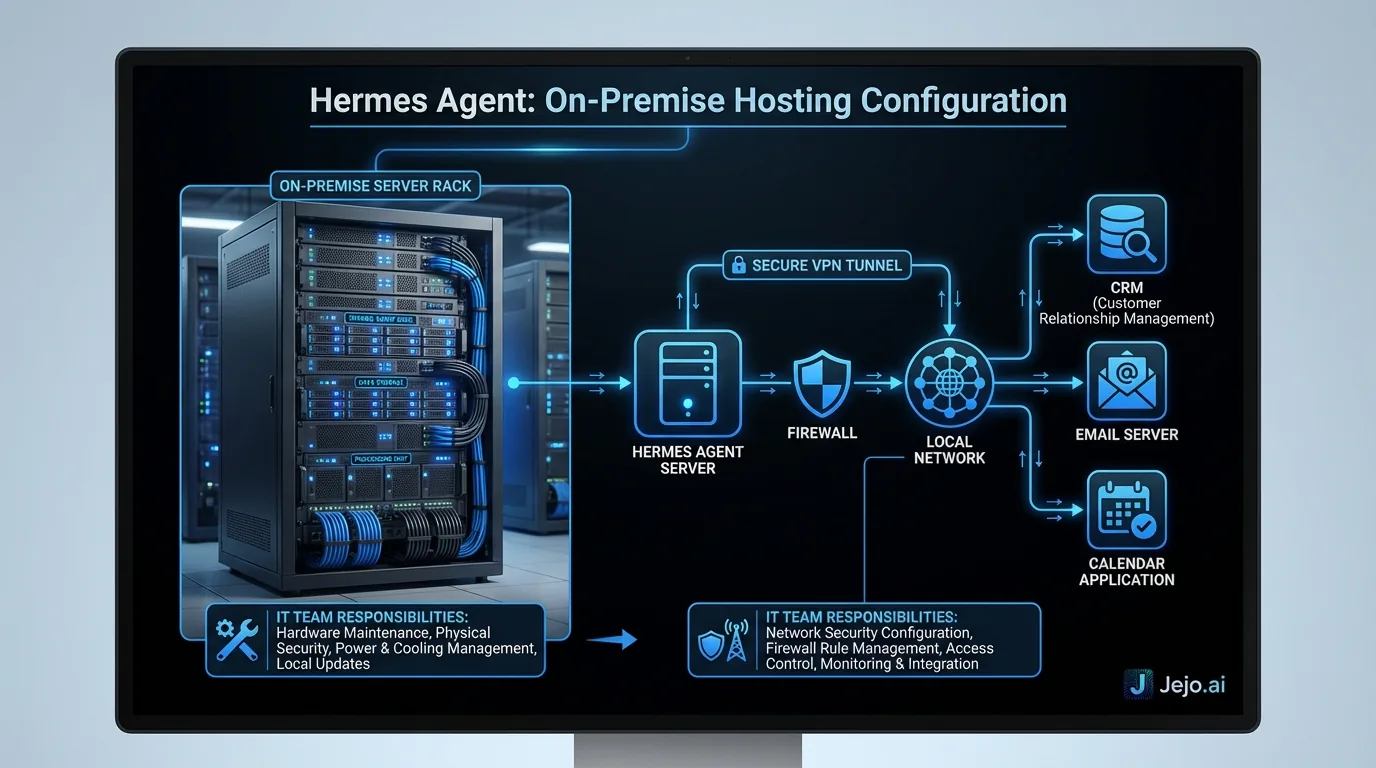
On-premise means Hermes Agent runs on hardware you own in a location you control. A server rack in your office, your company's data center, or a co-location facility.
Who needs this: businesses in healthcare, finance, government supply chain, or other regulated industries where a compliance requirement explicitly prohibits data leaving your physical control. Not businesses that "prefer" more data control. Businesses that have a compliance mandate requiring it.
On-premise deployment costs:
| Cost Category | Range | Notes |
|---|---|---|
| Server hardware | $1,500 to $5,000 one-time | Spec depends on usage volume |
| Co-location or rack space | $100 to $500/mo | If not in your own facility |
| IT labor for setup | $2,000 to $8,000 one-time | Varies by complexity |
| Ongoing maintenance | 5-10 hrs/mo | Updates, monitoring, backups |
| Power and cooling | $50 to $200/mo | If in your facility |
Total first-year cost for on-premise: $5,000 to $20,000. This is not a cost-saving strategy. On-premise costs more than managed. The reason to choose it is compliance, not cost.
One clarification: "on-premise" and "more secure" are not synonyms. A properly managed cloud deployment is typically more secure than an on-premise server maintained by a small business without dedicated security staff. The Verizon Data Breach Investigations Report consistently finds that small businesses are responsible for maintaining basic security hygiene on-premise, and most lack the resources to do it effectively. On-premise addresses data residency requirements, not security requirements.
Hosting Comparison by Business Type
| Business Type | Recommended Hosting | Reason |
|---|---|---|
| Consulting, agencies, professional services (1-20 people) | Managed (Jejo.ai) | No DevOps capacity, highest value per dollar |
| Tech startup with existing DevOps team | Cloud self-hosted | Marginal server cost, team already maintains infra |
| Healthcare practice with HIPAA requirements | On-premise or HIPAA-compliant managed | Compliance mandate |
| EU-based business with GDPR concern | Hetzner self-hosted or EU managed | Data residency |
| Financial services with client data restrictions | On-premise or certified managed | Compliance mandate |
| E-commerce business, 1-5 people | Managed (Jejo.ai) | Speed to deployment, no technical overhead |
The default for a service business with under 20 people and no compliance mandate is managed hosting. That's not marketing convenience. It's because the cost structure favors it: $750/mo vs $400 to $700/mo in actual fully-loaded self-hosting costs, plus the risk of downtime you're responsible for troubleshooting.
What Affects Agent Performance Beyond Hosting
Business owners sometimes focus on hosting when the real performance bottleneck is elsewhere. The hosting decision matters, but these factors matter as much or more:
LLM API latency. Your agent's response speed depends heavily on the underlying language model API. Managed deployments handle this automatically. Self-hosted deployments require you to choose and tune your LLM API connections. Integration quality. How well Hermes connects to your CRM, email, and calendar affects everything the agent does. Poor CRM data means poor lead qualification. A flaky calendar integration means missed scheduling tasks. Hosting doesn't fix bad integrations. Goal clarity. The quality of the goals you set determines what the agent does. A vague goal produces variable results regardless of where the agent is hosted. See how to use Hermes Agent for guidance on setting effective goals. Calibration time. The agent improves during the first 4 to 6 weeks as it learns from your corrections. Faster hardware doesn't accelerate this. Consistent, specific feedback does. Skill configuration. Hermes becomes more capable as you configure skills for specific tasks. A well-configured agent on mid-tier hosting outperforms a poorly configured agent on premium infrastructure. See Hermes Agent skills for how skill configuration works.For a full review of how Hermes performs across these dimensions, see Hermes Agent review. For pricing across all deployment options, see Hermes Agent pricing.
FAQ
What is the default hosting option for Hermes Agent?
Managed hosting through Jejo.ai is the default and most common deployment path. It requires no technical setup, includes infrastructure maintenance, and is operational within 48 hours of your kickoff call. Cost is $750/mo.
Can I move from managed to self-hosted later?
Yes. Your agent configuration, goals, and learned preferences can be exported. Moving to a self-hosted environment requires setting up the infrastructure first, then migrating configuration. It's a one-time technical project, not a seamless switch. Most businesses that start managed stay managed because the operational model works.
Is managed hosting GDPR-compliant?
You'll want to verify current compliance documentation directly with Jejo.ai, as GDPR compliance involves specific data processing agreements, server locations, and retention policies that can change. For EU-based businesses with strict GDPR requirements, asking for the DPA and data residency specifics before committing is standard practice.
What's the minimum server size for self-hosting?
Minimum: 4 GB RAM, 2 CPU cores, 20 GB storage. Production use with moderate volume (100 to 500 interactions per day) works reliably on these specs. Higher volume businesses should use 8 GB RAM and 4 CPU cores. See Hermes Agent Docker for the full technical requirements.
Does hosting location affect how fast the agent responds?
Minimal impact for most businesses. The main latency factor is the LLM API call, not server location. The difference between a server in your city vs one on the other coast is typically under 50 milliseconds per operation, which has no practical effect on agent performance for business operations tasks.
What should I ask before choosing a hosting option?
Three questions worth asking before you decide: Does your industry have compliance requirements around where data is processed? Do you have someone on your team who can maintain infrastructure? And is your time better spent on your business or on server management? Most service businesses answer no, no, and the second option, which points directly to managed hosting. See Hermes Agent pricing to compare the costs.
How long does Hermes Agent take to set up?
With managed hosting through Jejo.ai, the agent is live within 48 hours of your kickoff call. Your time investment is 30 minutes: one call to connect tools and describe your workflows. Self-hosted Docker deployment takes 4 to 8 hours for someone experienced with Linux servers. The 4-week calibration period applies to both paths and is where the agent learns your specific business. See Hermes Agent setup for the step-by-step timeline.