Quick answer
- What this covers: Chatbot vs AI agent: one confirms receipt and waits.
- Who it’s for: Founders and small business owners.
- What it costs: $50-$500/month.
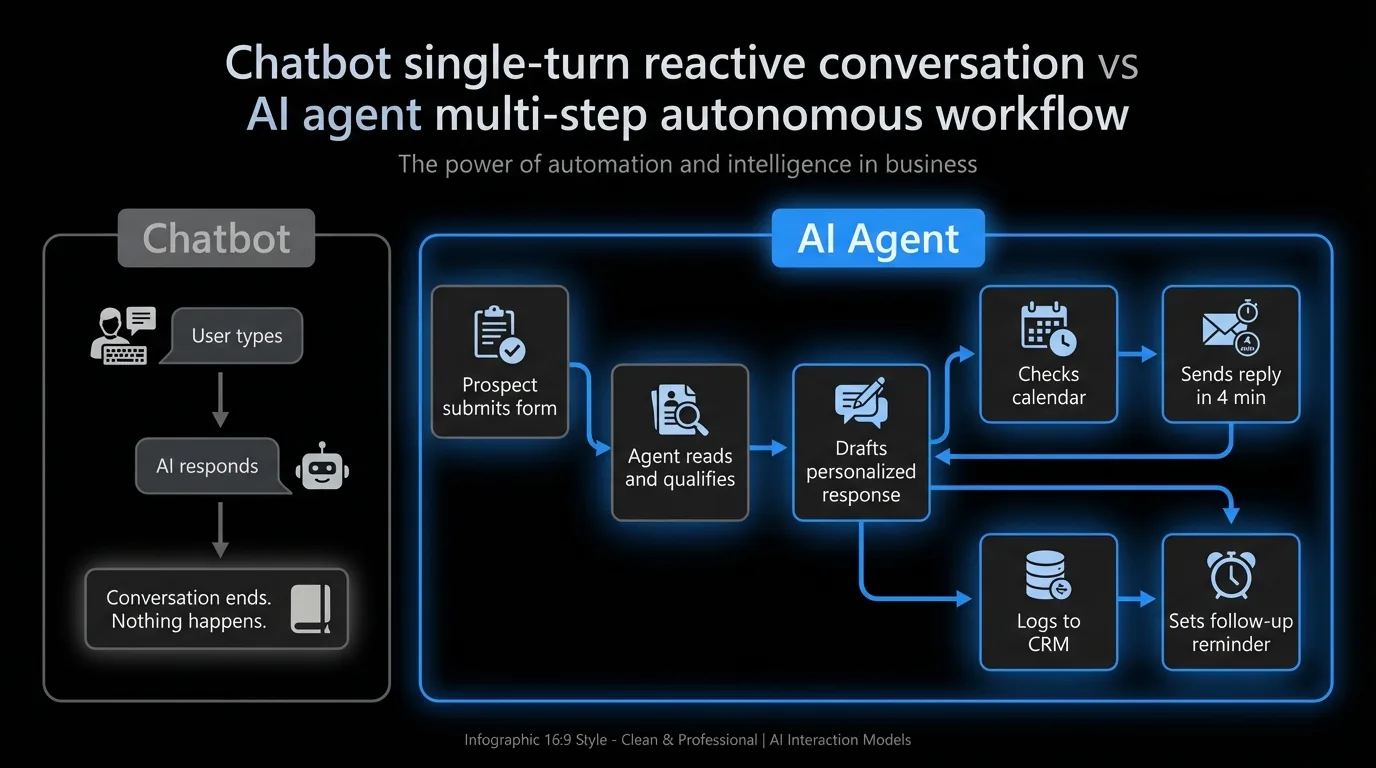
A prospect fills out your contact form at 9 PM. A chatbot confirms receipt and waits for morning. An AI agent reads the inquiry and sends a personalized reply in 4 minutes. That is the chatbot vs AI agent distinction in practice, and this article explains exactly how each works and where each one belongs.
Key takeaways:
- A chatbot waits for input. An AI agent acts while you sleep
- Response speed drives conversion: a 5-minute response rate converts leads 9x better than 30 minutes
- Most products marketed as "AI agents" are advanced chatbots. Test: what does it do when you are not talking to it?
- A managed AI agent handles the full follow-up cycle. A chatbot requires a human to close every loop
- The Wait vs Act Test: chatbots wait for input, agents act without it. Use this to evaluate any tool claiming to be an agent
In this article:
- What a Chatbot Actually Does
- What an AI Agent Actually Does
- Chatbot vs AI Agent: The Core Differences
- What the Difference Looks Like in Practice
- The Confusion in the Market
- The Most Common Chatbot Mistake
- Where AI Agents Make Sense
- FAQ
What a Chatbot Actually Does
A chatbot is a rules-based or language model-based tool designed to respond to inputs within a defined scope.
Rules-based chatbots (most business chatbots you encounter):- Respond based on keyword matching or decision trees
- Can only answer questions their script anticipated
- Break outside their defined scope: "I'm sorry, I don't understand that question."
- Generate conversational responses from a model
- Handle a wider range of inputs
- Still fundamentally reactive: they wait for a prompt and respond
The key characteristic: chatbots wait. They do not do anything until someone types something. When the conversation ends, they do nothing. They have no persistent memory of what happened before unless specifically engineered to remember.
ChatGPT used as a chat interface is a chatbot. You ask, it answers. You close the tab, nothing happens.
For the full picture on how AI fits into small business operations, see the AI for small business guide. For a deep look at what a real AI agent does in a business context, AI agents for small business covers capabilities and cost. And if you're currently relying on ChatGPT and wondering whether an agent would do more, ChatGPT for small business owners maps the distinction clearly.
What an AI Agent Actually Does
An AI agent is designed to take autonomous action toward a goal, not just generate text in response to a prompt.
The defining characteristics:
1. It has access to tools. An agent can send emails, update records, search the web, run calculations, access your calendar, or trigger integrations. A chatbot generates text. An agent does things. 2. It operates autonomously. You give it a goal, not just a prompt. "Monitor my inbox and draft responses to all new leads within 15 minutes." The agent checks your inbox, identifies leads, drafts responses, and sends them for review or sends them outright. No human prompts each step. 3. It retains context over time. A good AI agent knows your clients, your communication style, your pricing, and your history. When a returning client emails you, it does not start from zero. 4. It can chain multiple steps. New client inquiry arrives. The agent checks calendar availability, drafts a response with available times, logs the contact in the customer relationship management system (CRM), and sets a follow-up reminder if no response in 48 hours. That is a multi-step workflow run without human intervention.An AI agent differs from a chatbot by taking autonomous action without requiring a human prompt. When a prospect submits a contact form at 9 PM, a chatbot sends an automated confirmation and waits. An AI agent reads the inquiry, qualifies the lead, checks calendar availability, drafts a personalized response, sends it within 4 minutes, logs the contact in the CRM, and sets a follow-up reminder. Based on patterns we've seen across service businesses, a 5-minute response rate converts leads 9x better than a 30-minute response.
Chatbot vs AI Agent: The Core Differences
| Factor | Chatbot | AI Agent |
|---|---|---|
| Mode | Reactive (waits for input) | Proactive (initiates and executes) |
| Memory | Session-only (forgets after chat) | Persistent (retains business context) |
| Tool access | Usually none | Email, calendar, CRM, web, APIs |
| Action capability | Generates responses | Executes multi-step workflows |
| Autonomy | Zero autonomy | Acts toward goals without prompting |
| Monitoring | Does not monitor | Can watch inboxes, deadlines, triggers |
| Best use case | FAQ answering, basic triage | Operations, follow-up, proactive work |
What the Difference Looks Like in Practice
Same scenario. Two different tools. Dramatically different outcomes.
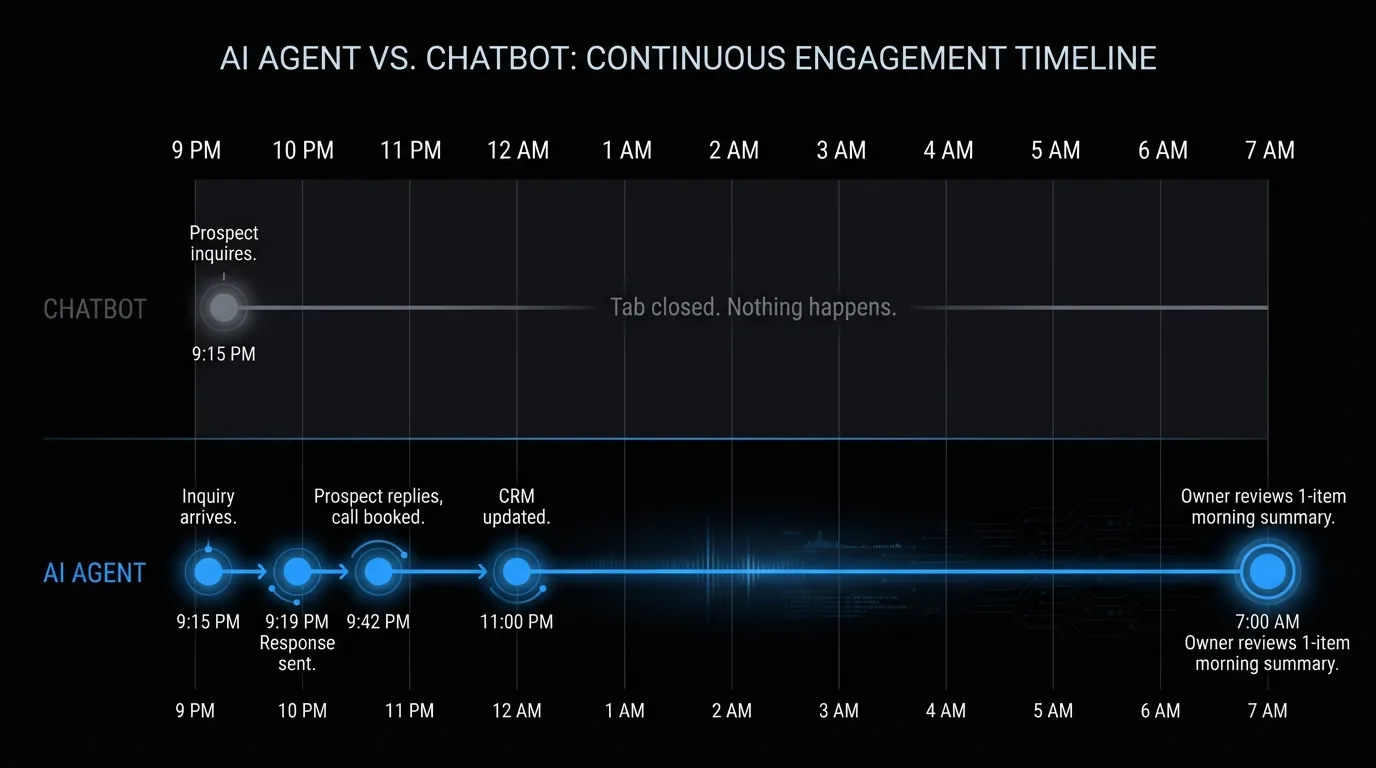
The scenario: A prospect fills out the contact form on your website at 9:15 PM on a Thursday. They are comparing 3 vendors and want to make a decision by Friday. They ask about pricing, availability, and whether you have worked with their industry. With a chatbot:The form triggers an automated confirmation email: "Thanks for reaching out. We will get back to you within 1 business day." No further action. The message sits unread until the owner opens their inbox Friday morning at 8:30 AM. They draft a reply and send it by 9:00 AM. The prospect had already chosen one of the other vendors at 7:30 AM.
Response time: 11+ hours. Outcome: lost deal. For a professional services firm where an average engagement is worth $3,000 to $8,000, that is one deal lost because the inbox was not watched overnight.
With an AI agent:The form submission arrives at 9:15 PM. Within 4 minutes, the agent has read the inquiry and checked whether the prospect's industry matches past work (it does: 3 relevant client examples exist). It found 2 open calendar slots, drafted a personalized response, and sent it. It logged the contact in the CRM, set a 24-hour follow-up reminder if no reply, and flagged the opportunity in the owner's morning review.
Response time: 4 minutes. The prospect replies at 9:42 PM to book the Friday call.
Outcome: meeting booked.
In our experience deploying AI agents across service businesses, the single biggest conversion improvement comes from the first response. Leads that get a personalized, contextual reply within 5 minutes convert at a fundamentally different rate than leads that wait until the next business day. The gap compounds across every lead that arrives outside business hours.
A B2B (business-to-business) consultancy tracked lost leads for one quarter before switching to an AI agent. They found 4 leads per month falling through between form submission and first working-hours response. The agent closed the gap. Booked discovery calls increased 35% from the same lead volume.
A B2B consultancy tracking lead response data found 4 leads per month falling through the gap between form submission and first working-hours response. After deploying an AI agent with a 4-minute response time, booked discovery calls increased by 35% from the same lead volume. The prospect at 9:15 PM booked at 9:42 PM that same night. Without the agent, that deal was lost before the business owner woke up. Consistent response speed on after-hours leads is the highest-ROI (return on investment) operational change for most service businesses.
The gap is not about response quality. It is about who closes the loop. A chatbot requires a human to complete the cycle. An agent closes it without one.
The Confusion in the Market
A lot of products marketed as "AI agents" are advanced chatbots. They have a better UI, maybe some memory features, maybe a few integrations. But if the fundamental operation is "user types, AI responds," it is a chatbot with better packaging.
True AI agents are characterized by what they do when you are NOT in the conversation. When you are asleep. When you are in a meeting. When a prospect fills out your contact form at 2 AM on a Sunday.
This is The Wait vs Act Test: a practical filter for any AI tool claiming to be an agent. Tools that wait for input are chatbots. Tools that act without input are agents.
Ask this question: "What does it do when I'm not talking to it?"
If the answer is nothing, it is a chatbot. If the answer is "it monitors X, takes action Y, and notifies you only when Z happens," it is an agent.
Chatbot vs AI Agent: Where Each One Makes Sense
Chatbots are not bad. They are the right tool for specific jobs.
Good chatbot use cases:- Website FAQ answering (hours, pricing, basic policies)
- First-line customer support triage
- Lead qualification forms with branching logic
- Internal knowledge base search
Basic chatbot tools for websites cost $0 to $50 per month. For FAQ answering and basic triage, that is often the right investment and a genuine improvement over nothing. Not every business needs a full AI agent. If your leads are simple, questions are predictable, and volume is low, a basic chatbot covers the FAQ layer at a fraction of the cost. A managed AI agent runs $750 to $1,000 per month. That cost difference is justified when the work the agent handles, lead qualification, follow-up, CRM logging, and multi-step sequences, would otherwise cost a part-time hire or result in lost revenue from slow response.
If someone visits your website at midnight and wants to know your refund policy, a chatbot handles that well. It does not require memory, tool access, or proactive behavior. It just needs to respond accurately to a known question.
The mistake is buying a chatbot and expecting it to handle operations that require judgment, context, and action.
The Most Common Chatbot Mistake
The mistake is not buying a chatbot. The mistake is buying a chatbot to do a job that requires an agent.
Here is what that looks like:
What business owners expect: "I will install a chatbot on my website. It will handle customer questions 24/7. I will not have to be available around the clock." What actually happens: The chatbot handles the questions it was programmed for: pricing, hours, basic policies. Anything outside that scope gets "I'm sorry, I don't have that information. Would you like to speak with someone?"Then nothing. Because there is no one available. The query logs. The prospect waits.
In a market where response speed drives conversion, that gap is expensive.
Speed alone is not the full answer. A generic, clearly templated reply at 4 minutes can lose credibility faster than a thoughtful, personalized reply at 2 hours. The research on response time assumes the fast response is also a contextual, relevant one. An AI agent that has been onboarded on your business sends a specific response. A basic automation sends the same reply to everyone.
The specific jobs a chatbot should not be hired to do:- Following up with leads after initial contact
- Managing multi-step sequences (quote, schedule, onboard, deliver)
- Sending alerts when something needs human attention
- Tracking whether a proposal was opened and following up at Day 3
- Managing recurring client communication with persistent context about prior interactions
These jobs require memory, tool access, and proactive behavior. Chatbots have none of these. Businesses that plug a chatbot into these workflows get poor results, blame AI, and conclude "AI doesn't work for my business." The tool was wrong for the job.
The right model: chatbots for public-facing FAQ on your website. AI agents for everything that happens after someone raises their hand.
Using a chatbot for work that needs an agent? If you are losing leads after hours or relying on manual follow-up, a managed AI agent closes those gaps automatically. Book a quick call to map out what the agent would handle in your business.
Where AI Agents Make Sense
AI agents earn their value in operational tasks with three characteristics: they happen repeatedly, they require context about your business, and they have a cost to doing them late or not at all.
Strong AI agent use cases:- Lead follow-up (speed matters: a 5-minute response rate increases conversion by 9x)
- Client onboarding (multi-step process with consistent requirements)
- Inbox monitoring and triage
- Weekly reporting from multiple data sources
- Meeting prep based on CRM history
- Proactive deadline and invoice follow-up
The pattern: anything where you want something to happen without being asked to make it happen.
One honest limitation: AI agents handle the repeatable parts of these workflows extremely well. Situations outside the documented parameters still need a human. A prospect writing in a language your business does not operate in, a complaint from a long-term client with complicated history, or a question the agent was never briefed on gets flagged for human review rather than handled. That flagging behavior is intentional. The agent handles the volume. Exceptions still land on a person's desk.
For industry-specific applications, see AI tools for consultants as an example of how agents handle operations in a service business context.
How the Chatbot vs Agent Distinction Plays Out by Industry
Different business types feel the gap differently. Here is how it shows up in three common scenarios.
Real estate agentsA chatbot on a real estate website handles "what homes do you have listed?" and "what are your office hours?" Those are useful. But leads arrive outside business hours, ask specific questions about specific properties, and response speed is the single biggest conversion driver (MIT research shows leads contacted within 5 minutes convert at 21x the rate of leads contacted after 30 minutes).
A chatbot answers FAQ. An agent follows up with every new lead within 5 minutes, qualifies their timeline and budget, and books the discovery call automatically. The agent wakes up to a calendar with booked appointments instead of an inbox with unread leads.
Accountants and bookkeepersA chatbot handles "do you work with small businesses?" and "what are your fees?" An agent monitors for late documents from clients (the most common source of missed deadlines), sends automated reminders at Day 3 and Day 7, logs responses, and flags non-responsive clients for direct follow-up. It handles intake scheduling, proposal follow-up, and the recurring communication most accountants do manually. The accountant's time goes to the work, not the administration around the work.
Coaches and consultantsA chatbot answers intake questions from a contact form.
An agent manages the full pre-client journey: initial response within minutes, discovery call scheduling, pre-call questionnaire delivery and follow-up if not completed, proposal send, and follow-up at Day 3 if the proposal has been opened but not signed.
A typical consultant loses 3 to 5 leads per month from inconsistent manual follow-up. An agent closes those gaps every time. At $2,000 to $5,000 per client engagement, 4 missed leads per month is $8,000 to $20,000 in potential revenue leaving the table annually, simply because no one was watching the inbox after hours.
The DIY Middle Ground: ChatGPT Plus Zapier
Many small business owners try to build agent-like behavior by connecting ChatGPT to Zapier. A Zap fires when a form is submitted, feeds the data to ChatGPT via a webhook, and uses the response to send an email. Functional. Fragile.
The limitation: ChatGPT has no persistent memory of your business across Zap runs. Every trigger starts from zero. Without engineering a memory layer, you get generic responses that do not reflect your client history, your voice, or your specific context.
It is a chatbot wearing automation clothes.
See the full comparison: DIY AI tools vs. a managed AI agent.
What to Ask Before Buying Either
Before committing to any AI product, run through these questions:
- Is this tool reactive or proactive?
- Does it retain memory between sessions? What does it remember?
- Can it take actions (send, update, schedule, notify) or only generate text?
- What happens when I'm not in the conversation?
- What does the onboarding look like? Does it learn my business or start generic?
A chatbot answers question 1 as reactive, questions 3-4 as no. An AI agent answers differently.
What a Managed AI Agent Does Differently
The chatbot vs. AI agent distinction matters. But the category most business owners are actually looking for is below both: a managed service that deploys and operates the agent for you.
A DIY AI agent built on Zapier and ChatGPT has the same core limitation as a chatbot: it requires you to engineer the context layer. Without persistent memory of your business, your clients, and your history, every automated response starts generic. A managed AI agent comes pre-onboarded to your business. It knows your clients by name, knows which proposals are open, knows your communication style, and acts accordingly.
The 10-hour onboarding that Jejo.ai runs is the difference between an automation and an employee. The agent that comes out the other side handles the full pre-client and ongoing-client journey: initial inquiry response within minutes, multi-step follow-up, CRM logging, proposal tracking, and proactive deadline management. At $750/mo, it sits between a chatbot tool and a part-time hire, with the behavior of neither. See how it works.
Who This Is For
- Service businesses with a lead intake process (consultants, coaches, real estate agents, accountants) where response speed directly affects conversion
- Business owners currently using a chatbot or basic automation who suspect they are missing leads outside business hours
- Any small business considering its first AI investment and unsure whether a chatbot or an agent is the right starting point
Who This Is NOT For
- E-commerce or retail businesses where FAQ chatbots are the correct tool and agents are overkill for the use case
- Businesses with fewer than 100 leads per month where manual follow-up is feasible and a full agent is not cost-justified
- Businesses that already have a staffed, real-time response function where the agent's core value (speed outside business hours) is already covered
The Bottom Line
The Wait vs Act Test draws the line clearly: a chatbot answers questions and stops. An AI agent closes loops and keeps going. For businesses where response speed drives conversion, a chatbot leaves money on the table every time a lead arrives outside business hours. See the full comparison of DIY AI tools vs. a managed agent or explore Jejo.ai pricing.
FAQ
Can a chatbot become an AI agent?
Some products add agent-like features to chatbot interfaces: memory, tool integrations, scheduled actions. The line between an advanced chatbot and a lightweight agent is blurring. The Wait vs Act Test still applies regardless of how the product is marketed: what does it do without your input? If the answer is nothing meaningful, it is a chatbot regardless of the label.
Is ChatGPT a chatbot or an AI agent?
ChatGPT in its standard form is a chatbot. It waits for your input, generates a response, and does nothing else. OpenAI's "Operator" features and custom GPTs with action integrations move toward agent behavior, but the core product is reactive. You must prompt it. It cannot monitor, initiate, or take multi-step action autonomously.
How much more expensive are AI agents than chatbots?
Chatbots range from free (basic website bots) to $50-$500/month for enterprise platforms. AI agents are priced as managed services because of the onboarding and setup required: typically $500-$2,000/month. The right comparison is not chatbot price vs. agent price but rather: what does the task cost when done by a human, and what would the agent replace?
Can an AI agent handle customer service?
Yes, for the operational layer: triage, routing, drafting responses, escalation triggers. AI agents are not suited for high-stakes emotional situations requiring human empathy. The right model: agent handles 80% of incoming contacts automatically, flags the 20% that need a human.
The 80% that an agent handles well: information requests, scheduling, status updates, routine follow-up, document delivery, intake forms, and appointment confirmations. The 20% that needs a human: complaints from high-value clients, complex disputes, situations requiring negotiation, and any contact where the emotional stakes are high enough that a scripted or templated response would make things worse. The agent's job in the 20% is not to handle the situation but to get it in front of a human immediately with full context attached.
Still using a chatbot for work that needs an agent?
See what a proactive AI agent handles differently: DIY AI vs. managed agent. Or explore pricing for a Jejo.ai agent built around your business.