Quick answer
- What this covers: Compare OpenClaw alternatives for 2026.
- Who it’s for: People evaluating openclaw.
OpenClaw exploded from obscurity to 90,500 monthly searches in 60 days. It's the most talked-about AI agent framework right now. But it's not the only option. Gartner's 2025 Hype Cycle for AI placed AI agents among the top technology priorities for businesses of all sizes, noting that the category was moving from experimental to production-ready faster than most previous enterprise software transitions.
If you're comparing OpenClaw alternatives, you need to know what's actually out there, what each option does well, and what tradeoffs you're making. This is the honest comparison, written for business owners, not developers.
The 5 Categories of AI Agent Platforms
Every OpenClaw alternative falls into one of these buckets.
| Category | What It Is | Examples | Best For |
|---|---|---|---|
| Open-source frameworks | Free code you self-host | OpenClaw, AutoGPT, CrewAI, LangGraph | Technical teams wanting control |
| No-code agent builders | Drag-and-drop agent creation | Relevance AI, AgentGPT, Botpress | Non-technical owners, simple workflows |
| Enterprise platforms | Full-stack AI deployment | Microsoft Copilot Studio, Salesforce Einstein | Large companies, 50+ employees |
| Managed agent services | Done-for-you deployment | Jejo.ai, boutique AI agencies | Business owners wanting results, not projects |
| Traditional automation | Rule-based task execution | Zapier, Make, n8n | Simple if-then workflows, no AI needed |
Most business owners shopping for OpenClaw alternatives actually want the managed service category. They want the result (an AI employee handling admin work 24/7) without the project (server setup, configuration, debugging).
Head-to-Head Comparison
OpenClaw vs. AutoGPT
AutoGPT was the first viral AI agent framework. It put "autonomous AI agents" on the map in 2023. Three years later, here's where it stands.
| Factor | OpenClaw | AutoGPT |
|---|---|---|
| Monthly searches | 90,500 (growing) | 12,000 (declining) |
| Active agencies deploying it | 176 | ~30 |
| Skill marketplace | 400+ pre-built skills | Limited |
| Business focus | Strong (dashboard, integrations) | Weak (developer-oriented) |
| Setup difficulty | Moderate | High |
| Community momentum | Accelerating | Slowing |
OpenClaw vs. CrewAI
CrewAI lets you build teams of AI agents that collaborate on tasks. Instead of one agent handling everything, you deploy multiple specialists.
| Factor | OpenClaw | CrewAI |
|---|---|---|
| Agent model | Single agent, multiple skills | Multiple agents, role-based |
| Setup complexity | Moderate | High |
| Best use case | Business operations (email, CRM, scheduling) | Complex multi-step projects |
| Non-technical friendliness | Moderate (dashboard) | Low (code required) |
| Hosting cost | $50-$200/mo | $75-$300/mo (more compute needed) |
OpenClaw vs. No-Code Builders (Relevance AI, AgentGPT)
No-code builders let you create agents by clicking, not coding. Appealing on the surface.
| Factor | OpenClaw | No-Code Builders |
|---|---|---|
| Setup time | 4-15 hours (self-hosted) | 1-2 hours |
| Customization depth | Deep (any workflow) | Shallow (within templates) |
| Scaling cost | Flat ($50-$200/mo hosting) | Usage-based (can spike) |
| Agent autonomy | High (24/7, multi-task) | Medium (limited complexity) |
| Vendor lock-in | None (open-source) | High (proprietary platform) |
| Data control | Full (self-hosted) | Limited (their servers) |
OpenClaw vs. Enterprise Platforms (Copilot Studio, Einstein)
Microsoft and Salesforce both offer AI agent capabilities within their ecosystems.
| Factor | OpenClaw | Enterprise Platforms |
|---|---|---|
| Monthly cost | $50-$750 | $2,000-$10,000+ |
| Setup time | Hours to days | Weeks to months |
| Ecosystem lock-in | None | Heavy (Microsoft/Salesforce stack) |
| Customization | Unlimited | Within platform limits |
| Support | Community or managed service | Enterprise support included |
| Target size | 1-50 employees | 50-10,000 employees |
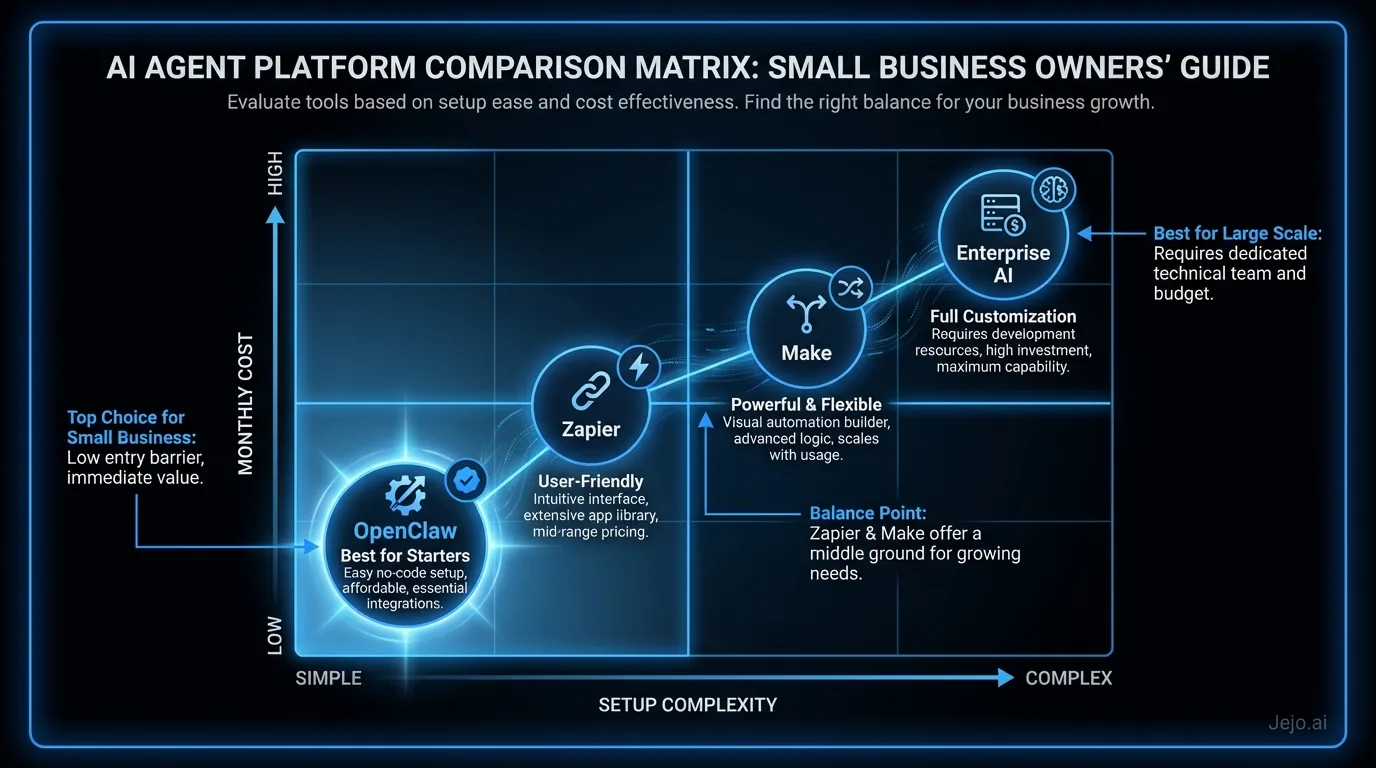
OpenClaw vs. Traditional Automation (Zapier, Make)
This comparison comes up constantly. It shouldn't. They're fundamentally different tools.
| Factor | OpenClaw | Zapier/Make |
|---|---|---|
| Intelligence | AI-based decisions | Rule-based (if X then Y) |
| Adaptability | Learns from corrections | Fixed rules only |
| Ambiguity handling | Interprets context | Breaks on unexpected input |
| Monthly cost | $50-$750 | $20-$150 |
| Complexity handling | Multi-step, judgment calls | Simple data movement |
| Setup | Moderate to high | Low |
The Managed Service Alternative
Here's what most comparison articles won't tell you: the real alternative to OpenClaw isn't another framework. It's having someone deploy OpenClaw for you.
176 agencies generate $327K per month deploying OpenClaw for businesses. That market exists because the gap between "OpenClaw can do amazing things" and "I can make OpenClaw do amazing things" is significant for non-technical owners.
Jejo.ai is one of these managed services. Same OpenClaw technology. No self-hosting. No Docker. No server management. $750 per month for a fully deployed, managed AI agent with skills configured for your business.The comparison that matters for most business owners isn't OpenClaw vs. CrewAI. It's "do I want to manage AI infrastructure, or do I want an AI employee that works on day 1?"
What Business Owners Actually Switch From
Based on patterns from 176 OpenClaw agency deployments, here's what businesses used before switching to OpenClaw and why they moved.
| Previous Setup | Why They Switched | Time to OpenClaw ROI |
|---|---|---|
| ChatGPT Pro ($200/mo) | Couldn't act autonomously, required constant prompting | 7 days |
| Virtual assistant ($1,500-$4,000/mo) | Too expensive for the hours covered, inconsistent quality | 14 days (immediate cost savings) |
| Zapier + manual work | Hit complexity ceiling, couldn't handle judgment calls | 14 days |
| Another AI agent framework | Lacked skill marketplace, poor business tooling | 7 days (already trained on concept) |
| Doing everything manually | Burnout, 60+ hour weeks, dropping balls | 5 days |
The most common switch: ChatGPT Pro users who realized there's a fundamental gap between "AI that generates text when asked" and "AI that works while you sleep." ChatGPT is a talented intern who only works when you're watching. OpenClaw is an employee who runs the office at 3 AM.
The second most common: VA users who did the math. A good VA at $2,500 per month works 80 hours. An OpenClaw agent at $750 per month works 720 hours. The VA is still valuable for relationship-heavy work, but the 80% of tasks that are pure operations? The agent handles those at 70% less cost with higher consistency.
New Entrants in 2026
The AI agent space has attracted new competitors since late 2025. Here's what's worth watching.
LangGraph (by LangChain): A graph-based agent framework that handles complex branching workflows better than most alternatives. Strong for businesses with workflows that have many conditional paths. Developer-focused, no business dashboard. Best for teams with senior engineers. Monthly cost is comparable to OpenClaw self-hosted. Botpress 3.0: A major update to an existing chatbot platform added autonomous agent capabilities. The upgrade narrows the gap with OpenClaw for customer support use cases. Still weaker on CRM, email, and financial integrations. Easier to set up, less powerful overall. n8n with AI nodes: The open-source automation platform added native AI decision nodes in 2025. It's not a purpose-built agent framework, but for businesses already running n8n workflows, the AI nodes reduce the need for a separate agent tool. Works well for businesses with 3 or fewer automated workflows that need occasional AI judgment. Breaks down for complex multi-skill agents. Verdict on new entrants: None have displaced OpenClaw for small business operations. LangGraph is more powerful but requires deeper engineering talent. Botpress and n8n with AI are easier but less capable. The gap between OpenClaw and the next-best option for a 1 to 20-person business has actually widened in 2026 as OpenClaw's skill marketplace grew and its agency ecosystem matured.Migration Paths Between Platforms
Switching AI agent platforms isn't trivial, but it's not catastrophic either. Here's what migration looks like from the most common starting points.
From Zapier to OpenClaw: Your Zapier workflows become configuration inputs for OpenClaw skills. The logic transfers; the execution platform changes. Simple triggers (form submission creates CRM contact) can be retired entirely since the OpenClaw agent handles both the trigger and the action with better context. Complex Zapier workflows that involve multiple steps and tools usually map cleanly to OpenClaw skill configurations. Expect 4 to 8 hours of migration work for a typical Zapier setup with 10 to 20 active zaps. From a no-code AI builder to OpenClaw: Export your agent configuration data if the platform allows it. Most proprietary agent builders don't offer clean export, so you'll recreate your workflow logic manually. If you've been using the platform for under 6 months, the migration is straightforward because there isn't much accumulated configuration to rebuild. The harder part is the learning curve: no-code builders abstract away concepts (like escalation rules and skill parameters) that you'll need to configure directly in OpenClaw. From another open-source framework to OpenClaw: This is the cleanest migration. If you're coming from AutoGPT or a LangChain-based setup, your business logic (rules, workflows, integrations) can be ported with developer help. The agent's memory and learning history usually can't transfer, so you restart the training period. Budget 2 to 4 weeks to get back to the accuracy level your previous agent had achieved. From a VA to OpenClaw: This isn't a technical migration; it's a workflow transition. Document every repeatable task your VA handles. Harvard Business Review's analysis of automation and workforce transitions recommends documenting workflows before automating them, noting that the documentation process itself often surfaces inefficiencies that improve outcomes regardless of the technology used. Match each to an OpenClaw skill. Set your escalation rules to mirror what you previously asked your VA to escalate. Run OpenClaw for 2 to 3 weeks before reducing VA hours, so the agent is trained before it's carrying full load.Total Cost of Ownership Over 3 Years
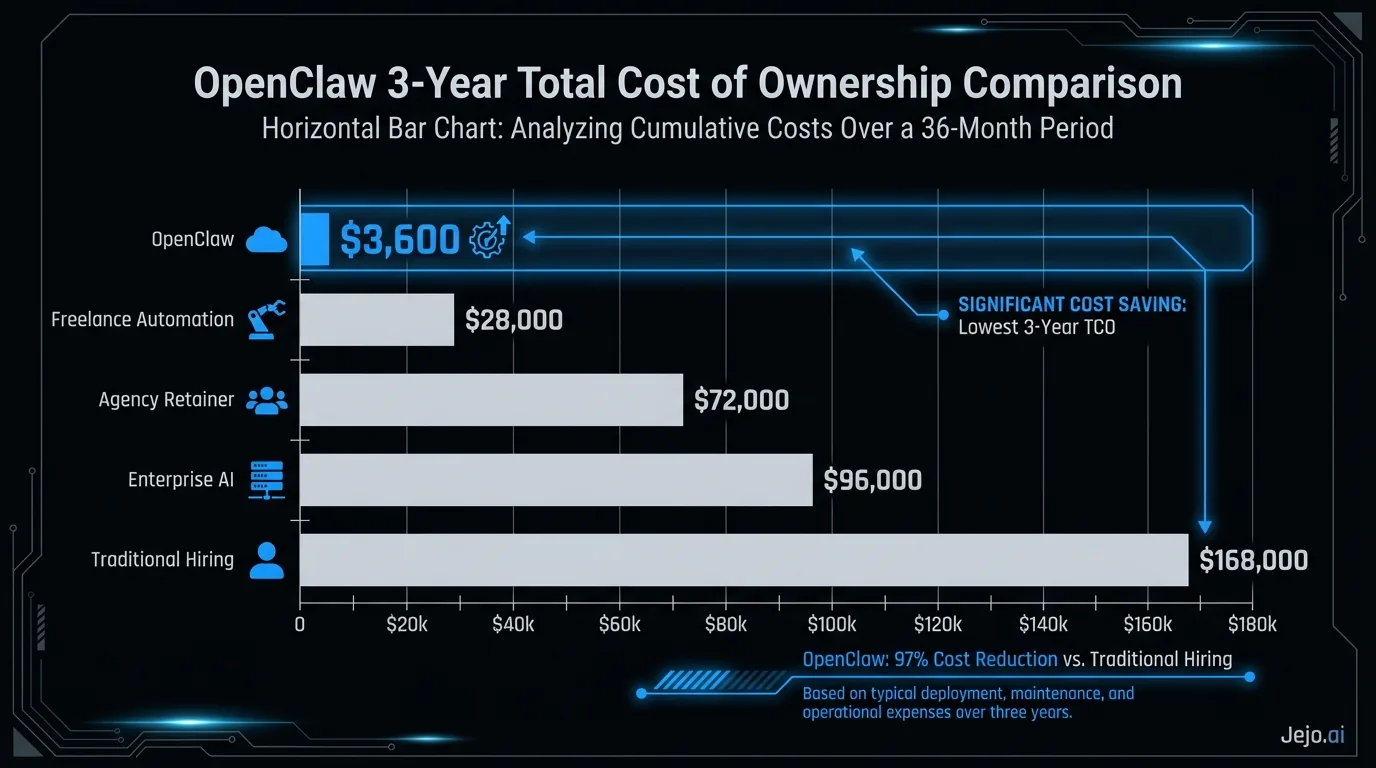
Most comparisons show 1-month snapshots. Here's what the decision looks like over 3 years, factoring in all costs.
| Platform | Year 1 | Year 2 | Year 3 | 3-Year Total |
|---|---|---|---|---|
| OpenClaw (self-hosted DIY) | $2,400-$6,000 | $1,200-$3,600 | $1,200-$3,600 | $4,800-$13,200 |
| OpenClaw (managed) | $9,000 | $9,000 | $9,000 | $27,000 |
| No-code builder (mid-tier) | $3,600-$6,000 | $3,600-$6,000 | $3,600-$6,000 | $10,800-$18,000 |
| Enterprise platform | $24,000+ | $24,000+ | $24,000+ | $72,000+ |
| Virtual assistant | $18,000-$48,000 | $18,000-$48,000 | $18,000-$48,000 | $54,000-$144,000 |
The self-hosted OpenClaw path delivers the lowest total cost of ownership for businesses that invest in the technical setup. No-code builders occupy a middle ground, cheaper than managed services but significantly more limited in capability. Enterprise platforms are only justified at scale where their integration depth and compliance features create genuine value.
What the table doesn't capture: the value recovered. A VA handles 80 hours per month. An OpenClaw agent handles 720 hours. Even at higher cost, the output differential often makes the agent the better investment when you count what gets done, not what gets spent. McKinsey's analysis of automation economics argues that total cost of ownership comparisons for AI tools should weight output capacity, not just input cost, since the throughput gap between human and automated workers compounds significantly over time.
The Build-vs-Buy Decision
This is the real question behind "OpenClaw alternatives." You're not comparing platforms. You're deciding between building your own AI capability or buying it from someone else.
Build (self-hosted OpenClaw): You invest time and technical resources upfront. You control everything. Long-term costs are lower. But you're adding "AI infrastructure management" to your responsibilities. For a business owner already wearing 3 to 5 hats, this is hat number 6. Buy (managed service): You pay a premium for someone else's expertise. Your agent works in days, not weeks. You spend zero time on infrastructure. The tradeoff: higher monthly cost and less customization control. The 80/20 rule applies here. 80% of businesses should buy. The 20% with technical resources should build. If you're reading an article titled "OpenClaw alternatives," you're probably in the 80%.How to Decide
Choose OpenClaw (self-hosted) if:- You have technical staff
- Data sovereignty is critical
- You want maximum customization
- Budget is under $500 per month
- You need 1 to 2 simple automations
- You want to start in under an hour
- Your workflows are template-friendly
- You're testing the concept before committing
- You want results this week, not this quarter
- You're not technical and don't want to be
- You're already spending $1,500+ per month on VAs or freelancers
- You want someone to call when something breaks
- Your needs are truly simple (if X then Y)
- You don't need AI judgment calls
- Budget is under $100 per month
- Your workflows don't involve ambiguity
For deeper platform understanding, read what is OpenClaw. For pricing details, see OpenClaw pricing. For the managed path, check out Jejo.ai's onboarding.
FAQ
What's the best OpenClaw alternative?
For non-technical business owners, Hermes Agent and Paperclip AI are the two strongest alternatives. Hermes Agent focuses on business operations (email, CRM, scheduling) with a fully managed deployment path. Paperclip AI uses a plain-language interface designed for minimal setup. Both are available through Jejo.ai at $750/mo, managed end-to-end. If you want technical flexibility and deep customization, CrewAI and AutoGPT are the closest open-source alternatives to OpenClaw's architecture.
OpenFang vs OpenClaw?
OpenFang is a narrower tool focused on network proxy management, not business automation. The name similarity causes confusion, but they're unrelated projects. OpenClaw is an AI agent framework for business operations. If you searched for OpenFang looking for an AI agent, OpenClaw is what you're looking for.
Is NanoClaw better than OpenClaw?
NanoClaw is a lightweight fork of OpenClaw optimized for low-resource deployments and edge environments. For standard small business use cases (email, CRM, scheduling), full OpenClaw outperforms NanoClaw because it has the broader skill marketplace and stronger community support. NanoClaw is worth considering if you need to run the agent on minimal infrastructure or have strict resource constraints.
Do I need to pick one platform?
No. Many businesses use OpenClaw for agent-based work (email, leads, scheduling) and Zapier for simple automations (form submissions, notifications). They complement each other. The agent handles thinking. The automation handles plumbing.
How do managed services like Jejo.ai compare to hiring an agency?
Agencies typically charge $3,000 to $10,000 for initial OpenClaw deployment plus $500 to $2,000 per month for ongoing management. Managed services like Jejo.ai bundle everything at $750 per month. The difference: agencies sell projects, managed services sell outcomes. An agency hands over a deployed agent and steps back. A managed service continues to monitor, maintain, and optimize your agent as part of the ongoing relationship.