Quick answer
- What this covers: Hermes Agent vs OpenClaw compared side by side.
- Who it’s for: People evaluating openclaw.
- What it costs: $140.
Hermes Agent and OpenClaw are both AI agent platforms, but they solve different problems for different business owners. This Hermes Agent vs OpenClaw comparison breaks down the real differences: what each does best, what each does poorly, and which one fits your specific situation.
No vendor spin. Data tables. Honest trade-offs.
If you need background first: What is Hermes Agent covers the Hermes side. What is OpenClaw covers OpenClaw.
Key takeaways:- Hermes Agent excels at business operations (email, lead follow-up, scheduling, CRM). OpenClaw excels at technical and research workflows
- Both are real autonomous agents. Both pass the 3-Question Agent Test. This isn't a chatbot-vs-agent comparison
- Managed Hermes through Jejo.ai: $750/mo. OpenClaw self-managed: varies by usage. Neither requires technical skills with the right deployment
- The right choice depends on your use case, not which platform is "better." Most service businesses need Hermes. Most technical teams need OpenClaw. Some need both
- Jejo.ai deploys and manages both. You don't have to choose one or configure either yourself
- Quick Comparison Table
- What Hermes Agent Does Best
- What OpenClaw Does Best
- Head-to-Head: 8 Factors That Matter
- Side-by-Side on Real Business Tasks
- Use Case Match: Which One Do You Need?
- Industry Breakdown: Which Fits Each Business Type
- Can You Use Both?
- The Jejo.ai Alternative: Managed Deployment of Either
- FAQ
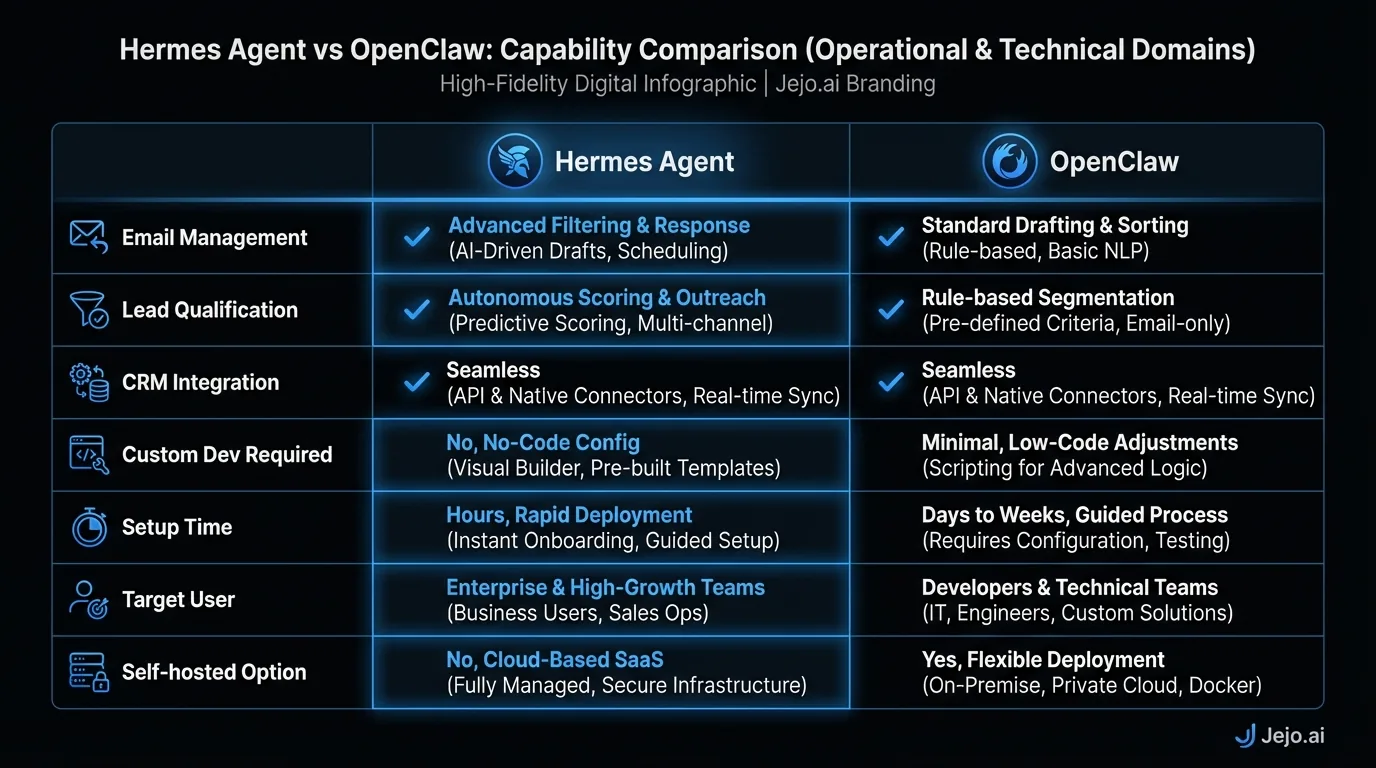
Quick Comparison Table
| Factor | Hermes Agent | OpenClaw |
|---|---|---|
| Primary strength | Business operations (email, leads, scheduling) | Technical workflows and research |
| Best for | Service businesses, 1-20 people | Technical teams, research-heavy orgs |
| Setup complexity (self-deploy) | Moderate | Moderate to High |
| Setup complexity (managed via Jejo.ai) | 30 minutes | 30 minutes |
| Monthly cost (self-deploy) | $70-$300 + your time | $50-$250 + your time |
| Monthly cost (managed) | $750/mo through Jejo.ai | $750/mo through Jejo.ai |
| Coverage hours | 168 hrs/wk (24/7) | 168 hrs/wk (24/7) |
| Calibration period | 4 weeks | 2-4 weeks |
| Email operations | Excellent | Basic |
| Lead follow-up | Excellent | Not designed for this |
| CRM management | Excellent | Limited |
| Research and analysis | Basic | Excellent |
| Technical task execution | Limited | Excellent |
| Content workflows | Good | Excellent |
| Learning speed | Fast (operational patterns) | Fast (technical patterns) |
| Non-technical owner friendly | Yes | Requires some guidance |
What Hermes Agent Does Best
Hermes Agent was built for business operations. It handles the work that keeps small business owners stuck at 60-hour weeks.
Email operations. Hermes reads your inbox, categorizes by urgency, drafts responses in your voice, follows up on stale threads, and escalates the 10% that needs you. The average business owner spends 3 to 4 hours per day on email. Hermes cuts that to 15 minutes of review. Lead qualification and follow-up. This is where Hermes shines brightest. New lead at 11 PM? Hermes qualifies them, sends a personalized response with calendar availability, logs the contact in your CRM, and sets a follow-up reminder. Response time: 2 to 4 minutes. Compare that to the 47-hour industry average. A study published in the Harvard Business Review found that companies following up within an hour of receiving an online inquiry are nearly 7x more likely to qualify the lead. Scheduling. Meeting coordination that normally takes 30 to 45 minutes of daily back-and-forth becomes automatic. Hermes checks availability, sends options, confirms, reschedules when needed, and sends reminders. CRM maintenance. Every interaction gets logged. Every contact gets updated. Every opportunity gets tagged. The CRM stays clean without you thinking about it. Client communication. Project status updates, milestone notifications, routine check-ins. Hermes handles the communication that builds client relationships but eats your calendar.For a deep review of Hermes Agent performance, see Hermes Agent review.
What OpenClaw Does Best
OpenClaw was built for technical and research-intensive work. It handles tasks that require analysis, synthesis, and technical execution.
Research and analysis. OpenClaw excels at gathering information from multiple sources, synthesizing findings, and producing structured analysis. Market research, competitive intelligence, data analysis. McKinsey estimates that knowledge workers spend 19% of their workweek searching for and gathering information. When a task requires pulling data from 10 sources, cross-referencing findings, and producing structured output, OpenClaw outperforms Hermes significantly. Technical workflows. Code review, documentation generation, system configuration, data processing. OpenClaw connects to development and technical tools natively. Teams that need an AI employee for backend work find OpenClaw more capable in this domain. Content creation pipelines. OpenClaw handles research-heavy content workflows: topic research, outline generation, draft creation, fact-checking, and revision. The depth of analysis in its output is a clear strength over Hermes. Complex multi-step reasoning. Tasks that require chaining 5 to 10 steps of analysis, each dependent on the previous result. OpenClaw handles these more reliably because it was designed for this type of work.For a full review of OpenClaw capabilities, see OpenClaw review. For pricing details, see OpenClaw pricing.
Head-to-Head: 8 Factors That Matter
1. Email and lead operationsWinner: Hermes Agent. This isn't close. Hermes was purpose-built for email operations and lead management. OpenClaw can send emails, but it lacks the specialized lead qualification, voice matching, and CRM integration that Hermes delivers out of the box. If your business lives and dies by email response speed, this single factor may settle the decision.
2. Research depthWinner: OpenClaw. When a task requires pulling data from 10 sources, cross-referencing findings, and producing a structured analysis, OpenClaw outperforms. Hermes can do basic research but doesn't match the depth or structure. For a business needing competitive intelligence reports or market analysis, OpenClaw is the clear choice.
3. Setup and onboardingTie (with managed deployment). Both platforms require calibration. Self-deployed, OpenClaw has a steeper learning curve for non-technical business owners. Through Jejo.ai, both take the same 30-minute kickoff call and 4-week calibration period.
4. CostTie. Self-deployed costs are comparable ($70 to $300/mo for either). Managed deployments through Jejo.ai are the same price: $750/mo each. The cost difference is negligible. The value difference depends entirely on which tasks you need handled.
5. Non-technical user friendlinessWinner: Hermes Agent. Hermes was designed for business owners who don't know (or care) what an API is. The interface is goal-oriented: "respond to all new leads within 5 minutes using my standard intro template." OpenClaw's interface assumes more technical comfort, even with a managed deployment.
6. Autonomy and proactive actionWinner: Hermes Agent (for operations). Hermes monitors inboxes, watches for triggers, and acts without prompting. OpenClaw is more task-oriented by default. You assign it a project and it executes. Hermes watches and acts continuously.
7. Content qualityWinner: OpenClaw. For long-form content, analysis documents, and research-backed writing, OpenClaw produces higher quality output. Hermes handles communication-style content (emails, follow-ups, updates) better.
8. Integration breadthWinner: Hermes Agent (for business tools). Hermes connects natively to the tools small business owners use: Gmail, Outlook, HubSpot, Pipedrive, Google Calendar, Calendly, and common project management platforms. OpenClaw integrates better with technical tools and development environments.
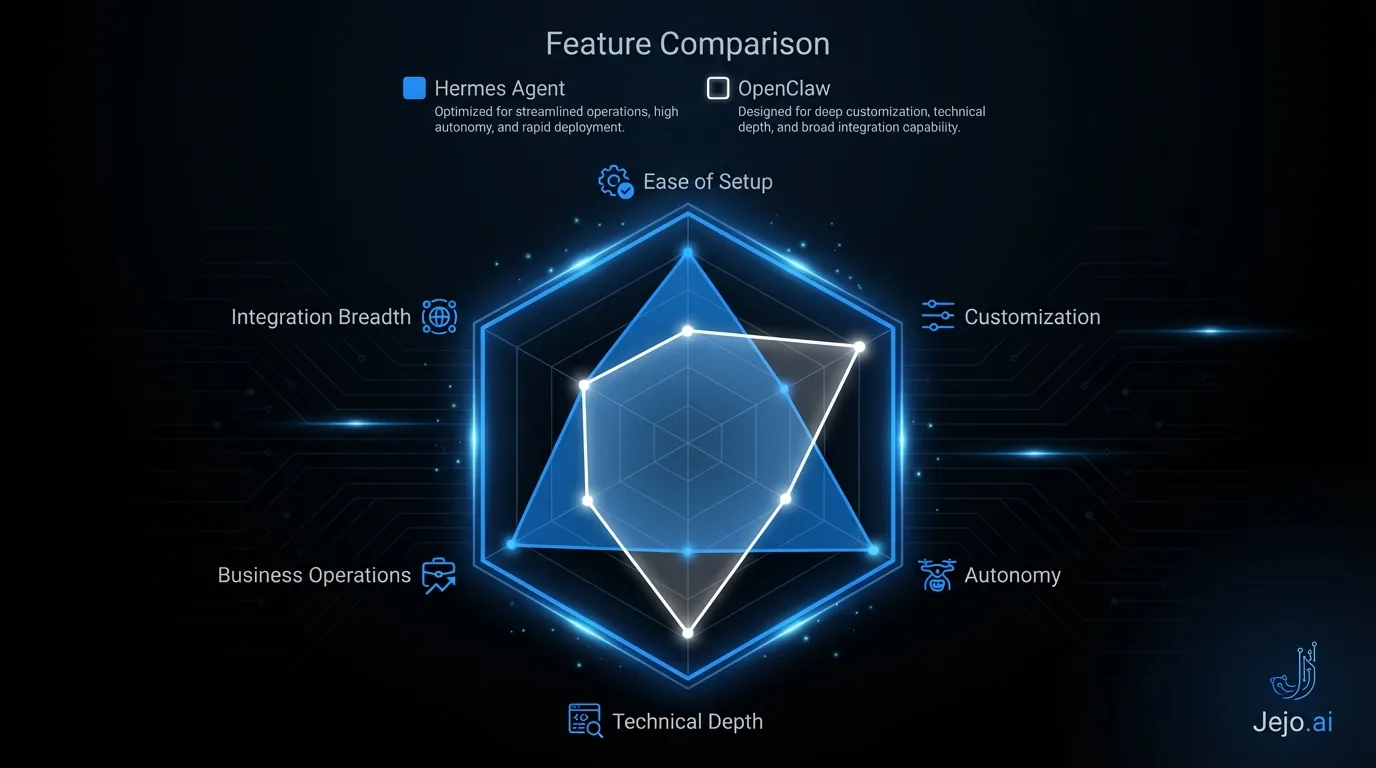
| Category | Hermes Agent | OpenClaw | Winner |
|---|---|---|---|
| Email and lead ops | 9/10 | 4/10 | Hermes |
| Research depth | 5/10 | 9/10 | OpenClaw |
| Setup ease | 8/10 | 6/10 | Hermes |
| Cost | 7/10 | 7/10 | Tie |
| Non-technical friendliness | 9/10 | 6/10 | Hermes |
| Operational autonomy | 9/10 | 7/10 | Hermes |
| Content quality | 6/10 | 9/10 | OpenClaw |
| Business tool integrations | 9/10 | 5/10 | Hermes |
Side-by-Side on Real Business Tasks
Abstract comparisons are less useful than watching both platforms handle the same specific task. Here's how each performs on 5 common business scenarios.
Task: Respond to a new inbound lead at 11 PM- Hermes: Reads inquiry, checks CRM for existing relationship, qualifies against your ICP criteria, drafts a personalized response, includes calendar link, logs contact, sets follow-up. Done in 3 minutes. You see it in the morning briefing.
- OpenClaw: Could be configured to do this, but it isn't designed for it. Requires significant custom workflow setup. Not its native strength.
- Winner: Hermes
- Hermes: Can gather basic information from websites and produce a summary. Adequate for surface-level competitive awareness.
- OpenClaw: Pulls from multiple data sources, cross-references information, identifies gaps and inconsistencies, produces a structured 10-page analysis with cited sources. Significantly more thorough.
- Winner: OpenClaw
- Hermes: Native function. Every email, meeting, and call note gets logged automatically. CRM stays current without manual input.
- OpenClaw: Not designed for this. Would require custom integration work to replicate.
- Winner: Hermes
- Hermes: Can produce a basic outline and draft, but depth is limited.
- OpenClaw: Researches market size, competitor landscape, pricing benchmarks, and customer pain points from multiple sources. Produces analysis that would take a human analyst 2 to 3 days.
- Winner: OpenClaw
- Hermes: Pulls project status from your PM tool, drafts personalized updates for each client, sends on schedule, handles replies. Completely autonomous.
- OpenClaw: Less suited. Can draft content but lacks native PM tool integration and autonomous sending behavior.
- Winner: Hermes
Industry Breakdown: Which Fits Each Business Type
Not all businesses need the same AI employee. Here's the clearest signal for common business types.
| Industry | Primary Need | Best Fit | Why |
|---|---|---|---|
| Consulting | Client comms + lead follow-up | Hermes | Ops-heavy, relationship-driven |
| Marketing agency | Client updates + content production | Both | Split use cases |
| Software development firm | Technical documentation + code review | OpenClaw | Technical workflows |
| Professional services (law, accounting) | Intake + scheduling + communication | Hermes | Client communication volume |
| E-commerce | Research + content + customer support | OpenClaw or both | Research and content needs |
| Real estate | Lead response + CRM + scheduling | Hermes | Speed-to-lead critical |
| Media/publishing | Research + content pipelines | OpenClaw | Content production depth |
Use Case Match: Which One Do You Need?
Choose Hermes Agent if:- You run a service business (consulting, agency, professional services)
- Your biggest time drain is email, scheduling, lead follow-up, or client communication
- You want an operational AI employee that works 24/7
- You're non-technical and want goals-based management, not configuration
- Your business has 20+ client interactions per week
- Your biggest time drain is research, analysis, or technical execution
- You need deep content creation beyond email and follow-up
- Your team is technically comfortable
- Your workflows involve complex multi-step reasoning and data processing
- You need operational coverage (Hermes) AND research/content capacity (OpenClaw)
- Your business has both client-facing operations and back-end analytical work
- You want complete AI coverage across your entire workflow
For business owners weighing AI agents against traditional hiring, the true cost of hiring and AI for small business map the full decision.
Can You Use Both?
Yes. Hermes Agent and OpenClaw don't compete for the same tasks. They complement each other.
A typical dual deployment:
- Hermes handles email, leads, scheduling, CRM, and client communication (operational layer)
- OpenClaw handles research, content production, analysis, and technical tasks (analytical layer)
The total cost for both through Jejo.ai is $1,500/mo. Compare that to hiring an operations coordinator ($4,700 to $7,300/mo) and a research analyst ($3,500 to $5,000/mo). According to the U.S. Bureau of Labor Statistics Occupational Employment Survey, operations coordinators and research analysts together command median salaries exceeding $120,000/yr combined. That's $8,200 to $12,300/mo in human cost replaced by $1,500/mo in AI cost.
A 12-person agency running both described it this way: "Hermes handles everything client-facing. OpenClaw handles everything we produce internally. Together they do what two full-time hires would do, at about 10% of the cost."
The Jejo.ai Alternative: Managed Deployment of Either
You don't need to choose a platform, deploy it yourself, or manage the infrastructure. Jejo.ai is a managed service that deploys and manages Hermes Agent, OpenClaw, or both for your business.
What that means in practice:- 30-minute kickoff call to map your operations
- We choose the right agent (or combination) for your use case
- Deployed and configured within 48 hours
- We manage calibration, optimization, and ongoing performance
- One monthly price. No technical maintenance on your end
Most business owners don't care whether their AI employee runs on Hermes or OpenClaw or a combination. They care that email gets handled, leads get followed up, and their week goes from 60 hours to 40.
That's what we deliver. See how onboarding works or compare to hiring.
FAQ
Which is better, Hermes Agent or OpenClaw?
Neither is universally better. Hermes Agent is better for business operations (email, leads, scheduling, CRM). OpenClaw is better for research, technical workflows, and content creation. For most service businesses, Hermes is the right starting point. For technical teams, OpenClaw fits better.
Can I switch from OpenClaw to Hermes Agent later?
Yes. With a managed deployment through Jejo.ai, switching or adding agents takes 48 to 72 hours. Any business context and learned preferences transfer. You're not locked into one platform.
Do I need technical skills to use either one?
With a managed deployment through Jejo.ai, no. Both platforms are configured and managed for you. Self-deployed, Hermes is more accessible to non-technical users. OpenClaw requires moderate technical comfort for self-deployment.
How much does it cost to run both?
Self-deployed: $140 to $600/mo in combined infrastructure costs plus 15 to 20 hours monthly of your maintenance time. Managed through Jejo.ai: $1,500/mo total for both agents, fully managed. Compare that to $8,200 to $12,300/mo for equivalent human staff.
What about Paperclip AI?
Paperclip is another AI platform in the space, focused on document processing and workflow automation. For a comparison of where it fits, see What is Paperclip AI. Jejo.ai evaluates all available platforms when designing your deployment and recommends whatever combination delivers the best results for your specific business.
If I'm not sure which I need, which should I start with?
Start with Hermes Agent. For most businesses, the operational layer (email, leads, scheduling) delivers faster and more measurable ROI than the analytical layer. Add OpenClaw in month 2 or 3 once Hermes is calibrated and running. Starting with both simultaneously splits your calibration attention and slows both.
Is Hermes Agent better than OpenClaw?
For small service businesses, Hermes Agent is better as a starting point. It deploys faster, requires less technical knowledge, and delivers measurable ROI on operations (email, leads, scheduling) within 30 days. OpenClaw pulls ahead when you need deep customization, a larger skill marketplace, or technical workflows that go beyond standard business operations. If you can only pick one to start, pick Hermes. Add OpenClaw once Hermes is running reliably.
What if OpenClaw or Hermes releases a major update?
With a managed deployment through Jejo.ai, platform updates are handled on your behalf. You don't need to track product releases, manage migrations, or re-configure anything. The managed service keeps both agents on current versions and adapts your workflows to new capabilities as they become available.