Quick answer
- What this covers: Email marketing for small business returns $36 per $1 spent.
- Who it’s for: Small business owners and solo founders.
This guide covers what to send, when to send it, and how to build a list without a marketing team.
Key takeaways:
- The $36 Return System runs on three mechanics: owned list, automated sequences, and consistent sending
- Email marketing returns $36 per $1 spent on average: well-optimized small business lists hit $50-$80
- Your email list belongs to you: no algorithm can bury it
- A welcome sequence of 5-7 emails, written once and automated, is the highest-ROI (return on investment) piece of copy most businesses never build
- An AI agent handles drafts, follow-up triggers, and sending on schedule: the difference between a strategy that runs and one that sits in a doc
In this article:
- Why Email Marketing Works for Small Businesses
- Building Your Email List (Without Buying One)
- Email Types Every Small Business Should Send
- Writing Emails That Get Opened and Read
- Email Automation: What to Set Up First
- Email Marketing Tools for Small Businesses
- The Role of AI in Small Business Email Marketing
- Measuring What Matters
Why Email Marketing Works for Small Businesses
How does email marketing work for small business? Email marketing for small business works by building a list of subscribers who opt in to hear from you, then sending useful content that builds trust over time. Your email list belongs to you. No platform can take it away. No algorithm can bury your content. You hit send and they receive it.The $36 Return System is what you're building: an owned channel that returns $36 for every $1 invested, run on three mechanics: a list that grows, automated sequences that convert, and a consistent sending schedule that compounds trust over time.
Every other marketing channel is rented. Your Instagram followers belong to Instagram. Your Facebook audience belongs to Facebook. Your Google ranking belongs to an algorithm.
For small businesses, this matters enormously. You're not competing with massive ad budgets on email. You're competing on quality of relationship. Small businesses with genuine customer relationships consistently outperform large brands in email because the content feels personal and relevant.
The numbers back this up:
| Metric | Industry average | Well-optimized small business |
|---|---|---|
| Open rate | 21.5% | 35-45% |
| Click-through rate | 2.3% | 5-8% |
| ROI | $36 per $1 spent | $50-$80 per $1 spent |
| Unsubscribe rate | 0.1-0.5% | Under 0.2% |
| Revenue per subscriber | $1-3/month | $3-10/month |
The gap between average and well-optimized comes down to one thing: relevance. Sending the right email to the right segment at the right time.
Email marketing ROI for small business: Average industry open rate is 21.5%, but well-optimized small business lists achieve 35-45%. ROI averages $36 per $1 spent industry-wide, rising to $50-$80 for engaged small business lists. A list of 1,000 subscribers generating $5/month each produces $5,000/month in email-attributed revenue, outperforming paid ads and social media on long-term customer lifetime value.
Building Your Email List (Without Buying One)
Your email list is only valuable if it's made up of people who actually want to hear from you. Buying a list or adding people without consent destroys your email deliverability (the ability for your emails to reach inboxes instead of spam folders) and violates laws like CAN-SPAM (the US anti-spam law) and GDPR (Europe's privacy regulation).Build your list through opt-ins. Here's what works for small businesses:
Lead magnets. Give something useful in exchange for an email address. A checklist, a template, a short guide, a discount, a free consultation booking. The lead magnet should be immediately relevant to the problem your business solves. A bookkeeping firm might offer "5 Tax Write-Offs Most Small Business Owners Miss." A coaching business might offer a free values assessment. Website opt-in forms. A popup or inline form on your highest-traffic pages. Don't make it intrusive, but don't hide it either. A good opt-in form converts 2-5% of visitors. If you get 500 visitors a month, that's 10-25 new subscribers per month just from existing traffic. Post-purchase sequences. Every customer who buys from you should get an automated email asking if they want to stay in touch. You already earned their trust. Converting buyers to subscribers is the highest-conversion list-building move available. Content upgrades. A specific bonus related to a specific blog post or page. If someone reads your article on pricing, a "Pricing Template for Service Businesses" offered at the bottom converts much better than a generic newsletter signup. Referrals from existing subscribers. Ask subscribers to forward your best emails to one person who would find it useful. Personal referrals have a 3-5x higher conversion rate than organic opt-ins.Don't obsess over list size in the early stages. 200 highly engaged, relevant subscribers are worth more than 2,000 people who barely remember signing up.
Not building a list yet? Every week without a list is a week of traffic and customers that don't come back. Book a strategy call to see how an AI agent builds and runs your welcome sequence from day one.
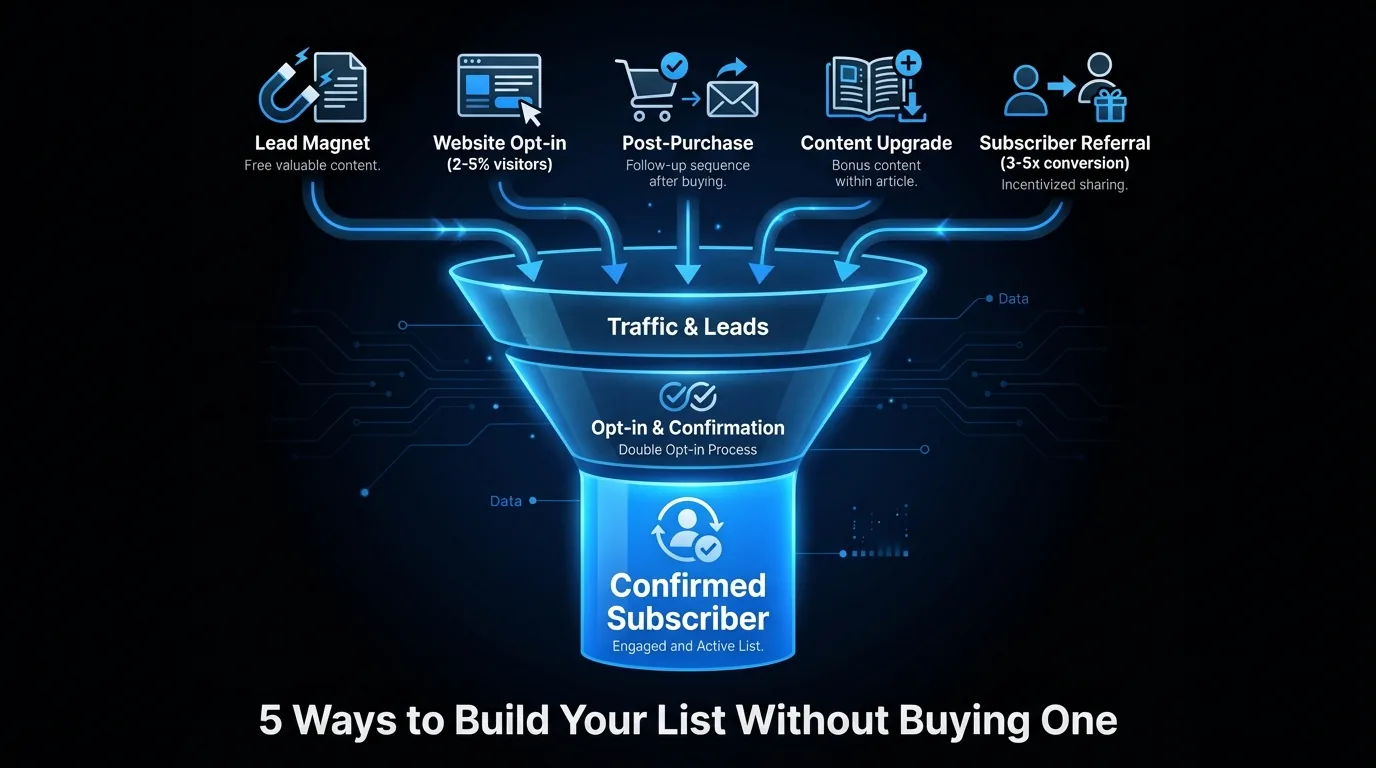 , Post-Purchase, Content Upgrade, Subscriber Referral (3-5x conversion). All feed into a funnel narrowing to 'Confirmed Subscriber' at the bottom in blue #2997ff. Caption: '5 Ways to Build Your List Without Buying One.' 16:9 infographic, clean professional.)
Email Types Every Small Business Should Send
There are four types of emails, and most small businesses only send one of them.
Welcome sequence (automated). The first component of The 3-Email Foundation. When someone joins your list, the first 5-7 emails set expectations, build trust, and position your offer. A good welcome sequence introduces who you are, what problem you solve, who you serve, social proof, and one invitation to take the next step. Write it once. It runs forever. Nurture emails (semi-regular). Educational, useful, non-promotional content. Share what you know. Solve small problems for free. Show your thinking. Nurture emails build the relationship that makes selling easier later. Frequency: 1-2 per week for active businesses, 2-4 per month minimum to stay top of mind. Promotional emails (occasional). Offers, launches, sales, limited-time promotions. The ratio matters: if every email is a pitch, people unsubscribe. A good ratio is 3-4 nurture emails for every 1 promotional email. When you do pitch, pitch clearly. Don't bury the offer. Transactional emails (automated). Receipts, confirmations, onboarding sequences, appointment reminders. These have the highest open rates of any email type (60-80%) because people are expecting them. Use this real estate. Include a relevant next step or useful tip in every transactional email, not just the transaction confirmation.Writing Emails That Get Opened and Read
Subject lines determine whether your email gets opened. Content determines whether the reader takes action. Both matter.
Subject line rules for small businesses:- Keep it under 50 characters (most people read email on mobile)
- Curiosity or specificity outperform generic: "3 things I stopped doing to get 4 days back" beats "Newsletter Issue #47"
- Use the recipient's first name sparingly, not in every subject line
- Avoid spam triggers: "FREE," all caps, excessive exclamation points
- Test two versions on your first 20% of recipients, send the winner to the rest
Write like you're talking to one specific person, not a crowd. Use their language. Reference their real problems. Be direct. Short paragraphs: 1-3 sentences max. One main point per email. One call to action per email.
The biggest mistake small business email marketers make: trying to cover too much in one email. Pick one thing. Make the case for that one thing. Ask the reader to do one thing.
Email Automation: What to Set Up First
Automation is where email marketing becomes a lever, not just a task. The starting point is The 3-Email Foundation: welcome sequence, abandoned lead sequence, reactivation sequence. These three cover 80% of email revenue for small businesses. Build them before anything else. Every other automation you add sits on top of this base.
Here are the three sequences every small business should have running first.
The welcome sequence (5-7 emails over 10 days). Automated from the moment someone subscribes. Day 1: welcome and what to expect. Day 2: your story and why this business exists. Day 4: the problem you solve, specific and concrete. Day 6: social proof (results, testimonials, case study). Day 9: soft pitch or next step invitation. The re-engagement sequence (3 emails over 14 days). Triggered for subscribers who haven't opened in 90 days. Email 1: "Are you still interested in [topic]?" Email 2: a high-value piece of content as a reminder of why they subscribed. Email 3: "This is your last email unless you want to keep hearing from us." This sequence cleans your list and re-activates a percentage of cold subscribers. The post-purchase sequence (3-5 emails over 30 days). For customers, not just subscribers. Onboarding tips. Social proof that reinforces their decision. Invitation to share results. Upsell or referral ask. Customers who feel cared for post-purchase are 70% more likely to buy again.After these three are live, add automations based on behavior: clicked a specific link, visited a pricing page, downloaded a specific resource. Behavioral triggers (automated emails that fire when someone takes an action) outperform time-based triggers (emails sent on a fixed schedule) by 3x on average.
Email automation ROI for small business: The 5-7 email welcome sequence is the highest-lifetime-value piece of copy most businesses never build. A 3-email re-engagement sequence reactivates 10-15% of cold subscribers; the post-purchase sequence increases repeat purchase rate by 70%. Behavioral triggers outperform time-based triggers by 3x.
Email Marketing Tools for Small Businesses
You don't need expensive software to run effective email marketing. You need a tool that handles list management, automation, and basic analytics.
| Tool | Monthly cost (under 1,000 subs) | Best for |
|---|---|---|
| Mailchimp | Free-$20/mo | Beginners, simplest setup |
| Kit (formerly ConvertKit) | Free-$29/mo | Content creators, bloggers |
| ActiveCampaign | $29/mo | Automation-heavy businesses |
| Brevo (formerly Sendinblue) | Free-$25/mo | Transactional email + marketing |
| Klaviyo | Free-$30/mo | E-commerce businesses |
For most small businesses under 5,000 subscribers: start with Mailchimp free tier or Kit free tier. When you outgrow the free features (typically at $1,000+/month in email-attributed revenue), upgrade.
The Role of AI in Small Business Email Marketing
Email marketing is one area where AI agents provide immediate, measurable value.
Writing emails takes time. A lot of it. A typical email takes 30-60 minutes to write, review, and schedule. An AI agent trained on your brand voice and customer knowledge can draft emails in minutes. You review, tweak, approve.
More importantly, AI agents handle the follow-up that most business owners forget. A customer doesn't respond to a proposal. A subscriber downloads a lead magnet but never replies to the welcome sequence. A client hasn't checked in for 60 days. An AI agent tracks these triggers and sends the right follow-up at the right time, without you remembering to do it.
This is what marketing agency automation looks like applied to email: systematic, personalized, on schedule, without the overhead.
For a solo operator or small team, having an AI agent manage your email marketing execution, not just tools, is the difference between a strategy that runs and one that sits in a doc somewhere.
One service business owner set up a 5-email welcome sequence in a single afternoon using AI drafts. It ran automatically for 6 months and converted 14% of new subscribers into booked calls, without a single manual follow-up.
What to Send When You Have No Ideas
Every business owner hits the blank page problem. Here are 10 email ideas that work for nearly any small business:
- A lesson learned this week (1 mistake and what it taught you)
- A question you get all the time, answered in depth
- A behind-the-scenes look at how you do your work
- A client success story (with permission or anonymized)
- A counter-intuitive take on something in your industry
- A tool or resource you've been using and why it helps
- Your opinion on a trend or news item in your space
- A story about why you started this business
- A comparison of two options your clients frequently debate
- A checklist or template you use internally
The best small business emails feel like getting a useful note from someone you respect. Not a newsletter. Not a pitch. A note.
What This Looks Like in Practice
Rachel owns a 2-person interior design studio in Portland. She started her email list in September 2024 with zero subscribers. Her strategy: one email per week, written in 20 minutes on Sunday evening, sent Monday morning.
In our experience, the welcome sequence is the piece of marketing copy that most small businesses never build, yet it drives more lifetime customer value than any single campaign. Rachel skipped the welcome sequence at first. The discipline of weekly emails built the relationship anyway.
Her emails were short. Usually 150-250 words. A project photo, 2-3 sentences on what she learned from it, and a link to her portfolio. No offers. No pressure. Just useful, specific content from someone who clearly knew what she was doing.
By January 2025, she had 280 subscribers. In February, she sent one promotional email: eight slots open for spring design consultations at $400 each. She filled all 8 in 72 hours. Revenue from one email: $3,200.
The ratio that made it work: 18 consecutive nurture emails before a single pitch. Her subscribers trusted her. They had read her work for months. When she finally asked, they said yes.
She now has 1,100 subscribers running the exact same format at the same frequency. Revenue per subscriber has grown from $11 per month to $28 per month. The system did not change. The list did.
Measuring What Matters
Most small business owners track open rates and nothing else. Open rates matter but they're not the end goal. Here's the hierarchy:
Revenue per subscriber. The only number that connects the $36 Return System to actual business outcomes. Divide email-attributed revenue by total list size each month. Target: $3-10 per subscriber per month depending on your business type. Click rate. What percentage of openers click a link? Low click rates (under 2%) usually mean the email body doesn't match the subject line promise, or the CTA isn't clear. List growth rate. Are you adding more subscribers than you're losing? Target: 5-10% net growth per month in early stages. Unsubscribe rate. Over 0.5% per email means something is wrong: wrong audience, wrong frequency, or wrong content. Under 0.2% means your list is happy.Track these monthly. Make one change at a time. Email marketing improves through iteration, not overhaul.
What Email Marketing Won't Do Immediately
Three honest expectations before you build the system.
It takes 6-18 months to build a list large enough to drive consistent revenue. Most small businesses start with 50-200 contacts. Getting to 500-1,000 engaged subscribers, where email generates reliable inbound, requires consistent list-building alongside consistent sending. Don't measure success at month 3. Measure it at month 12. The $36 ROI average masks wide variance. A warm list of 400 buyers generates more revenue than a cold list of 4,000 people who barely remember subscribing. Growing fast with lead magnets that attract the wrong audience produces low open rates, high unsubscribes, and deliverability damage that takes months to repair. Grow slowly and relevantly. Email won't save a weak offer. A well-optimized sequence with a 40% open rate and a 5% click rate still produces zero bookings if the offer doesn't resonate. If conversion rates stay below 0.5% after 6 months of consistent sending, the problem usually isn't the email. It's the positioning or the offer. Fix those first before optimizing the sequence.Connecting Email to Your Overall Marketing System
Email doesn't work in isolation. It works best as part of a broader system where different channels feed each other.
Content marketing drives organic traffic. That traffic converts to email subscribers. Email nurtures subscribers toward purchase. Purchases create customers who refer new subscribers.
For small businesses running marketing without a full team, this flywheel runs on a combination of good content and smart automation. Content marketing for small business covers the top-of-funnel piece. Social media for small business covers the distribution layer. Email is the conversion and retention engine.
When these work together with AI handling the operational execution, you have a marketing system that runs largely without daily management. That's the goal: use cases in marketing automation show what's possible when the pieces are connected.
What the Solution Actually Looks Like
Here's what email marketing looks like when an agent handles the execution.
Tuesday morning, you approved last week's article. The agent extracted the 4 most useful paragraphs, wrote a subject line, and queued an email for Thursday. It also flagged 3 subscribers who downloaded your lead magnet but didn't open the welcome sequence, and drafted a re-engagement email ready for your review.
You spent 15 minutes. Your email went out on schedule. Your cold subscribers got followed up with.
The writing voice and strategic direction are yours. The scheduling, follow-up triggers, and list hygiene run automatically.
Most small business owners have a clear sense of what they'd send if they had the bandwidth. The bottleneck isn't ideas. It's execution.
Jejo.ai agents handle email marketing execution as part of the full operations package at $750/month, or $12,000/year. Compare that to a marketing agency email retainer at $2,000-$5,000/month that still requires approval from you on every send. Your list stays yours. The work gets done. 30-day guarantee. No long-term contract.Who This Is For
This guide is for you if:- You have (or are building) an existing customer base or consistent website traffic
- You can commit to sending at least twice a month consistently for 6+ months
- You want a marketing channel you own outright, not one rented from a platform
- You're a brand-new business with zero audience and zero traffic to convert to subscribers
- You can't commit to consistent sending (email rewards consistency above everything)
- Your customers don't communicate by email or prefer other channels
The Bottom Line
The $36 Return System works when all three mechanics run together: a growing owned list, automated sequences that convert, and consistent sending that builds trust. The 3-Email Foundation (welcome, abandoned lead, reactivation) drives 80% of email revenue before a single broadcast goes out. Email marketing for small business returns $36 for every $1 spent on average, with well-optimized lists reaching $50-$80. A 5-7 email welcome sequence, written once and automated, converts 10-15% of new subscribers into booked calls and drives more lifetime value than any single campaign. Jejo.ai agents handle email drafts, follow-up triggers, and list management at $750/month with a 30-day guarantee.
FAQ
How often should a small business send marketing emails?
Minimum: twice a month. Optimal: once a week. More than 3 times per week for most businesses creates fatigue and unsubscribes unless your content is exceptionally high-value. Consistency matters more than frequency. Missing weeks drops open rates by 15-20% because subscribers forget who you are.
Do I need a large list for email marketing to work?
No. A list of 500 engaged subscribers can drive meaningful revenue. One coaching business owner with 400 subscribers reported $8,000/month in email-attributed revenue. The math: 400 subscribers, 35% open rate (140 openers), 5% click rate (7 clickers per email), with a $2,000 offer. One sale per 2 emails sent pays for the entire list. Quality and engagement matter more than size.
What's the difference between a newsletter and an email sequence?
A newsletter is broadcast: you send it to your whole list at a scheduled time, and it goes to everyone regardless of where they are in their relationship with your business. An email sequence is triggered: it starts when someone takes an action (subscribing, buying, clicking a link) and delivers emails based on timing or behavior. Both have a role. Sequences do the heavy lifting for conversion. Newsletters maintain the relationship.
Is email marketing dead with social media and TikTok everywhere?
No. Email open rates have increased 18% over the past 3 years. Unlike social media, email reaches 100% of your list (in theory). The average organic social post reaches 5-10% of followers. Email isn't dead. For small businesses without ad budgets, it's the most reliable channel available.
How do I write emails if I'm not a copywriter?
Write the way you talk. Imagine one specific customer you love working with. Write to them. One topic per email. Short paragraphs. A clear ask at the end. Bad grammar is fine if the content is useful. Templates and frameworks help but the most effective small business emails sound like a person, not a brand.
Ready to stop leaving email revenue on the table?
See how an AI agent handles your email marketing execution. Book a strategy call to see what it looks like for your business. Or see the plans to compare options.