Quick answer
- What this covers: The best AI tools for small business in 2026, ranked by actual usefulness.
- Who it’s for: Small business owners and solo founders.
- What it costs: $50/month.
Over 10,000 AI tools for small business launched in the last two years. Most make you less productive, not more. Every tool saves time on one task and adds another system to manage. Stop asking which tool to add. Ask which tasks to eliminate entirely.
Key takeaways:
- A stack of 4-5 tools costs $100-$300/month but still demands 10+ hours of weekly management across platforms
- The biggest ROI (return on investment) from AI isn't a faster task: it's eliminating the task entirely through an agent
- The 30-Day Payback Test: any tool you add must recover its monthly cost within 30 days or get cut from the stack
- AI agents covering multiple functions run $750-$1,000/month with near-zero management after setup
- The businesses getting the most from AI give good inputs, review outputs critically, and keep judgment-heavy work off the automation stack
In this article:
- How to Evaluate AI Tools for Small Business
- Writing and Content AI Tools
- Email and Communication AI Tools
- Operations and Scheduling AI Tools
- Customer Service AI Tools
- Finance and Bookkeeping AI Tools
- AI Agents: The Different Category
- Tools by Business Stage
How to Evaluate AI Tools for Small Business
Before going through the list, a framework for deciding what's worth your time.
Before anything else, run The Stack or Skip Test: three questions before adding any AI tool. Does it replace a task you do manually? Can you start in under 30 minutes? Does the math work at your current volume? One no, and you skip it. Every tool in this guide passed The Stack or Skip Test. Most tools that come up in a Google search do not.
Once a tool clears The Stack or Skip Test, apply the 30-Day Payback Test: will this tool recover its monthly cost within 30 days? If not, cut it. Most tools that fail this test don't fail because they're bad. They fail because the time to manage them eats the savings.
Does it eliminate a task or just speed it up? Speeding up a task is useful. Eliminating it is transformational. Writing a blog post 30% faster saves an hour. Having an AI agent write, schedule, and distribute the post without you touching it saves the whole day. What does it cost vs. what it replaces? Many business owners compare AI tool costs against zero. The right comparison is against the cost of doing the task yourself or hiring someone to do it. How much setup and management does it require? A tool that saves 2 hours but requires 1 hour of management weekly has a real ROI of 50% time savings. An agent that requires 10 hours of upfront setup but then runs with minimal management has compounding returns. Does it learn your business? Generic AI tools produce generic output. Tools and agents that retain context about your business, your voice, your customers produce increasingly better output over time.| Evaluation criterion | Weight |
|---|---|
| Time saved per week | High |
| Quality of output | High |
| Setup effort | Medium |
| Monthly cost | Medium |
| Learning/memory over time | High |
AI tool evaluation framework for small business: Four criteria matter most: time saved per week (high weight), output quality (high weight), setup effort (medium weight), monthly cost (medium weight). Businesses using AI for complete task elimination see 3-4x higher productivity gains versus those using AI only to speed up existing tasks. A tool saving 2 hours but requiring 1 hour of management nets 50% efficiency; an agent requiring 10 hours of setup but near-zero ongoing management delivers compounding returns over months.Lisa runs a 2-person event planning company in Vancouver. In January 2026, she ran 3 tools through The Stack or Skip Test: a writing assistant ($29/month), a scheduling optimizer ($34/month), and a customer inquiry bot ($39/month). The writing tool cleared the 30-Day Payback Test at 1.5 hours saved per week against her $150/hour billing rate. The scheduling optimizer required 2 hours of weekly data entry to feed it and failed. The inquiry bot misrouted 4 out of every 20 requests, creating callbacks that cost more time than answering directly, and failed. She added one tool. Net result: 1.5 hours per week recovered. $29/month spent.
Writing and Content AI Tools
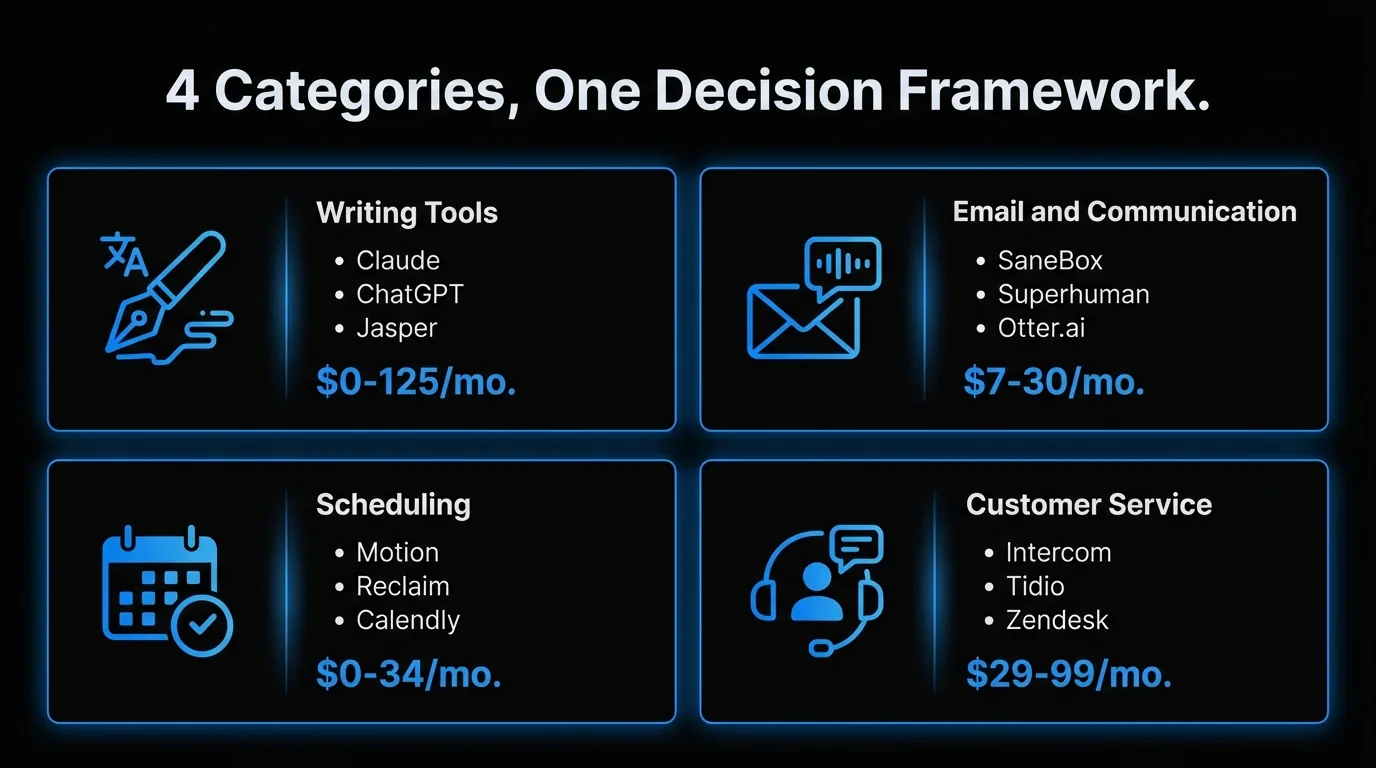
Claude (Anthropic) and ChatGPT (OpenAI)Both are capable writing assistants. Claude tends to produce longer, more detailed content. ChatGPT is faster on shorter tasks. For small business owners, either works for drafting emails, social posts, proposals, client communications, and internal documents.
Best use: Drafting first versions of anything text-based. Not final copies. You still need to review and edit before publishing.
Cost: Both have free tiers. Paid plans run $20/month for individuals, team plans vary.
Limitation: Neither remembers your business from session to session without custom configuration. Every session starts fresh unless you use persistent memory features or custom GPTs.
JasperMarketing-focused writing tool with templates for ads, social posts, email sequences, landing pages. Better for volume and variation than depth. Useful for businesses producing a lot of marketing content at scale.
Cost: $49-$125/month depending on usage.
Best for: Marketing agencies, e-commerce businesses, high-volume content producers.
Grammarly BusinessBeyond spell check: tone suggestions, clarity edits, engagement scoring. Integrates with Gmail, Slack, Google Docs, and most writing environments. Catches the communication habits that make professional writing look amateur.
Cost: $25/month per member.
Best for: Any business where written communication quality reflects directly on the brand.
Email and Communication AI Tools
SaneBoxFilters and prioritizes your inbox using AI. Not a writing tool. A triage tool. Learns which emails are important to you over time and moves low-priority messages to separate folders. Reduces inbox overwhelm without changing your email provider.
Cost: $7-$36/month depending on features.
Best for: Anyone spending more than 90 minutes per day in email.
SuperhumanEmail client with AI-assisted features: automated responses, summary of long email threads, follow-up reminders, triage shortcuts. Much faster than Gmail or Outlook for power users.
Cost: $30/month.
Best for: High-volume email users who want speed. Not budget-friendly for casual email users.
Otter.aiTranscribes meetings and calls in real time. Generates summaries and action items. Integrates with Zoom, Google Meet, and Microsoft Teams. Eliminates the need to take notes during calls.
Cost: Free tier (300 minutes/month), paid at $16.99/month.
Best for: Any business owner who runs meetings and needs a record without manual note-taking.
Operations and Scheduling AI Tools
MotionAI-powered calendar that automatically schedules your tasks, meetings, and deep work blocks based on your priorities and deadlines. When a meeting gets added, Motion reshuffles your task schedule automatically. Reduces the cognitive overhead of figuring out when to do what.
Cost: $34/month for individuals, $20/month per person for teams.
Best for: Business owners managing a mix of fixed meetings and flexible task work.
Reclaim.aiSimilar to Motion but with stronger team coordination features. Blocks time for habits, focus work, and personal commitments automatically. Syncs across team members to find optimal meeting times without back-and-forth.
Cost: Free tier available, paid plans from $10/month.
Best for: Small teams needing coordinated scheduling.
Calendly with AI routingThe scheduling standard for small businesses. New AI features route meeting requests to the right team member, qualify leads before booking, and personalize confirmation messages. Eliminates all scheduling back-and-forth.
Cost: Free tier works for most solo businesses. Teams plans from $16/month per user.
Best for: Any business with recurring external meetings.
Customer Service AI Tools
Intercom (with AI Copilot)Customer messaging platform with AI that handles common questions automatically. The AI resolves 30-50% of support tickets without human involvement. What it can't handle escalates to you or a team member. Works across website chat, email, and social.
Cost: $39-$99/month depending on features. Usage-based pricing applies.
Best for: Businesses with high inbound customer question volume.
TidioLighter-weight alternative to Intercom. AI chatbot that handles FAQs, product questions, and booking flows. Easier setup, lower cost. Good for small businesses that need basic automation without enterprise complexity.
Cost: Free tier available, paid from $29/month.
Best for: Small e-commerce businesses, local service businesses, businesses just getting started with chat automation.
Zendesk with AIFull customer service platform with AI ticket routing, automated responses, and agent assist features. Overkill for most small businesses under 500 support tickets per month. Worth it when support volume grows to the point where manual handling is breaking down.
Cost: $55+/month per agent.
Best for: Growing businesses where customer service has become a full-time function.
Finance and Bookkeeping AI Tools
QuickBooks with AI featuresMost small businesses already know QuickBooks. The AI layer added in 2024-2025 handles expense categorization, anomaly detection, and cash flow predictions. Reduces bookkeeping time by 40-60% for businesses already on the platform.
Cost: $30-$100/month depending on plan.
Best for: Any small business that needs financial tracking. The default choice.
Dext (formerly Receipt Bank)Extracts data from receipts and invoices using AI, codes them to the right expense category, and syncs to QuickBooks or Xero. Eliminates manual expense entry. Point your phone camera at a receipt and it's processed.
Cost: $20-$40/month.
Best for: Business owners with high receipt volume, frequent travel expenses, or teams submitting expenses.
PilotAI-assisted bookkeeping service: combines software automation with human review. For small businesses that don't want to manage their own books at all. Monthly cost includes both the technology and the human oversight.
Cost: $499-$999/month depending on transaction volume.
Best for: Business owners who want bookkeeping handled completely, not just assisted.
AI Agents: The Different Category
Everything listed above is a tool. You use a tool. You manage a tool. You open it when you need it.
An AI agent is an employee. You train it. It runs. It handles things proactively without you opening it.The difference matters for small business owners because the limiting factor isn't which specific tools you use. It's time. Managing 8 different tools, even excellent ones, still takes time. Briefing, reviewing, adjusting, maintaining. Each tool is another system to manage.
An AI agent replaces the need to manage multiple tools. It handles the underlying tasks: inbox management, scheduling, follow-up, content drafting, client communication, reporting. The agent uses whatever tools are appropriate to complete those tasks. You manage one agent, not eight tools.
One marketing consultant replaced 5 separate tools with a single AI agent. Her weekly time managing platforms and reviewing outputs dropped from 12 hours to under 2. The agent cost more than the tools combined. She still called it the best business decision of the year.
This is the distinction between a chatbot and an AI agent: a chatbot answers questions when asked. An agent monitors, acts, and follows through without being asked.
For small businesses, the practical question is whether the volume and repetition of tasks warrants a managed agent versus individual tools. If you're spending 15+ hours per week on administrative and operational tasks, the agent model produces much higher ROI than layering tools on top of each task.
What a trained AI agent handles:- Email inbox: triage, draft responses, flag urgent items
- Calendar: scheduling, confirmations, reminders
- Follow-up: sequences for leads, clients, proposals
- Content: drafts for social, email, blog based on your voice
- Reporting: weekly business summaries, performance flags
- Client onboarding: intake forms, welcome sequences, setup tasks
The full comparison is at Jejo.ai vs ChatGPT and Zapier, which addresses the common objection: "Can't I just build this myself?"
AI agent vs individual tools for small business: A stack of 4-5 tools costs $100-$300/month but demands 10-15 hours of weekly management across platforms. An AI agent at $750-$1,000/month covers comparable scope (inbox, scheduling, follow-up, content drafting, reporting) with near-zero management after setup. One marketing consultant who replaced 5 tools with a single agent dropped weekly platform management from 12 hours to under 2, then used that time to pitch 8 new corporate clients.
Managing 5+ tools and still feeling behind? The tools aren't the problem. The overhead of running them all is. Book a strategy call to see what a single AI agent would consolidate for your specific business.
Tools by Business Stage
Not every tool is right for every stage of business. Here's a practical breakdown:
| Stage | Focus | Recommended tools | Monthly budget |
|---|---|---|---|
| Just starting (under $5K/month) | Writing, basic scheduling | Claude or ChatGPT free, Calendly free, Grammarly | $0-$40 |
| Growing ($5K-$20K/month) | Email triage, task management, bookkeeping | SaneBox, Motion, QuickBooks | $80-$150 |
| Scaling ($20K-$100K/month) | Customer service, content, full operations | Intercom, AI agent for operations | $500-$1,500 |
| Established ($100K+/month) | Full operational coverage, industry-specific | Full AI agent deployment | $750-$2,000 |
The pattern: early stage is about saving time on specific tasks. Growing stage is about removing cognitive load. Scaling stage is about replacing operational headcount with systems.
Industry-Specific AI Tools for Small Business
Some AI tools are built for specific verticals. Worth knowing if your business is in one of these categories.
Real estate: AI tools handle property descriptions, lead follow-up, CMA reports, and client communication. AI tools for real estate agents covers the specific stack for agents and brokers. Marketing and agencies: AI for content production, client reporting, and campaign management at scale. AI agents for marketing covers the agency-specific use cases. Bookkeeping and accounting firms: AI for document extraction, categorization, and client communication automation. AI bookkeeping for small business covers the accounting vertical specifically.What AI Won't Do (Be Honest About This)
AI tools are not a substitute for business strategy. They don't replace relationship-building. They don't generate genuine ideas or creative direction, they execute on direction you provide. They don't handle genuinely novel situations that fall outside their training.
Tool fatigue is real. Every tool added to a stack saves time on one task and adds another system to maintain. A business owner managing 6 tools is doing real work just keeping them in sync. Most aren't managing them well. They're fixing import errors, re-exporting data that didn't sync, and checking dashboards that never quite tell the full story. The overhead of saving time becomes its own job. AI output requires meaningful human editing to be good. The businesses getting the highest quality output from AI writing tools invest 30-60 minutes per week refining prompts, correcting errors, and adding specific context. Generic prompts produce generic content. Getting AI tools to produce at a high level takes more calibration than the marketing implies. AI tools don't replace judgment. They remove volume work. Deciding which leads to prioritize, how to handle a difficult client, which partnerships matter: none of this gets easier with an AI tool. The tools are only as valuable as what you do with the time they recover.The business owners who get the most value from AI are clear about what they want, give good input, review output critically, and use the time they save on the things that actually require them.
AI handles volume and repetition. You handle judgment and relationships. That's the division that makes small businesses competitive with larger ones.
For AI automation in small business, the unlock comes from being deliberate about which tasks to automate and which to protect.
What This Looks Like in Practice
Nina runs a 2-person event planning business in Toronto. She was spending 12 hours per week on emails, vendor follow-ups, and client communication. She had tried 4 different tools. Each one passed The Stack or Skip Test individually. Each one saved time on a specific task and added a new system to manage. The net result: she was still drowning.
In our experience, this is the exact pattern that precedes a switch to an AI agent: multiple tools, still overwhelmed, and the overhead of managing the tools has become its own job.
She stopped adding tools and switched to a single AI agent in February 2026. The agent handled inbox triage, drafted vendor follow-up emails, and sent client update summaries every Friday. Setup took 2 days.
Six weeks in, her administrative week dropped from 12 hours to 3. She used the recovered time to pitch 8 corporate clients she had never had capacity to approach. Four responded. Two became clients. Combined contract value: $40,000.
The tools were not the problem. The number of them was.
The Alternative: One Agent Instead of Ten Tools
Every tool in this guide has a real use case. The problem isn't any individual tool. It's the overhead of managing all of them.
A writing tool. An email client. A scheduling app. A customer service platform. A bookkeeping add-on. Each saves time on one task. Each requires setup, updates, and ongoing attention. Each is another system to check.
An AI agent works differently. You train it once on your business. It handles inbox triage, scheduling, follow-up sequences, content drafting, and client communication as a single coordinated system. You manage one thing. It handles ten.
The ROI math isn't just about cost. Run The Stack or Skip Test on the stack as a whole, not each tool individually. Then apply the 30-Day Payback Test to the combined cost. A stack of 5 tools at $250/month costs less than an agent. But that stack still requires 10-15 hours per week of management across platforms. An agent at $750/month might cost more on paper and recover 12 hours per week. Most business owners who do that math stop adding tools.
Jejo.ai runs at $750/month and covers the full operational scope that would otherwise require 5-8 separate tools plus a VA to coordinate them. $12,000/year, 30-day guarantee.If you're managing 5+ tools and still feel behind, the tool list isn't the problem.
Who This Is For
This guide is for you if:- You're spending 15+ hours per week on admin, email, and operational tasks
- You've tried multiple tools and still feel behind
- You're scaling past $20K/month and operational overhead is the real bottleneck
- You're in early stage (under $5K/month) and free tools cover your current needs
- Your operational overhead is under 5 hours per week
- Most of your business requires in-person work or phone-based client management
The Bottom Line
The right AI tools for small business depend on your stage: early-stage businesses get the most from free writing and scheduling tools ($0-$40/month). Scaling businesses ($20K+/month) consistently get higher ROI from a single AI agent than from 5-8 individual tools combined. Jejo.ai agents replace the full stack with one coordinated system at $750-$1,000/month with a 30-day guarantee.
FAQ
What is the most useful AI tool for a small business in 2026?
For most small businesses, an AI writing assistant (Claude or ChatGPT) combined with a scheduling tool (Calendly or Motion) covers the highest-volume time savings in the first 30 days. If administrative overhead is the bigger bottleneck, an AI agent that handles inbox, scheduling, and follow-up together is the higher-ROI move.
How much do AI tools cost for a small business?
Individual tools range from free to $50/month each. A complete stack of 4-5 tools typically runs $100-$300/month. An AI agent that replaces the need for individual tool management runs $750-$1,000/month. The comparison isn't just cost. It's cost plus management overhead.
Can a small business use AI without any technical knowledge?
Yes. The tools in this guide require no coding, no technical background, and minimal setup. The tools that require more configuration (Zapier-style automations, custom AI workflows) are optional and worth avoiding until the basics are working well.
Is AI better than hiring a virtual assistant?
For operational tasks (inbox, scheduling, follow-up, data entry), an AI agent handles comparable scope with zero management overhead and better consistency than most VA arrangements. For tasks requiring genuine human judgment, relationship warmth, or physical presence, humans still have the edge. AI agent vs ChatGPT and Zapier. The full comparison is there.
Will AI replace my employees?
For roles defined primarily by volume and repetition, AI will absorb increasing amounts of that work. For roles requiring judgment, creativity, client relationships, or specialized expertise, humans remain essential. The honest answer: review what each team member does and categorize each task. The repetitive, systematic tasks are candidates for AI. The judgment-heavy tasks are not.
Ready to go beyond individual AI tools?
See what a trained AI agent handles for your business: compare AI agent vs DIY tools or explore Jejo.ai pricing.