Quick answer
- What this covers: AI agents for real estate respond to leads in under 5 minutes and help solo agents close 2-4 more deals per year.
- Who it’s for: Real estate agents and brokers.
- What it costs: $750.
Most real estate agents respond to online leads 38 hours after they arrive. AI agents for real estate respond in under 5 minutes, every time, including Saturday at 11 PM. The agent who replies first closes 78% more deals. This guide covers exactly what they do, what they cost, and whether one fits your business.
Key takeaways:
- The 5-Minute Response Rule is the most undermanaged metric in real estate: responding within 5 minutes converts at 21x the rate of a 30-minute response. The industry average is 38 hours
- Most solo agents lose 12-18 hours per week to follow-up, pipeline management, and client updates that can run on autopilot
- An AI agent costs $750-$1,000/month, replacing $2,500-$5,000/month in ISA (Inside Sales Agent) and admin support while adding 24/7 availability
- Agents doing $2M-$10M in annual volume typically close 2-4 more transactions per year with consistent automated follow-up
In this article:
- What AI Agents for Real Estate Actually Do
- The Real Estate Lead Problem AI Agents Solve
- What AI Agents Cost vs. What They Replace
- What AI Agents Cannot Do in Real Estate
- Setting Up an AI Agent for Real Estate
- What the First 90 Days Look Like
- Common Mistakes When Setting Up an AI Agent for Real Estate
- FAQ
What AI Agents for Real Estate Actually Do
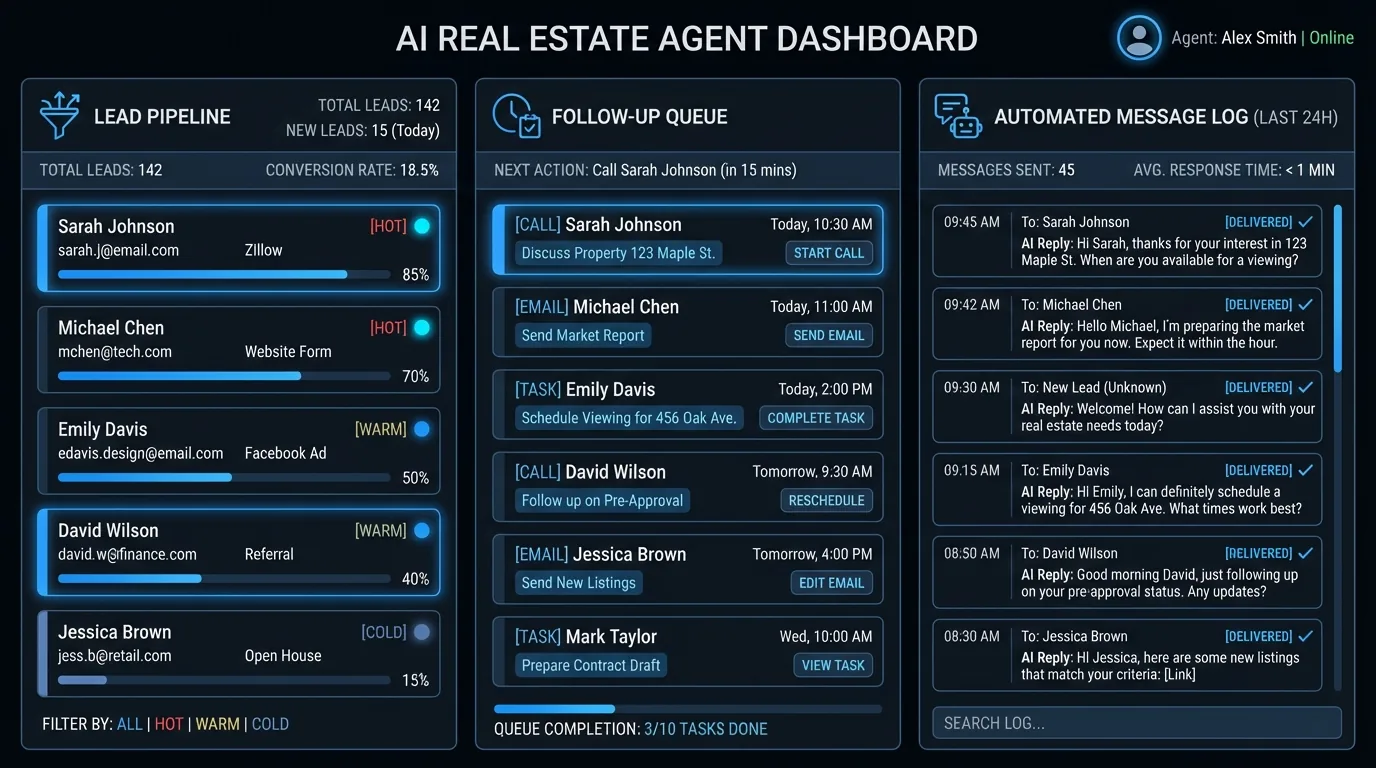
An AI agent for real estate is an autonomous system that monitors your inbox, CRM (customer tracking system), calendar, and pipeline, then takes action without waiting for instructions. Unlike a chatbot that responds when asked, an agent acts first. For real estate specifically, this means lead follow-up within minutes, pipeline tracking, listing coordination, and post-showing follow-ups handled automatically 24/7.An AI agent is not a chatbot. A chatbot responds when someone asks a question. An agent acts first. It monitors your inbox, your CRM, your calendar, and your pipeline, then takes action without waiting to be told.
For real estate specifically, here is what that looks like:
Lead follow-up: A new inquiry comes in at 11pm on Saturday. The agent sends a personalized response within 3 minutes. Not a template. A response that references the specific property they asked about, asks qualifying questions, and offers two showing times based on your actual calendar. Pipeline management: The agent tracks where every lead sits in your funnel. Anyone who goes quiet for 5 days gets a check-in. Anyone who opened your email twice without replying gets a different message. You know exactly who to call because the agent tells you. Listing coordination: New listing goes live. The agent sends announcement emails to your database, posts to your social channels, and schedules follow-up messages to everyone who showed interest in similar properties in the last 90 days. Post-showing follow-up: You do 8 showings on a Saturday. The agent sends personalized follow-ups to all 8 buyers by Sunday morning, collects feedback, and flags the two most likely to make an offer. Client updates during a transaction: Under-contract clients want constant reassurance. The agent sends weekly status updates, answers common questions about the process, and flags anything that needs your direct attention.Across real estate businesses we've worked with, the most common reaction after the first 30 days is: "I didn't realize how many leads were falling through before."
The Real Estate Lead Problem AI Agents Solve
Speed to lead is the most important metric in real estate that most agents ignore.| Response time | Lead conversion rate |
|---|---|
| Under 5 minutes | 21x higher than 30-minute response |
| 5 to 30 minutes | 4x higher than 1-hour response |
| 1 to 24 hours | 2x higher than next-day response |
| Over 24 hours | Industry average (most agents) |
The math is brutal. Most agents respond to online leads in 24 to 48 hours. The agents who consistently win are responding in minutes. They are not faster humans. They have systems that respond for them.
This is The 5-Minute Response Rule: every lead, regardless of when it arrives, gets a personalized response within 5 minutes. Not a template acknowledgment. A response that references the specific property they asked about and offers next steps. The 5-minute window is where most agents lose the deal before they even know there was one.
AI agents handle this gap. A lead comes in, the agent responds immediately, qualifies them, and alerts you when they are ready to talk. You spend your time on hot conversations, not chasing cold leads.
Real estate lead response stats: The median response time for online real estate leads is 38 hours. Leads contacted within 5 minutes convert at 21x the rate of leads contacted after 30 minutes. The majority of leads go with the first agent who responds. A solo agent handling 40-60 active inquiries per month manually cannot respond to all of them within 5 minutes. An AI agent responds to every lead within 3-5 minutes, 24/7, including evenings and weekends.What AI Agents Cost vs. What They Replace
Most real estate agents think they need an assistant to handle follow-up. Here is the real math:
| Resource | Monthly cost | What you get |
|---|---|---|
| Part-time admin assistant | $1,500 to $3,000/mo | 20 hrs/wk, business hours only, turnover risk |
| Transaction coordinator | $300 to $600 per transaction | Transaction management only, no lead work |
| ISA (Inside Sales Agent) | $2,500 to $5,000/mo | Lead calling, business hours, limited by scripts |
| AI agent (Jejo.ai) | $750 to $1,000/mo | 24/7, all lead follow-up, all pipeline management, client comms |
For a solo agent closing 20 to 30 transactions per year, the AI agent replaces $3,000 to $5,000/mo in support costs while adding capabilities no human support can match: midnight follow-ups, zero turnover, and zero management overhead.
For a team lead running 5 to 10 agents, the math gets even better. One AI agent handles follow-up across the whole team for less than the cost of one part-time ISA.
How This Is Different From AI Tools for Real Estate
Most guides about AI tools for real estate agents cover software: CRMs with AI features, listing description generators, automated home valuation tools. These are tools. They do what you tell them.
An agent is different. An agent watches your business, makes decisions, and acts. You set the rules once. It runs the system.
The practical difference: you do not open a tool to write follow-up emails. Your agent sends them, then tells you what happened.
This is the core distinction explained in AI agent vs chatbot: tools require your input to produce output. Agents produce output without waiting for you.
What AI Agents Cannot Do in Real Estate
Honest list:
Negotiate. Negotiation requires emotional intelligence, timing, and trust. An AI agent does not replace your role in the negotiation room. Show properties. Physical presence at showings, inspections, and walkthroughs is still yours. Build deep relationships. The handwritten note, the referral coffee, the post-close dinner: these are yours. The agent handles the volume work so you have more time for the relationship work. Handle complex situations off-script. When a transaction goes sideways in an unusual way, the agent flags it for you. It does not improvise. Read a person on a call. During a buyer consultation, an experienced agent hears hesitation and adjusts the conversation in real time. Automated follow-up runs the same sequence for every lead regardless of where they actually are mentally. The agent handles volume. Reading the specific person is still yours. Time messages for difficult situations. Automated sequences fire on schedule. They don't know that a prospect just fell through on another offer or that a client is mid-divorce. A templated check-in at the wrong moment can cost a relationship that was still recoverable. Flag sensitive contacts manually before the automation takes over. The pattern: AI agents handle the volume, the repetition, and the timing. Humans handle judgment, relationship-building, and exceptions.For agents also managing their own books, AI bookkeeping for small business covers how AI handles invoicing and financial reporting automatically. If you're running your own marketing alongside real estate operations, AI agents for marketing covers content, email, and lead nurture in the same agent architecture.
Setting Up an AI Agent for Real Estate
The setup process with Jejo.ai runs about 10 hours in the first week. It covers:
- Business DNA Extraction - A deep-dive session where the agent learns your market, your lead sources, your typical buyer and seller profiles, and your communication style.
- Pipeline mapping - Connecting your CRM, your inquiry sources (Zillow, Realtor.com, your website), and your email.
- Playbook creation - Defining the follow-up sequences, qualifying questions, and escalation triggers specific to your business.
- Review and calibration - A live test run where you review the agent's first 20 responses and tune anything that needs adjustment.
After setup, the agent runs without daily input. Weekly 15-minute reviews let you monitor performance and adjust as your pipeline changes.
What the First 90 Days Look Like
Most agents who adopt an AI agent go through three clear phases.
Days 1-10: Setup and calibration.The Business DNA Extraction session takes 3-4 hours. You cover your primary lead sources (Zillow, your website, referrals), your typical buyer and seller profiles, your market area, your communication style, and the specific scenarios you encounter most.
The agent then handles its first 20-30 real interactions while you review each response and flag anything to adjust. Every agent's business is slightly different. This is where the agent learns yours.
Days 11-30: Supervised operation.The agent runs 80% independently. You review a daily summary each morning. New leads get contacted within minutes. The 5-Minute Response Rule runs automatically from day one. Follow-up sequences are running. You step in for anything the agent flags as outside its playbook. By day 30, most agents are down to a weekly 15-minute review.
Days 31-90: Full operation.You start to notice what changed. Your inbox is shorter. The pipeline has fewer cold leads sitting uncontacted. You are spending more time on showings and negotiations and less time writing the same follow-up emails you have written 300 times. The typical agent reports recovering 12-18 hours per week by this point.
One solo agent in the Phoenix market saw 3 previously cold leads re-engage within 48 hours of activating automated follow-up sequences. Two went on to close.
Losing leads to faster agents? Most solo agents respond to online inquiries 12-38 hours after they arrive. An AI agent responds in under 5 minutes, every time, including Saturday night. AI agent for real estate or book a call.
What AI Agents Look Like for Different Real Estate Professionals
For solo agents doing $3M-$8M in volume:The primary value is consistent follow-up without an assistant. You handle 40-60 active inquiries at any given time. Manually following up on all of them takes 8-10 hours per week. The AI agent contacts every lead within 5 minutes, runs a 14-day follow-up sequence, and surfaces only the leads showing genuine buying signals.
A solo agent in this volume range typically closes 2-4 additional transactions per year directly attributable to leads that would have gone cold without consistent follow-up. At an average commission of $12,000, that's $24,000-$48,000 in additional annual revenue from the same lead volume.
For team leads with 3-8 buyer agents:The challenge at this level is inconsistency. Different agents follow up differently. Some are disciplined. Some let leads sit for 48 hours. An AI agent creates a floor: every lead across the entire team gets an immediate, professional response regardless of which agent it routes to. Team leads report that standardizing lead response alone increases team-wide conversion by 15-25%.
For investor-focused agents:Investors ask more questions, respond faster, and act on data more than emotion. AI agents excel here because the communication is high-volume and information-dense. An investor asking about cap rates on 12 properties in a single afternoon can get accurate, researched responses to all 12 without the agent sitting at a keyboard all day. Investor-focused agents using AI agents report handling 3x the active investor relationships without adding staff.
Common Mistakes When Setting Up an AI Agent for Real Estate
Not providing enough context during setup. An AI agent is only as good as what it knows about your business. Agents who rush the Business DNA Extraction session and provide shallow answers get a generic agent that sounds like a template. The setup session deserves 3-4 full hours. Bring your last 20 email threads. Show the agent what good communication looks like in your voice. Expecting perfection in week one. The agent will write responses you would have phrased differently. That is feedback, not failure. The calibration period exists exactly for this. Review the first 30 responses carefully and flag specific language or scenarios that need adjustment. Agents who do this consistently have a polished operation by day 30. Agents who skip review get an agent that keeps making the same errors. Using the agent to replace relationship-building. The agent handles volume work. It does not handle the relationship work. If you route your top-referral-source clients through automated follow-up without flagging them for personal attention, you will lose relationships. Maintain a short list of contacts who always get a personal response. The agent handles everyone else. AI agents for real estate in numbers: An AI agent at $750-$1,000/month replaces $2,500-$5,000/month in ISA and admin support. Setup takes 10 hours over the first week. Agents handling $2M-$10M in annual volume typically recover 12-18 hours per week and close 2-4 additional transactions per year with consistent AI-assisted follow-up. At an average $12,000 commission, 2 additional transactions covers the agent's annual cost in the first month. Based on industry data on agent productivity and average commission rates across US residential markets.Who AI Agents for Real Estate Are For
Solo agents doing $2M to $10M in volume per year. You are drowning in admin while trying to grow. An AI agent replaces the assistant you cannot afford yet and handles the follow-up you do not have time for. Teams with 3 to 10 agents. You need consistent follow-up across the whole team without building a dedicated operations role. The agent handles the system work; your agents handle the relationship work. Investor-focused agents. Investors move fast, ask a lot of questions, and need data quickly. AI agents excel at high-velocity, high-volume communication. Referral-based agents who want to systematize the "staying in touch" part of their business without spending hours a week on it.Who This Is NOT For
Luxury agents where every client expects deeply personal, white-glove communication at every touch point. AI agent-assisted communication is high quality, but some buyers and sellers at the $5M+ level expect to always be talking to the principal. Agents doing 1 to 3 transactions per year. The economics do not work at that volume. An AI agent makes sense when you have enough incoming leads and pipeline activity to justify the monthly cost. Teams that already have a full admin and ISA in place. If you have humans doing this work well, the ROI (return on investment) calculation changes., 2. Instant Response (under 5 min label), 3. Qualification Sequence (checklist icon), 4. CRM Updated (database icon), 5. Agent Alerted (bell icon for hot leads). Each step in a rounded box. Blue accent on the arrows and active nodes. 16:9 infographic style, clean and professional.)
The Alternative: One Agent Instead of Ten Tools
Most real estate agents know what they need: faster follow-up, consistent pipeline management, and client communication that doesn't fall through when they are in back-to-back showings.
What they don't need is another tool to learn, configure, and maintain.
An AI agent handles all three without requiring you to build workflows, maintain integrations, or check a CRM daily. It monitors your lead sources, responds within minutes, tracks where every lead sits in your funnel, and sends the follow-up you would have sent if you had time.
The cost: $750/month through Jejo.ai ($9,000/year). For a solo agent, that replaces $2,500-$5,000/month in ISA and admin support. For a team, it standardizes follow-up across all agents without an operations hire.
The setup runs about 10 hours in the first week. After that, your weekly involvement drops to a 15-minute review. The 30-day money-back guarantee means the first month carries no risk.
How Jejo.ai works for real estate or review the pricing options before hiring your next assistant.The Bottom Line
AI agents for real estate respond to every lead within 5 minutes (vs. the industry average of 38 hours), handle pipeline follow-up automatically, and recover 12-18 hours per week for solo agents. At $750-$1,000/month, they replace $2,500-$5,000/month in ISA and admin costs while adding 24/7 availability. Agents doing $2M+ in annual volume close 2-4 more transactions per year with consistent automated follow-up. See how it works for real estate.FAQ
What can an AI agent do for a real estate agent?
An AI agent for real estate handles lead follow-up (responding within minutes, 24/7), pipeline management (tracking every lead and triggering follow-up sequences), listing announcements, post-showing follow-up, and client communication during transactions. It acts autonomously without waiting for instructions.
How much does an AI agent cost for real estate?
Jejo.ai's AI agent costs $750 to $1,000 per month ($9,000 to $12,000/yr). That replaces $2,500 to $5,000/mo in ISA and admin costs while adding 24/7 availability and zero management overhead. The 30-day money-back guarantee makes the first month risk-free.
Is an AI agent the same as a real estate AI tool?
No. AI tools (CRM automation, listing description generators) do what you tell them. An AI agent acts on its own based on rules you set once. The difference is like a calculator vs. an employee who handles your bookkeeping without being asked.
How long does setup take?
Setup with Jejo.ai takes about 10 hours over the first week, including the Business DNA Extraction session. After that, the agent runs with weekly 15-minute reviews.
Can an AI agent replace a transaction coordinator?
Partially. An AI agent handles client communication and status updates throughout a transaction. It does not replace the specific administrative work of a transaction coordinator (document management, deadline tracking, compliance). Many agents use both: AI for communication, TC for paperwork.
The split works like this: the AI agent sends weekly update emails to buyers and sellers, answers common questions about what happens next in the process, and flags anything that needs the agent's direct attention. The TC manages the contract documents, tracks contingency deadlines, coordinates with the title company, and ensures compliance with state disclosure requirements. The AI agent costs $750-$1,000/month across all your transactions. A TC charges $300-$600 per transaction. On a 20-transaction year, that's $6,000-$12,000 in TC fees. Most agents find that using both still saves money compared to doing all the communication manually while also paying a TC, because the agent's communication handling reduces the time the TC spends answering client questions.
Ready to stop losing leads to faster agents?
See exactly how Jejo.ai works for real estate on the real estate industry page or book a strategy call to map out your specific pipeline. Already curious about pricing? See plans.