Quick answer
- What this covers: What is a virtual assistant?
- Who it’s for: Small business owners considering a virtual assistant.
Key takeaways:
- General VAs cost $5-$15/hour offshore but the true annual cost including management time is $19,000-$35,000
- Average VA tenure at agencies is 6-12 months: every departure resets the knowledge your business took months to build
- The 3-Type VA Model in 2026: general (admin), specialized (function-specific), AI-hybrid (human + AI tools). Knowing which you need prevents a costly mismatch
- In 2026, AI agents handle most general VA tasks at $9,000-$12,000/year with 24/7 availability and no management overhead
- Human VAs still win for stakeholder relationships, high-stakes conversations, and anything requiring physical presence
In this article:
- What Is a Virtual Assistant: The Basics
- What Virtual Assistants Actually Do
- How Much Does a Virtual Assistant Cost?
- Where Virtual Assistants Work Well
- Where Virtual Assistants Break Down
- Virtual Assistant vs. Employee: The Cost Comparison
- What Is a Virtual Assistant in 2026? How AI Is Changing the Role
- How to Hire a Virtual Assistant (If You Decide To)
What Is a Virtual Assistant: The Basics
What is a virtual assistant? A virtual assistant (VA) is a remote worker who provides administrative, technical, or creative support to business owners and teams. Work is typically task-based or time-based: you define what needs doing, the VA does it, you pay for hours worked or a monthly retainer.The 3-Type VA Model organizes the VA market into three distinct roles. Knowing which type you need before hiring is the single most common mistake to avoid.
General VAs handle a wide range of administrative tasks. Email management, calendar scheduling, data entry, travel booking, basic research, customer service responses. They are the most common type and the most affordable. Specialized VAs focus on a specific function. A social media VA manages platforms and content. A bookkeeping VA handles accounts receivable and reconciliation. A sales VA qualifies leads and manages your CRM (customer relationship manager). Specialized VAs cost more and require more vetting but deliver better results in their domain. Executive VAs (EVAs) support senior business owners or executives at a high level. They handle complex scheduling, coordinate across departments, draft communications, manage projects, and sometimes make decisions on the owner's behalf. An experienced EVA with deep company knowledge is the most valuable form of the role.The term "virtual assistant" covers a freelancer on Upwork doing 5 hours of inbox management per week and a full-time remote employee managing a CEO's operations. The label covers a wide range of capability and commitment.
What Virtual Assistants Actually Do
Here is a realistic breakdown of the most common VA task categories, organized by frequency:
| Task category | Examples | VA type |
|---|---|---|
| Email management | Sorting inbox, drafting replies, unsubscribing, flagging urgent items | General |
| Calendar and scheduling | Booking meetings, managing conflicts, sending reminders | General |
| Customer service | Responding to inquiries, handling complaints, processing refunds | General |
| Research | Competitor analysis, vendor comparison, content research | General |
| Data entry | Updating CRM records, spreadsheet management, form processing | General |
| Social media management | Scheduling posts, responding to comments, monitoring mentions | Specialized |
| Content creation | Writing blog posts, newsletters, captions | Specialized |
| Bookkeeping | Invoicing, expense tracking, reconciliation, payroll prep | Specialized |
| Lead generation | Finding prospects, outreach sequences, CRM updates | Specialized |
| Project management | Coordinating teams, tracking deliverables, chasing deadlines | Executive |
| Executive support | Travel coordination, board prep, stakeholder communication | Executive |
Most business owners hire a general VA to handle inbox and calendar management first, then layer in specialized work as trust builds.
How Much Does a Virtual Assistant Cost?
VA pricing varies widely depending on location, experience, and specialization. Here are current 2026 market rates:
| VA Type | Location | Hourly rate | Monthly retainer (40 hrs/mo) |
|---|---|---|---|
| General VA | Philippines | $5-$12/hr | $200-$480/mo |
| General VA | Eastern Europe | $12-$20/hr | $480-$800/mo |
| General VA | United States | $25-$50/hr | $1,000-$2,000/mo |
| Specialized VA (social/content) | Philippines | $8-$18/hr | $320-$720/mo |
| Specialized VA (bookkeeping) | Philippines | $10-$20/hr | $400-$800/mo |
| Executive VA | Philippines | $15-$25/hr | $600-$1,000/mo |
| Executive VA | United States | $40-$80/hr | $1,600-$3,200/mo |
The all-in cost of a VA includes more than hourly rate. Account for onboarding time (typically 20-40 hours to get a new VA productive), management overhead (expect 3-5 hours per week managing a VA in the first 90 days), and tool costs (project management, communication platforms, access provisioning).
For a detailed breakdown of VA pricing by tier and use case, see what virtual assistants really cost in 2026. Once you're ready to delegate, tasks for a virtual assistant gives you the complete list of what to hand off first.
What does a virtual assistant cost for small business? General VA rates run $5-$12/hr (Philippines), $12-$20/hr (Eastern Europe), $25-$50/hr (United States), but the all-in 1-year cost tells a different story: $3,600-$9,600 at hourly rate alone, plus $13,000-$20,800 in management time at $50/hr owner rate. Bureau of Labor Statistics data shows 26% annual turnover in administrative support, meaning most small businesses face full retraining costs every 4 years. True annual cost all-in: $19,000-$35,000 offshore, $34,000-$63,000 US-based.
Where Virtual Assistants Work Well
VAs deliver real value in specific situations. Before listing tasks, run them through The Delegation Readiness Test: can you document the task in under 10 minutes? Does it recur at least weekly? Does it NOT require your specific judgment? Three yeses means delegate. Anything else, keep or automate. The common thread for tasks that pass: they are defined, repeatable, and do not require deep company context to execute.
High-volume inbox management. If you receive 100+ emails per day and spend 3+ hours managing them, a good VA can take that to 45 minutes of review for you. The VA handles the 80% that is routine. You handle the 20% that requires your judgment. Calendar coordination. Scheduling across multiple time zones, coordinating team availability, and managing complex itineraries is exactly the kind of task that a detail-oriented VA handles better than most business owners. Customer service volume. For businesses with consistent, repeatable customer inquiries, a VA following documented scripts delivers a consistent experience and frees up significant time. Research and vendor comparison. When you need to compare 10 software options, find 20 potential suppliers, or research a market, a competent VA with clear instructions does this well and fast. Part-time administrative support. If you need 10-20 hours of help per month and cannot justify a full hire, a VA is the most flexible and cost-effective option. One solo consultant cut calendar coordination from 3 hours per week to 15 minutes after handing it to a VA with a 1-page scheduling preferences doc. Setup took one afternoon.A 4-person recruitment firm handed inbox management to a general VA in week one using a 2-page priority system. By week 3, the owner stopped touching email before noon. That single delegation freed 6 hours per week she reinvested in business development.
Where Virtual Assistants Break Down
Most business owners who have hired VAs and been disappointed ran into one of four problems.
Context loss. A VA learns how you work, your clients, your preferences, your business quirks over months. When they leave (and turnover in the VA industry is high), you start over. The knowledge walks out the door. The management tax. Managing a VA takes real time. Writing clear instructions for every task, reviewing outputs, providing feedback, and handling the communication overhead is work. Some business owners discover they are spending more time managing than the VA is saving. Availability mismatch. VAs work hours. If your business generates tasks at 10pm or over the weekend, a VA is not there. You are back to doing it yourself or waiting until Monday. Scope limitations. A good general VA is not a marketer, strategist, or project manager. If you need someone to make judgment calls, manage ambiguous situations, or proactively identify problems, a standard VA will wait to be told what to do. Tasks that fail The Delegation Readiness Test on the judgment criterion are exactly the tasks that cause friction when handed to a VA.These are not flaws in any specific VA. They are structural limitations of the model. For a direct comparison of what happens when VA limitations matter most, see chatbot vs AI agent.
VA turnover costing you months of rebuilt context? The average small business loses 3-6 months of accumulated context every time a VA leaves. That's not a VA quality problem. It's a structural problem with the model. Book a strategy call to see how an AI agent handles the same scope without the context loss.
Virtual Assistant vs. Employee: The Cost Comparison
Business owners often consider a VA as an alternative to their first employee. The comparison is worth doing carefully.
| Factor | General VA (Philippines) | Part-time employee (US) | Full-time employee (US) |
|---|---|---|---|
| Monthly cost | $300-$800/mo | $2,000-$3,500/mo | $4,000-$7,000/mo |
| Benefits | None | Partial | Full (+30-40% of salary) |
| Management overhead | Medium | Medium | High |
| Task flexibility | High | Moderate | Low |
| Business knowledge retention | Low (turnover risk) | Medium | High |
| Availability | Business hours (their timezone) | Set hours | Set hours |
| Total 1-year cost | $3,600-$9,600 | $24,000-$42,000 | $65,000-$100,000+ |
For a business owner managing under $500K in annual revenue, the VA model makes financial sense over a US-based hire. The tradeoffs are management overhead and the knowledge retention problem.
For the complete picture of what hiring really costs once you factor in benefits, onboarding, management time, and turnover, see the true cost of hiring an employee.
VA vs employee vs AI agent cost comparison: General VA (Philippines): $19,000-$35,000/year all-in with management time. US part-time employee: $24,000-$42,000/year. An AI agent covering comparable digital scope runs $9,000-$12,000/year with near-zero management overhead, 24/7 availability, and permanent context retention.
What Is a Virtual Assistant in 2026? How AI Is Changing the Role
The VA market in 2026 looks different from 2020. AI tools have automated many of the most common VA tasks, which has pushed the value of human VAs upmarket and created a new category: AI-augmented VAs.
The 3-Type VA Model now has a practical fourth role emerging alongside the original three. Three things are happening simultaneously:
AI tools are now automating low-skill VA work. Data entry, form filling, basic email responses, and simple research are handled by AI faster and cheaper than human VAs. Business owners who previously hired a VA for 10 hours of data entry per week do not need that anymore. AI agents are replacing general VAs for many business owners. An AI agent handling email, calendar, lead follow-up, and content creation does the work of a general VA without the management overhead, context loss, or availability gaps. The cost is $750-$1,000/month versus comparable VA rates, with 24/7 availability and zero onboarding friction. Human VAs are moving into higher-skill roles. Experienced VAs who can handle strategic work, manage complex stakeholder relationships, and make judgment calls in ambiguous situations are more valuable than ever. The VA market is splitting: low-skill work goes to AI, high-skill work goes to human specialists. AI-hybrid VAs are the emerging fourth type in the 3-Type VA Model: human VAs who use AI tools to increase their own output. An AI-hybrid VA handles 2-3x the task volume of a traditional VA and produces better-formatted deliverables. If you hire in 2026, ask candidates what AI tools they use and how.What this means for you: if you are considering a VA for calendar management, inbox sorting, or basic research in 2026, an AI agent will likely serve you better. If you need someone who can represent your voice in high-stakes conversations, build relationships, or navigate complex interpersonal situations, a skilled human VA is still the answer.
How to Hire a Virtual Assistant (If You Decide To)
If after reading this you decide a human VA is the right fit, here is the process that works.
Step 1: Define the role. Run every candidate task through The Delegation Readiness Test first: can you document it, does it recur weekly, does it not require your judgment? Only tasks that pass all three belong in a VA scope. Estimate time per task per week. If the total is under 10 hours, you probably want hourly or project-based. Over 20 hours, consider a retainer. Step 2: Document before you hire. For every task you plan to hand off, write a brief procedure: what the output looks like, what information the VA needs to complete it, what your standards are. Hiring without documentation guarantees frustration for both sides. Step 3: Source candidates. For general VAs, platforms like Upwork, OnlineJobs.ph (Philippines-focused), and Virtual Staff Finder have large talent pools. For specialized VAs, look for specialists with industry-specific portfolios. Step 4: Test with a paid project. Before committing to a retainer, give shortlisted candidates a paid test task that represents real work. Evaluate output quality, communication style, and turnaround time.In our experience, the test task is the single most reliable signal in the hiring process. Here is what a good test task looks like for a general VA: send the candidate your last 20 emails and ask them to sort by priority (urgent, needs reply, archive), draft responses to 5 of them, and flag 3 that need your direct attention.
A strong VA returns organized output in 90 minutes. A great one adds a note explaining their priority logic. That note tells you how they think, which is the one thing a resume cannot show.
Step 5: Start with a 30-day trial period. Set clear expectations for the first 30 days. Weekly check-ins, documented feedback, and a defined review at day 30. Most relationship problems are visible by day 30. Step 6: Invest in onboarding. Plan for 20-40 hours of onboarding time. The biggest mistake is expecting a VA to hit the ground running with minimal instruction. The upfront investment in training pays back over months.What to Know Before You Hire
Three realities the agency listings don't mention.
VAs handle repeatable tasks well. The problem starts when you need them to exercise judgment. A VA follows your calendar priority rules precisely. They won't reschedule your call with a key client who just sent an annoyed email, because they don't know what that email means in context. That read stays with you. Most VA arrangements take 60-90 days to reach full productivity. The first month is often slower than doing the task yourself. Expect 3-5 hours per week in training, corrections, and documentation gaps during that period. The payback starts in month 2 when execution reaches independence. The management overhead compounds as scope grows. A VA handling one task type is manageable. Add three categories and you're running a small operation. Each new category adds weekly check-ins, documentation maintenance, and error correction cycles. Efficiency gains from delegation don't scale linearly with the number of tasks you hand off.What This Looks Like in Practice
Elena owns a boutique interior design firm in Seattle. She hired a general VA in early 2025 to handle client scheduling and invoice follow-up, freeing 9 hours per week. At her $200/hour billing rate, that freed $1,800 per week in capacity she reinvested in client work. Seven months in, her VA left for a full-time role. Retraining a replacement cost 3 weeks of Elena's time plus roughly $3,600 in onboarding overhead before outputs returned to the standard the previous VA had built.The math still worked over 12 months. $19,200 in recovered capacity against $8,400 in VA fees plus the transition cost. But the context loss was real and took two months to fully rebuild. Anyone who's been through it will tell you the disruption doesn't show up in the ROI calculation. It shows up in the week-to-week execution.
What a Managed AI Agent Does Differently
Understanding what is a virtual assistant is useful. Understanding what has replaced VAs for most general administrative work in 2026 is more useful if you're about to hire one.
A managed AI agent is not a chatbot, a ChatGPT subscription, or a Zapier workflow to maintain. It's a service that learns your business through deep onboarding, then runs operations proactively without daily instruction.
The comparison to a general VA is direct. A VA needs documentation for each new task type. An agent builds context from your actual business over time. A VA requires 5-8 hours per week of management. An agent requires a weekly review. A VA's knowledge walks out when they leave. An agent's context compounds every month.
The cost comparison is equally direct. A general VA at offshore rates costs $19,000-$35,000 per year including your management time. An AI agent covering comparable scope costs $9,000-$12,000 per year.
For high-stakes communication, phone work, in-person tasks, and relationship-sensitive situations, a skilled human remains the right choice.
For everything else, the economics strongly favor a managed agent. Jejo.ai starts at $750/month with a 30-day guarantee. No long-term commitment required.
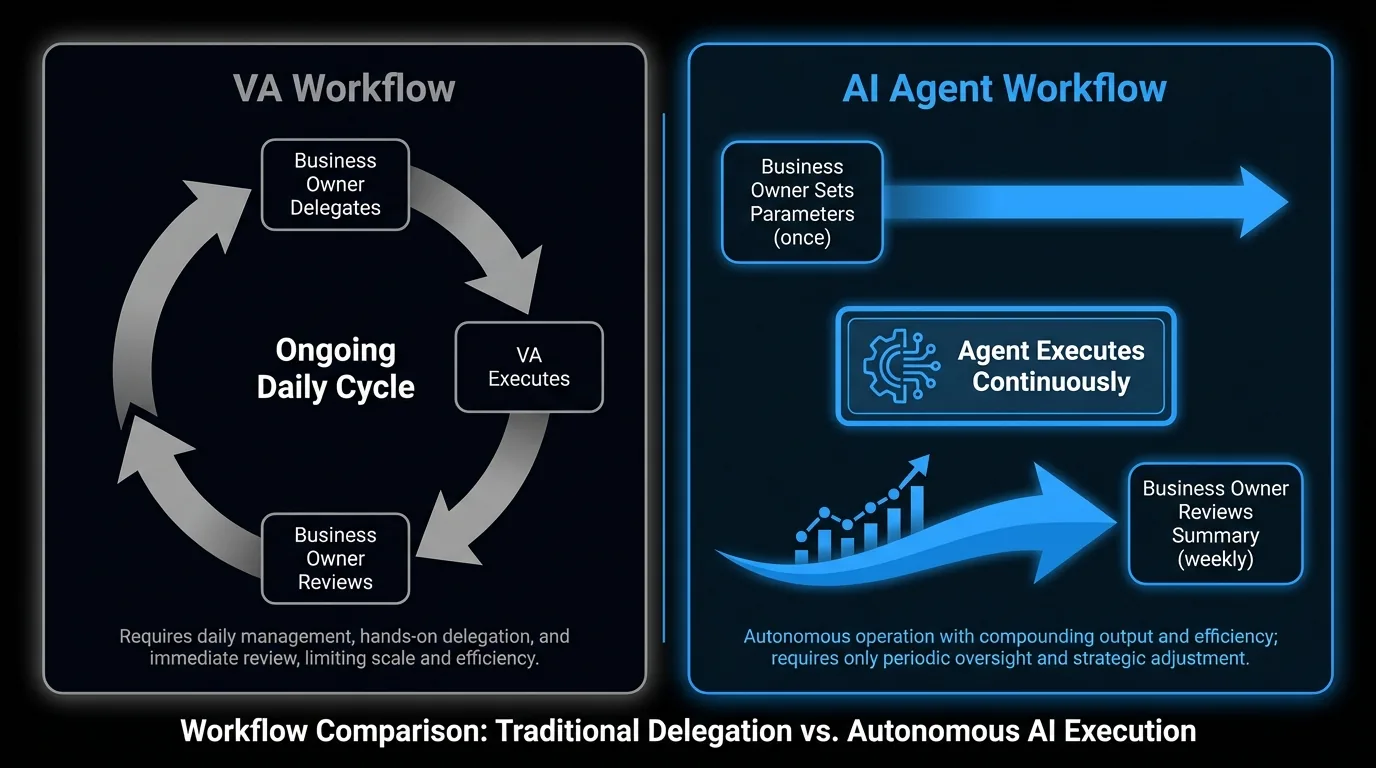 . Circular arrow showing ongoing daily cycle. Right 'AI Agent Workflow' in blue #2997ff: Business Owner Sets Parameters (once) → Agent Executes Continuously → Business Owner Reviews Summary (weekly). Single large arrow showing compounding output over time. 16:9 infographic, clean professional.)
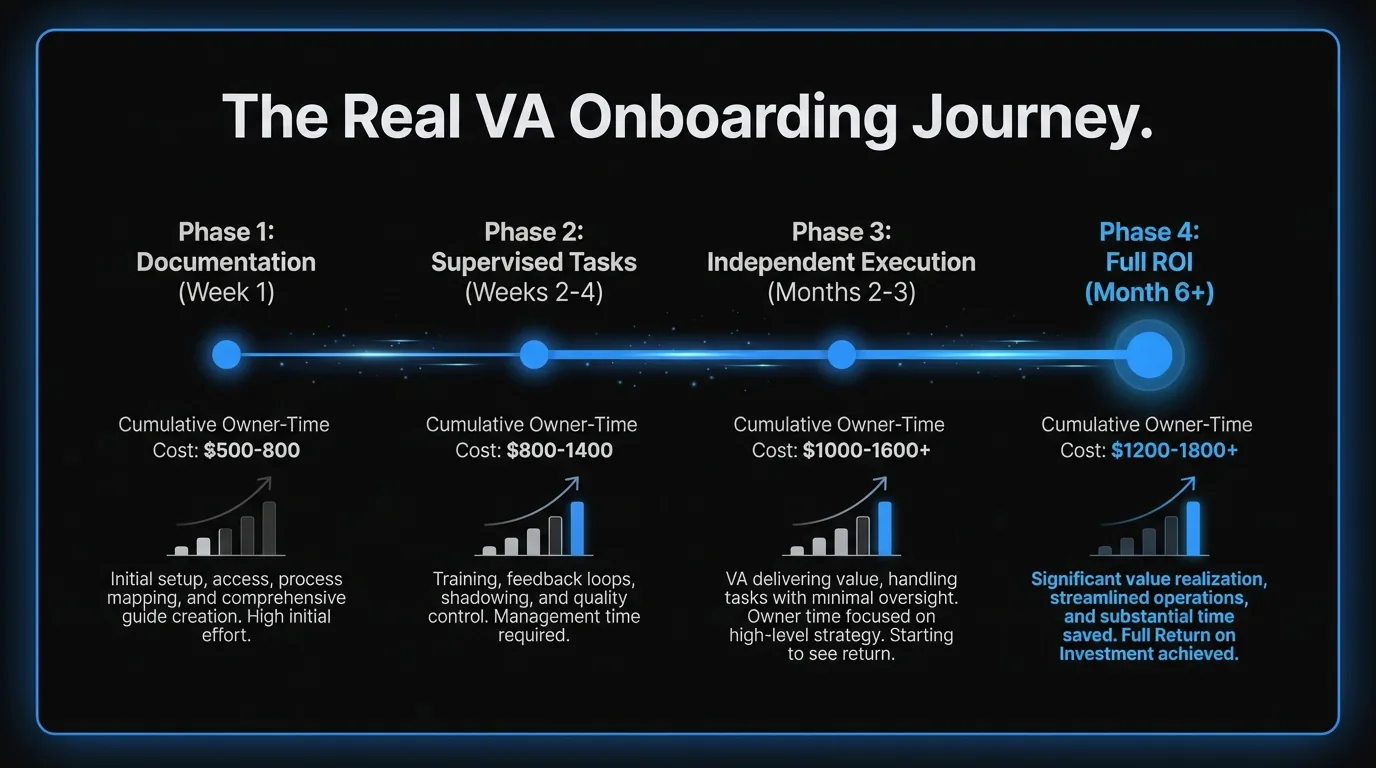 : 'Documentation', $500-800 in owner time. Phase 2 (Weeks 2-4): 'Supervised Tasks', $300-600 in management time. Phase 3 (Month 2-3): 'Independent Execution', VA delivering value. Phase 4 (Month 6+): 'Full ROI' in blue #2997ff. Cost milestones shown below each dot in smaller text. Header: 'The Real VA Onboarding Journey.' 16:9 infographic, clean professional.)
Who This Is For
This guide is for you if:- You're evaluating your first VA hire and want to understand the real costs before committing
- You need phone-based, in-person, or relationship-sensitive work handled by a human
- You have simple, well-documented repeatable tasks and time to manage someone
- You've already been burned by VA turnover and lost months of rebuilt context
- Most of your work is digital and doesn't require a human voice or physical presence
- You're spending 15+ hours/week on operational tasks and need a system that compounds
The Bottom Line
What is a virtual assistant in 2026 depends on which tasks you're trying to fill. For phone calls, high-stakes relationships, and in-person work, a skilled human VA is still the right answer. For the 70-80% of small business work that is digital, repeatable, and doesn't require a human voice, Jejo.ai agents handle comparable scope at $9,000-$12,000/year with 24/7 availability and zero context loss on a 30-day guarantee.FAQ
What is the difference between a virtual assistant and a personal assistant?
A personal assistant (PA) typically works in-person or full-time with a single person. A virtual assistant works remotely, often for multiple clients simultaneously, and handles tasks via digital communication. The functional overlap is significant, but a PA usually has deeper involvement in the day-to-day decisions and a higher level of trust and context.
How many hours per week does a business owner typically need a VA?
Most business owners starting with their first VA use 10-20 hours per month. This covers basic inbox management, calendar coordination, and one or two recurring tasks. As trust builds and documentation improves, hours often expand to 40-80 per month. Full-time VA arrangements (160+ hours/month) are common for business owners who have successfully delegated significant operations.
What is the biggest mistake when hiring a virtual assistant?
Hiring without documentation. Business owners who expect a VA to figure out their preferences, systems, and standards without written procedures end up frustrated and the VA ends up confused. Write down what good output looks like before the first day.
Can a virtual assistant handle confidential business information?
Yes, but protect yourself properly. Use a signed NDA (non-disclosure agreement), restrict access to sensitive data using permission-based tools, and use password managers that share credentials without exposing the underlying password. Never share direct login credentials to banking, payroll, or sensitive customer data without proper access controls.
Is a virtual assistant or an AI agent better for my business in 2026?
For repeatable, task-based work that does not require relationship judgment, an AI agent typically outperforms a VA on cost, availability, and consistency. For work requiring human judgment, stakeholder relationships, or deep business context that carries reputation risk, a human VA remains more reliable. Many business owners use both: an AI agent for the volume and a skilled human VA for the high-trust work.
Ready to see what actually replaces your VA search?
Most business owners looking for a virtual assistant find that an AI agent handles the core work they had in mind, without the management overhead. Compare VA vs AI agent to see the full breakdown, or book a strategy call to see what a Jejo.ai agent would handle in your business specifically.