Quick answer
- What this covers: Hermes Agent Docker lets you self-host your AI agent on your own infrastructure.
- Who it’s for: People evaluating hermes agent.
Hermes Agent runs on your infrastructure if you want it to. The Docker deployment path is real, documented, and used by businesses with specific reasons to self-host. This guide covers what deploying Hermes Agent via Docker actually involves, who has legitimate reasons to do it, what it costs in time and money, and why most small business owners end up choosing a different path.
No jargon wall. Practical information for people who are deciding, not people who already decided.
Key takeaways:- Docker deployment is for businesses with specific infrastructure requirements. Data sovereignty, compliance mandates, or existing DevOps capacity are the main reasons to self-host
- Self-hosting Hermes via Docker moves technical ownership to you. Updates, uptime, scaling, and security patches become your responsibility
- The actual deployment time is 2 to 6 hours for someone with Docker experience. Without experience, that number multiplies fast
- Most business owners with 1 to 20 people choose managed deployment at $750/mo. The time cost of self-hosting typically doesn't pencil out against the savings
- What Docker Deployment Means for Hermes Agent
- Legitimate Reasons to Self-Host
- What the Docker Deployment Process Involves
- Infrastructure Requirements and Ongoing Costs
- The Hidden Time Cost of Self-Hosting
- Self-Host vs Managed: The Real Comparison
- FAQ
What Docker Deployment Means for Hermes Agent
Docker is a tool that packages software into containers, standardized units that run consistently across different computing environments. Docker containers have become the industry standard for deploying cloud-native applications, with over 13 million developers using the platform. When you deploy Hermes Agent via Docker, you're running the agent software on hardware you control, whether that's your own servers, a VPS, or a cloud instance you manage.
This is different from the default deployment path where Jejo.ai hosts and manages the infrastructure for you.
Both paths run the same Hermes Agent software. The difference is ownership: who maintains the servers, who handles updates, who gets paged at 2 AM when something breaks.
For business owners evaluating this choice, the question isn't "can I self-host." It's "should I, and what will it actually cost me."
For context on how Hermes Agent works before getting into deployment specifics, see what is Hermes Agent.
Legitimate Reasons to Self-Host
There are real cases where self-hosting via Docker makes sense. Not theoretical reasons. Actual business needs.
Data residency requirements. Some regulated industries require that customer data and communication processing stay within specific geographic boundaries or on infrastructure you directly control. The EU's GDPR and similar regulations in 14+ jurisdictions now impose strict requirements on where business data is processed and stored. If your compliance officer says "no third-party SaaS for client data," Docker self-hosting may be required, not optional. Existing infrastructure and DevOps capacity. If your business already runs internal servers with a team member responsible for maintaining them, adding Hermes to that stack costs less than it would for a business starting from zero. The marginal cost of one more container on an already-managed server is low. Security audit requirements. Some enterprise clients, particularly in finance, healthcare, or government supply chains, require that vendors demonstrate direct control over their software environment. A self-hosted deployment satisfies audits that a managed SaaS deployment doesn't. Custom integration requirements. Businesses with highly custom internal systems, legacy databases, or proprietary APIs sometimes need to deploy Hermes in a network environment where it can directly access internal systems that aren't publicly reachable. Cost at scale. At high volume, self-hosting on infrastructure you already pay for can be cheaper than managed deployment pricing, particularly for businesses processing thousands of interactions per day.If none of these apply to your business, you're not a Docker deployment candidate. You're a managed deployment candidate. The rest of this article is still useful for understanding the tradeoffs, but the decision is probably already made.
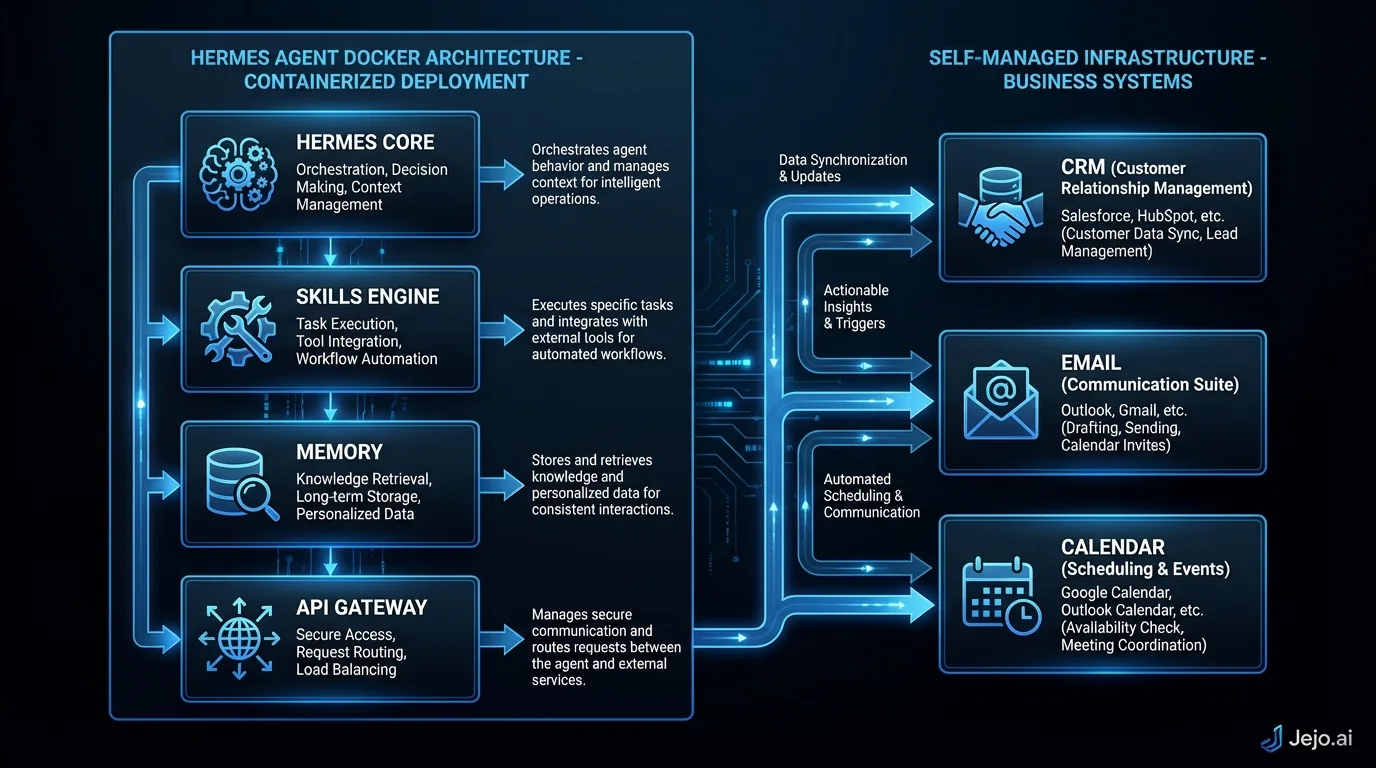
What the Docker Deployment Process Involves
Here's what deploying Hermes Agent via Docker actually requires, step by step.
Prerequisites before you start:- Docker and Docker Compose installed on your target server
- A server with at least 4GB RAM and 2 CPU cores (8GB RAM recommended for production)
- A domain and SSL certificate configured for the agent's web interface
- API credentials for the LLM provider (OpenAI, Anthropic, or similar)
- Credentials for the business tools you're connecting (email, CRM, calendar)
- Pull the Hermes Agent Docker image from the registry
- Configure your `docker-compose.yml` with environment variables (API keys, database connection strings, agent configuration)
- Configure persistent storage volumes for the agent's memory and logs
- Set up a reverse proxy (nginx or Caddy) to handle HTTPS termination
- Run the container and complete the initial setup wizard via the web interface
- Connect your business tools through the integration configuration
- Configure your agent's initial goals and escalation rules
- Run a calibration period with active monitoring before enabling autonomous operation
For someone with Docker experience, steps 1 through 5 take 2 to 4 hours. Steps 6 through 8 are the same regardless of deployment path: they're the business configuration, not the technical setup.
For someone without Docker experience, step 1 through 5 can take 1 to 3 days of learning and troubleshooting before the environment is stable.
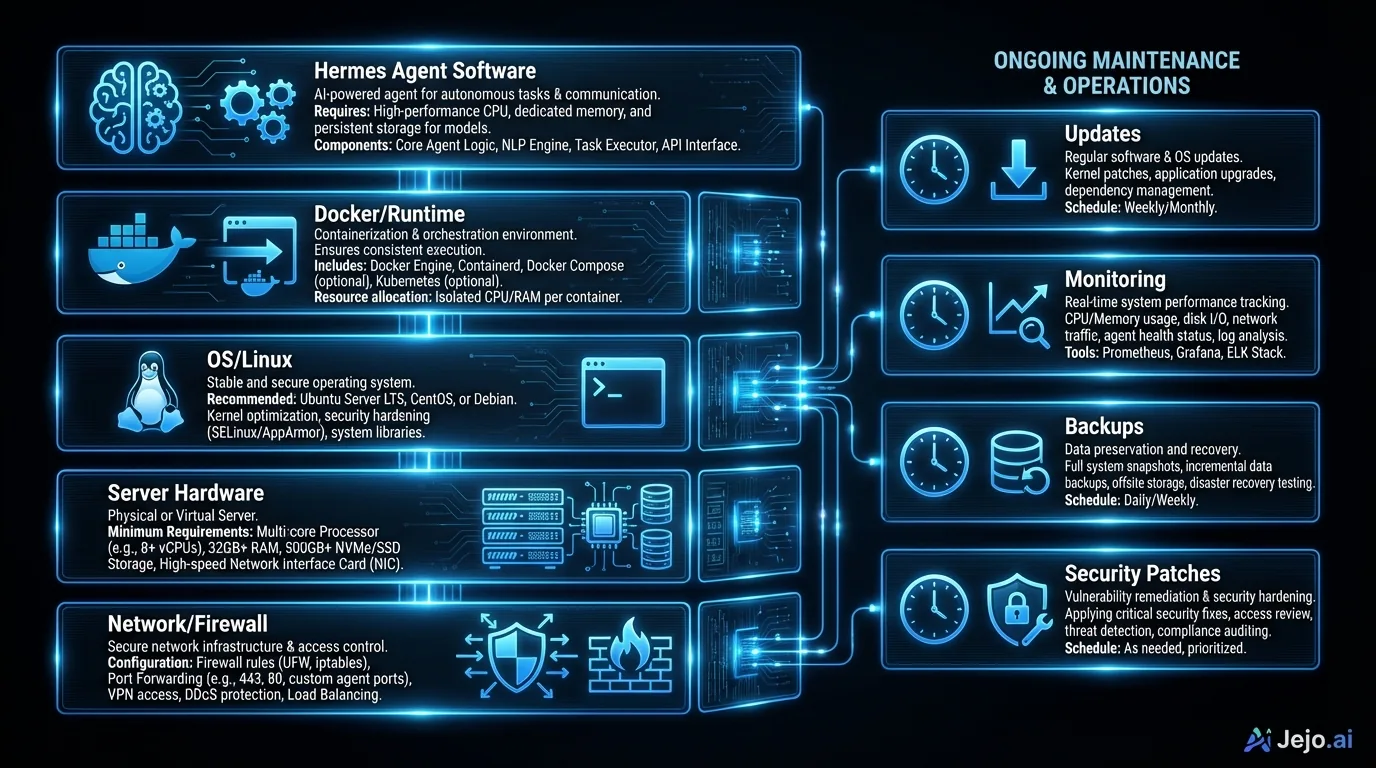
What you're responsible for after deployment:- Monitoring container health and uptime
- Applying updates when new Hermes Agent versions release
- Database backups for agent memory and configuration
- SSL certificate renewal
- Security patches for the host OS and Docker environment
- Troubleshooting integration failures when connected tools change their APIs
That list grows with the complexity of your setup. Each item requires time or a team member who knows what they're doing.
Infrastructure Requirements and Ongoing Costs
Self-hosting has real infrastructure costs that don't show up in the initial setup.
| Resource | Minimum | Recommended | Purpose |
|---|---|---|---|
| RAM | 4 GB | 8 GB | Agent processing and memory |
| CPU | 2 cores | 4 cores | Concurrent task handling |
| Storage | 20 GB | 50 GB | Logs, agent memory, model cache |
| Monthly data transfer | 50 GB | 200 GB | Tool integrations, API calls |
| Uptime SLA | 99.5% | 99.9% | Agent availability for autonomous operation |
A VPS with these specs on AWS, DigitalOcean, or similar providers runs $30 to $120/mo depending on configuration and provider. Add the cost of your time for ongoing maintenance: 30 minutes to 2 hours per month for a clean-running setup, more when something breaks.
The honest infrastructure cost for a competently self-hosted Hermes Agent: $50 to $150/mo in cloud costs, plus 2 to 5 hours per month of your time or a team member's time.
For a business owner billing $150 to $300/hr for their work, the time cost alone often exceeds the $750/mo managed deployment price within the first quarter.
The Hidden Time Cost of Self-Hosting
Infrastructure costs are visible. Time costs are not.
Here's where self-hosting time goes that most people undercount:
Initial setup time. Even with Docker experience, the first deployment takes longer than expected. Tool integrations break. SSL configurations need adjustment. Environment variables are wrong. A realistic estimate for clean initial deployment: 4 to 8 hours for an experienced DevOps practitioner. Update management. Hermes Agent releases updates that include new features, bug fixes, and security patches. Each update requires pulling the new image, checking breaking changes in release notes, updating your `docker-compose.yml` if configuration changed, and verifying that your integrations still work after the update. Budget 1 to 2 hours per update, typically monthly. Troubleshooting integration failures. Third-party APIs change. CRM authentication tokens expire. Calendar sync breaks when Google updates OAuth requirements. Each of these incidents requires investigation and usually a code or configuration change. These happen 2 to 4 times per year on a typical self-hosted setup. Budget 2 to 4 hours per incident. Disaster recovery. If your server goes down, someone needs to restore from backup and bring the agent back online. If you don't have a documented recovery procedure and someone who can execute it, your business operations stop until the agent is restored.This is the full picture of self-hosting. The upfront cost gets the attention. The ongoing maintenance cost is what makes the math work or not.
Self-Host vs Managed: The Real Comparison
Here's a direct comparison for a business owner doing the math.
| Dimension | Docker Self-Hosted | Managed via Jejo.ai |
|---|---|---|
| Monthly cost | $50-$150 (infra) + time | $750 flat |
| Initial setup time | 4-16 hours | 30 min kickoff call |
| Ongoing maintenance | 2-8 hrs/mo | 0 (handled for you) |
| Update responsibility | You | Jejo.ai |
| Uptime guarantee | Self-managed | Included |
| Support when broken | Community/forums | Dedicated account manager |
| Security patching | You | Jejo.ai |
| Technical skill required | Docker, Linux, networking | None |
The $750/mo managed price looks different once you account for what it replaces. You're not paying for hosting. You're paying for a team to run the infrastructure, monitor the agent, apply updates, fix integration issues, and provide support when something unexpected happens.
For a business owner at $200K to $2M in revenue, the question is never "is $750 cheaper than self-hosting." The question is: "Is my time worth more than $750/mo, and would I rather spend it on my business than on server maintenance?" SBA data shows that small business owners work an average of 50 hours per week, making their effective hourly rate, and therefore the cost of every hour diverted to infrastructure, higher than most realize.
For most business owners, the answer is yes. That's why most Hermes Agent deployments run through Jejo.ai.
For the rare business with a legitimate compliance or infrastructure requirement that mandates self-hosting, Docker is the right path and the cost is justified. For everyone else, it's engineering for engineering's sake.
For pricing context and comparison, see Hermes Agent pricing. For a head-to-head comparison with other AI agent platforms that also offer self-hosting, see Hermes Agent vs OpenClaw.
FAQ
Can Hermes Agent be self-hosted?
Yes. Hermes Agent is available as a Docker container for businesses that need to self-host on their own infrastructure. The deployment requires Docker experience and a server meeting minimum specifications. Most small businesses use managed deployment through Jejo.ai instead.
What are the server requirements for Hermes Agent Docker?
Minimum requirements: 4 GB RAM, 2 CPU cores, 20 GB storage. Recommended for production: 8 GB RAM, 4 CPU cores, 50 GB storage. You'll also need a domain with SSL configured and outbound internet access for the agent to reach integrated tools and LLM APIs.
Why would someone self-host instead of using managed deployment?
The main legitimate reasons are data residency requirements for compliance, existing internal infrastructure that makes the marginal cost low, enterprise security audit requirements, or custom internal integrations that require the agent to run inside a private network. For businesses without these specific requirements, managed deployment is typically the better choice.
How long does Docker deployment take?
For someone with Docker and Linux experience, initial deployment takes 4 to 8 hours including initial configuration. For someone learning Docker for the first time, expect 1 to 3 days. The business configuration steps (connecting tools, setting goals, calibration) take the same time regardless of deployment path.
What happens when Hermes Agent releases an update on self-hosted?
You're responsible for pulling new Docker images and applying updates. Each update typically takes 1 to 2 hours including testing. Managed deployments through Jejo.ai receive updates automatically with no action required from you.
Is Hermes Agent free?
No. There is no free tier for Hermes Agent. Self-hosted Docker deployment requires a server ($70 to $300/mo infrastructure cost) plus your time for maintenance. The managed path through Jejo.ai is $750/mo all-inclusive. The Docker path looks cheaper on paper, but factor in the setup time (4 to 8 hours) and ongoing monthly maintenance (5 to 10 hours) before comparing. For most service business owners, managed deployment delivers better ROI. See Hermes Agent pricing for the full comparison.