Quick answer
- What this covers: AI tools for real estate agents save 3 hours daily on admin.
- Who it’s for: Real estate agents and brokers.
Real estate agents spend 35-40% of their workweek on admin that never closes a deal. The best AI tools for real estate agents cut that to under 45 minutes a day. Follow-up, listing descriptions, scheduling, pipeline management. All running without you opening a single app.
If you want a broader look at how AI is changing small business operations, the AI tools by industry guide covers what's working across different business types.
Key takeaways:
- A typical AI tool stack for real estate (CRM + ChatGPT + scheduling + transaction management) costs $407-$607/month and still requires 3-4 hours of daily manual coordination
- The 3-Hour Daily Recovery: an AI agent returns 3-plus hours per day from admin to client work. Over a 200-day work year, that is 600 hours of recovered capacity
- Speed to lead matters more in real estate than almost any other industry: leads contacted within 5 minutes are 21x more likely to convert than leads who wait 30 minutes
- Once an AI agent handles follow-up and pipeline management, most of the separate tool stack becomes redundant
 In this article:
- What AI Tools for Real Estate Agents Actually Do in 2026
- The Best AI Tools for Real Estate Agents (By Category)
- What No Individual Tool Solves: The Coordination Problem
- How Much Do AI Tools for Real Estate Cost?
- What a Real Day Looks Like: Tools vs. Agent
- Common Mistakes Agents Make With AI Tools
- Step-by-Step: Moving From a Tool Stack to an AI Agent
- FAQ
What AI Tools for Real Estate Agents Actually Do in 2026
AI tools for real estate agents fall into three categories: content tools (listing descriptions, emails, social posts), CRM tools (follow-up sequences, lead scoring), and scheduling tools (showing requests, calendar management). Each saves 20-30 minutes per task. None of them coordinate with each other. An AI agent is different: it monitors your inbox, flags hot leads, drafts responses, updates your CRM (customer tracking system), and sends follow-ups without being asked. The practical difference is 30 minutes saved per task versus 3-4 hours saved per day.Most AI tools marketed to agents fall into three categories:
- Content tools: write listing descriptions, emails, social posts
- CRM tools: automate follow-up sequences, score leads
- Scheduling tools: handle showing requests, calendar management
The gap is coordination. Each tool does its own thing. None of them talk to each other. The agent still has to tie it all together.
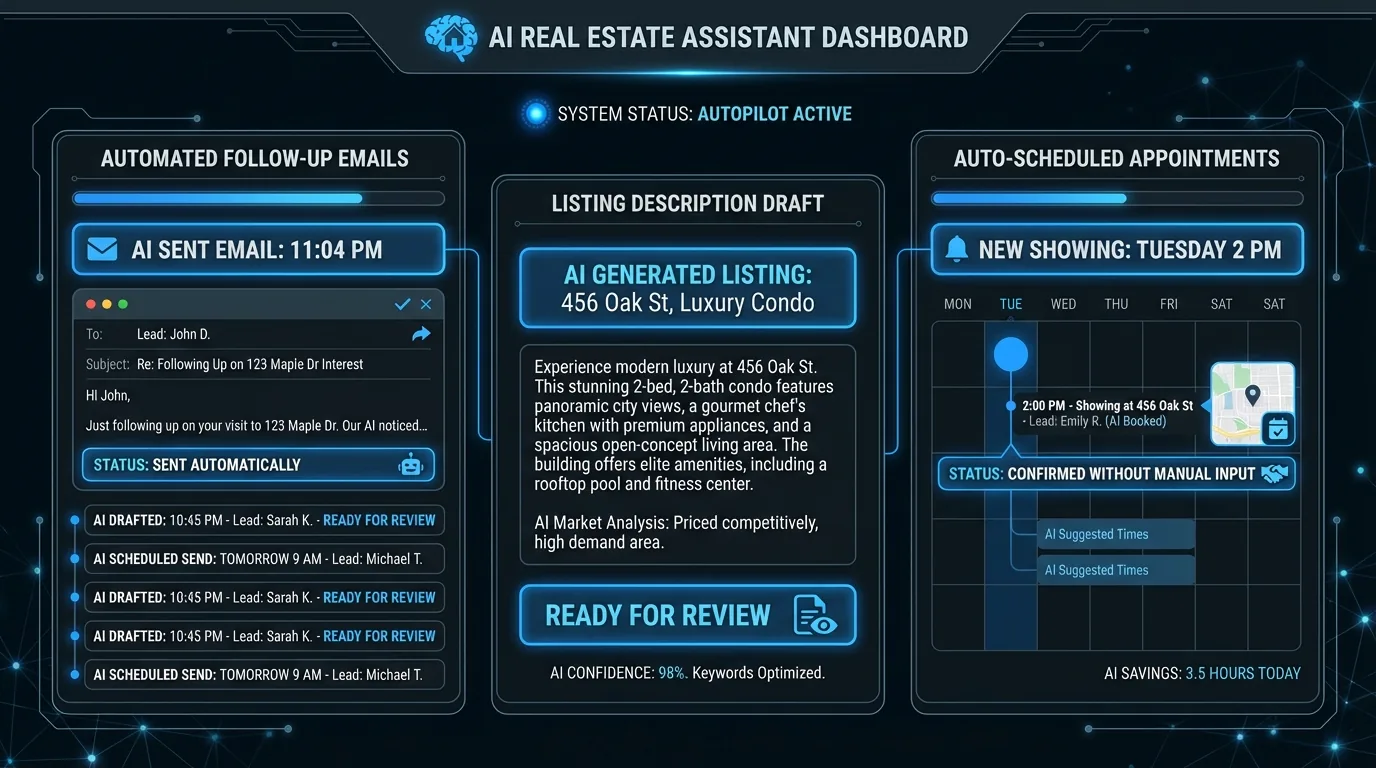
That's the difference between AI tools and an AI agent. Tools wait to be used. An agent monitors your inbox, flags hot leads, drafts responses, updates your CRM, and sends follow-ups without being asked.
| Task | Tool approach | AI Agent approach |
|---|---|---|
| New lead comes in | Manual entry into CRM | Auto-captured, enriched, responded to in 5 min |
| Listing description | Open tool, write prompt, copy output | Auto-drafted when listing details are submitted |
| Follow-up sequence | Build sequence in CRM manually | Triggered automatically based on lead behavior |
| Showing request | Check calendar, reply manually | Scheduling link sent, calendar updated, reminder set |
| Post-showing follow-up | Remember to do it | Sent automatically 2 hours after showing |
| Weekly pipeline review | Compile manually from CRM | Summary in your inbox every Monday at 7 AM |
That gap is The 3-Hour Daily Recovery in one sentence: tools make individual tasks faster, but an AI agent eliminates the coordination layer between them.
Across the real estate agents we've worked with, the shift from a tool stack to an AI agent consistently produces the same reaction: "I didn't realize how much time I was spending on coordination, not just tasks."
The Best AI Tools for Real Estate Agents (By Category)
These are the tools agents actually use, not marketing demos.
CRM and Lead Management
Follow Up Boss pairs well with AI tools and has native automations. Most agents use it with ChatGPT to draft personalized follow-up messages. The workflow still requires manual triggering. kvCORE has built-in AI lead scoring. It flags which leads are most likely to convert based on behavior. Useful, but it only surfaces information. You still have to act on it. Lofty (formerly Chime) automates some follow-up sequences. Better than nothing, but responses feel templated and leads notice.Content and Listing Tools
ChatGPT / Claude for listing descriptions. Give it 5 bullet points about the property, get a draft in 30 seconds. Saves 20-30 minutes per listing. Most agents use this already. Canva AI for social graphics. Generates listing carousels and open house posts quickly. Useful for agents who handle their own social media. Grammarly for professional email polish. Small time savings but adds up.Transaction Management
Dotloop and DocuSign handle the paperwork side. Not strictly AI, but automation matters here. Most agents already use one of these. Skyslope adds workflow automation on top of document management. Creates task checklists automatically when a transaction opens. AI tool stack for real estate agents: A typical setup (kvCORE or Lofty at $300-$500/month + ChatGPT Plus at $20 + Canva Pro at $15 + Calendly at $12 + Dotloop at $45) costs $392-$592/month. Each tool saves 20-30 minutes on specific tasks. Total manual coordination between tools still requires 3-4 hours per day. The average agent spends 35-40% of their workweek on administrative tasks. This tool stack reduces that time by 15-20%, leaving 20-25% of the week still on admin.What the best tool stack still won't do:
AI tools surface signals, not decisions. kvCORE flagging a lead as "high interest" based on page visits doesn't mean that lead is ready to buy. You still have to read the actual conversation, interpret the context, and make the call. Tools reduce volume. They don't replace your read of a client. Automated sequences sound automated. Even well-built drip emails eventually feel like sequences. The leads who notice are often the ones you most want to convert. AI tools help you be consistent. Consistent and robotic is not the same as consistent and effective. No tool handles the real-time handoff. When a lead calls while you're in a showing, no AI tool answers the phone, qualifies them, and books the appointment. That's an agent capability. Tools handle scheduled, text-based communication. They don't handle live interruptions.What No Individual Tool Solves: The Coordination Problem
Here's what happens when you use 5-6 separate AI tools:
- New lead comes in from Zillow at 9 PM
- You see it at 8 AM the next morning
- You manually enter it into your CRM
- You write a follow-up (maybe using ChatGPT)
- You send it 11 hours after the lead arrived
- The lead already called someone else
One real estate team we worked with automated listing update emails and cut their response time to new leads from 4 hours to under 10 minutes. Their contact-to-showing rate went up 30% in the first 60 days.
No combination of individual tools solves this without constant manual monitoring. An AI agent does.
An agent like Jejo.ai monitors your lead sources in real time. When a new inquiry comes in, the agent enriches the contact, drafts a personalized response using context from their inquiry, sends it within minutes, updates your CRM, and schedules a follow-up if there's no response within 24 hours. All without you touching it.
For real estate agents, that's the difference between a $400K year and a $600K year. Not a tool upgrade. A structural change in how the business works.
Still responding to leads the morning after they come in? You're leaving 80% of online leads on the table. See how an AI agent handles lead response for real estate or book a 20-minute call.
AI Automation for Real Estate: The High-Value Use Cases
Not every task is worth automating. These are the ones that actually move the needle:
Lead response speed. First response under 5 minutes. Automated. No exceptions. Drip sequences that feel personal. Most CRM sequences feel robotic. An AI agent writes sequences that reference the specific property the lead asked about, their neighborhood, their timeline. Listing prep. Description, disclosure checklist, photography brief, MLS (Multiple Listing Service) input. This process takes 2-3 hours manually. An agent can handle 70% of it. Client check-ins. Buyers and sellers want updates. Agents forget to send them when busy. An agent sends them automatically based on transaction milestones. Review requests. After close, most agents forget to ask for reviews. An agent sends the request 3 days after closing, follows up once if no response. Market report emails. Monthly neighborhood updates keep past clients engaged. Agents know they should send them. Most don't because it takes an hour to compile. An agent compiles and sends them automatically.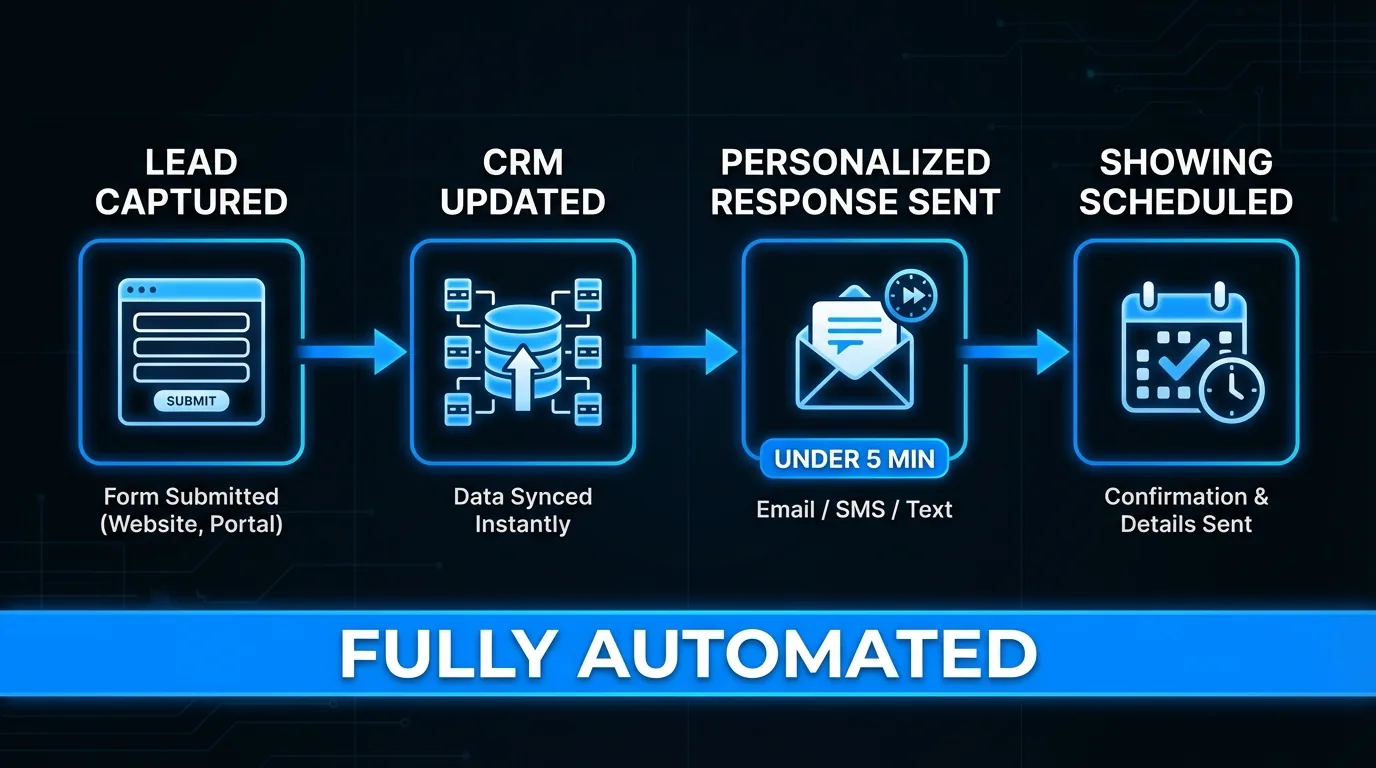 , 2. CRM Updated (database icon), 3. Personalized Response Sent (under 5 min label, envelope icon), 4. Showing Scheduled (calendar icon). Blue arrows between steps. Each step labeled in white. "Fully Automated" banner across the bottom. 16:9 infographic style, clean and professional.)
How Much Do AI Tools for Real Estate Cost?
Here's what a typical agent pays for a stack of AI tools:
| Tool | Monthly cost | What it does |
|---|---|---|
| kvCORE or Lofty | $300-$500 | CRM with lead automation |
| ChatGPT Plus | $20 | Content drafting |
| Canva Pro | $15 | Social graphics |
| Grammarly | $15 | Writing polish |
| Calendly | $12 | Scheduling |
| Dotloop or DocuSign | $45 | Transaction management |
| Total | $407-$607/mo | Multiple disconnected tools |
| Jejo.ai AI Agent | $750-$1,000/mo | All tasks handled, coordinated, proactive |
Agents handling their own bookkeeping alongside client work will find similar value in AI bookkeeping for small business. And if you're running your own marketing alongside real estate, AI agents for marketing shows the same coordination principles applied to content, lead nurture, and email.
Real Estate Agents Who Already Use AI Agents
The pattern is consistent across agents who make the switch:
They start with tools. ChatGPT for listings, a CRM for follow-up. They save some time but still feel behind. The follow-up still falls through the cracks. The inbox still overwhelms.
Then they move to an agent. The first month is the setup phase. The agent learns their voice, their market, their client communication style. By month 2, it's running 80% of their back-office independently.
The most common thing agents say: "I can't believe I was doing all of this myself."
One buyer's agent in Dallas reduced her admin time from 3.5 hours a day to under 40 minutes within 60 days of switching. She closed 4 additional transactions that year and attributed them directly to faster follow-up on leads that previously would have gone cold.
If you want to see exactly what an AI agent handles for real estate agents, the AI agent for real estate agents page breaks it down by use case. For a complete deep-dive on AI agents built specifically for real estate operations, see the AI agents for real estate guide.
What a Real Day Looks Like: Tools vs. Agent
The tool stack version (Tuesday morning for a busy buyer's agent):8:00 AM: Check inbox. Three new Zillow leads came in overnight. Manually enter each one into kvCORE. Write three follow-up emails using ChatGPT, about 15 minutes each plus 5 minutes editing. Send at 8:45 AM, 14 hours after the leads arrived.
9:30 AM: Two new leads submitted a contact form on your website at 9 AM. You see them now. You're heading to a showing at 10 AM. You'll follow up when you're back at 1 PM. Those two leads are already talking to other agents.
2:00 PM: Post-showing. Write follow-ups to the 8 buyers from Saturday's showings. This takes 40 minutes because each one needs a slightly different message. You do it because you know it matters but it kills your afternoon.
5:00 PM: Compile your weekly pipeline summary from kvCORE. 20 minutes of manual pulling and copy-pasting into a spreadsheet to share with your broker.
Total: 3.5 hours on admin. Two substantive conversations with actual clients. The AI agent version (same Tuesday):7:58 AM: The three Zillow leads received personalized responses at 11:02 PM, 11:14 PM, and 11:31 PM last night. Two replied this morning. The agent flagged both as "high interest, ready for a call." Your inbox shows: "2 hot leads to contact today."
9:05 AM: The website leads from 9 AM received responses by 9:06 AM. One asked for available showing times. The agent sent a scheduling link automatically.
2:00 PM: The 8 post-showing follow-ups went out at 10:15 AM Sunday morning. Three buyers responded with feedback. The agent flagged one as "most likely to offer."
5:00 PM: Your weekly pipeline summary arrived in your inbox at 7 AM Monday. It's already done.
Total: 40 minutes on admin. Six substantive conversations with actual clients.The difference between these two days is The 3-Hour Daily Recovery: moving from a tool stack to an AI agent returns 3 or more hours per day from admin to client work. Over a 200-day work year, that is 600 hours. At even $150/hr in commission value, that is $90,000 in recovered productive capacity.
That is a real difference in how you spend 8 hours.
Common Mistakes Agents Make With AI Tools
Buying tools before knowing what's costing the most time. Most agents buy a new tool when they feel behind. They sign up for the latest CRM feature or add a new AI writing tool without measuring where the time actually goes. Track one week before buying anything. Log every hour. The pattern is almost always: 35-40% of the work week is email and follow-up. Fix that first. Using ChatGPT without a system. Agents who use ChatGPT ad hoc (open it, write a prompt, get output, close it) save some time but get inconsistent quality and no compounding benefit. The agents who get real value build a library of 8-10 reusable prompts for their most common tasks: listing descriptions, follow-up emails, offer summaries, market updates. Same prompt every time, same quality every time, 5 minutes instead of 25. Expecting tools to replace judgment. kvCORE scoring a lead as "high" based on website visits does not mean that lead is actually ready to buy. AI tools surface signals. You still have to interpret them. Agents who act mechanically on AI scores without reading the actual conversation context make poor calls. Use tools for volume management, not for replacing your read of a client. Running too many tools without checking if they conflict. Follow Up Boss and kvCORE both try to own lead management. Using both creates duplicate contacts, split conversation history, and confusion about which system is the record. Pick one system of record. Every other tool feeds into it or out of it. Two CRMs running in parallel is worse than one mediocre CRM.Step-by-Step: Moving From a Tool Stack to an AI Agent
If you're ready to consolidate, here's how to make the switch without losing pipeline visibility.
Step 1: Export everything from your current CRM. Every contact, every conversation history, every note. Do this before touching anything else. Back it up. Step 2: Complete the Business DNA Extraction. The onboarding session needs real examples. Bring your last 15-20 email threads. Show what good follow-up looks like in your voice. Bring the qualifying questions you use with new buyers. The more specific the input, the better the agent from day one. Step 3: Run the agent alongside your existing tools for 2 weeks. Don't switch off anything yet. Let the agent handle incoming responses while you manually handle a parallel sample. Compare the outputs side-by-side. This gives you confidence before committing. Step 4: Migrate your active pipeline. Move your 30-60 most active leads into the agent's system. Watch what it does with them over 5 days. Adjust anything that needs calibration. Step 5: Cancel the tools you no longer need. Once the agent is handling follow-up and pipeline management, the separate CRM automation, scheduling tool, and manual follow-up process are redundant. Cancel them. The savings often offset a significant portion of the agent's monthly cost.The Alternative: One Agent Instead of Ten Tools
Six tools running in parallel is not a strategy. It is a maintenance job.
Most real estate agents accumulate tools reactively: a CRM when leads started slipping, ChatGPT when writing took too long, a scheduling tool when the back-and-forth got exhausting. The result is a stack that requires daily management and still drops the ball when you're away from your desk.
An AI agent consolidates what those tools handle into one system that runs without your involvement. Lead captured, enriched, responded to within minutes. CRM updated automatically. Follow-up sequenced based on behavior. Weekly pipeline summary in your inbox Monday morning.
Jejo.ai does this for $750/month. That is less than most agents spend on their tool stack today, and it includes the coordination layer that no tool combination can provide.
The 30-day money-back guarantee means you can run it alongside your existing tools for a month and compare. Agents who make the switch typically cancel $300-$400/month in redundant tools within 60 days.
How Jejo.ai works for real estate agents or compare the options. AI tool stack vs. AI agent for real estate: Tool stack (kvCORE + ChatGPT + Canva + Grammarly + Calendly + Dotloop) costs $407-$607/month and reduces admin time by 15-20%. An AI agent (Jejo.ai) costs $750-$1,000/month and reduces admin time by 70-80%, from 3.5 hours/day to under 45 minutes. Tool stack still requires manual lead entry, 11+ hour response delays overnight, and separate maintenance for each integration. The top quartile of salespeople spend 65%+ of their time in direct client interaction vs. 35% for average performers.Who This Is For
- Solo agents handling 20+ active inquiries per month who are losing leads overnight and on weekends due to slow response times
- Buyer's agents and team leads where consistent, fast follow-up across every lead source is the primary lever for closing more deals
- Agents currently spending $400+/month on a tool stack who want to consolidate into one system that handles coordination automatically
Who This Is NOT For
- Agents doing fewer than 10 transactions per year where the economics of a $750/month agent don't add up against current volume
- Teams with a dedicated ISA and admin already in place who are already hitting fast response times systematically
- Agents who want to continue owning and configuring their own workflow tools (see the tool comparison table above for the best individual options)
The Bottom Line
AI tools for real estate agents cost $407-$607/month for a typical stack and save 20-30 minutes per task while still requiring 3-4 hours of daily manual coordination. An AI agent at $750-$1,000/month saves 3-4 hours per day by handling coordination automatically, responding to leads within 5 minutes around the clock, and delivering weekly pipeline summaries without manual input. Agents who switch typically cancel $300-$400/month in redundant tools within 60 days. See the options.FAQ
What is the best AI tool for real estate agents?
There is no single best tool because tools only solve one problem at a time. The best setup depends on what's costing you the most time. For most agents, lead response speed and follow-up consistency are the biggest gaps. An AI agent addresses both automatically, while a single tool only addresses one.
Can AI write real estate listing descriptions?
Yes. ChatGPT and Claude both produce solid listing descriptions from bullet points. Give the tool the property details: bedrooms, bathrooms, key features, neighborhood highlights, target buyer. Expect a draft in 30 seconds. Plan on 5-10 minutes of editing. It saves roughly 20-30 minutes per listing compared to writing from scratch.
How does AI help with real estate lead follow-up?
AI helps in two ways. First, CRM tools like kvCORE and Lofty automate sequences, but they're template-based and require setup. Second, an AI agent monitors incoming leads in real time, drafts personalized responses based on the specific inquiry, and sends them automatically, often within 5 minutes. The second approach converts significantly better.
Do AI tools replace real estate agents?
No. AI tools replace the administrative work that keeps agents from doing what they're actually good at: building relationships, negotiating, reading a market. The agents who adopt AI fastest aren't replacing themselves. They're serving more clients with the same number of hours.
How long does it take to set up an AI agent for real estate?
Jejo.ai uses a 10-hour Business DNA Extraction process to learn how the business works, who the clients are, and how the agent communicates. Most agents are operational within 2-3 weeks and running independently by day 30. There's a 30-day money-back guarantee if it doesn't work.
Ready to stop losing leads to slow follow-up?
See how Jejo.ai handles lead response, follow-up, and client communication for real estate agents. Book a strategy call to see exactly what an AI agent would handle in your business, or explore the real estate use case.