Quick answer
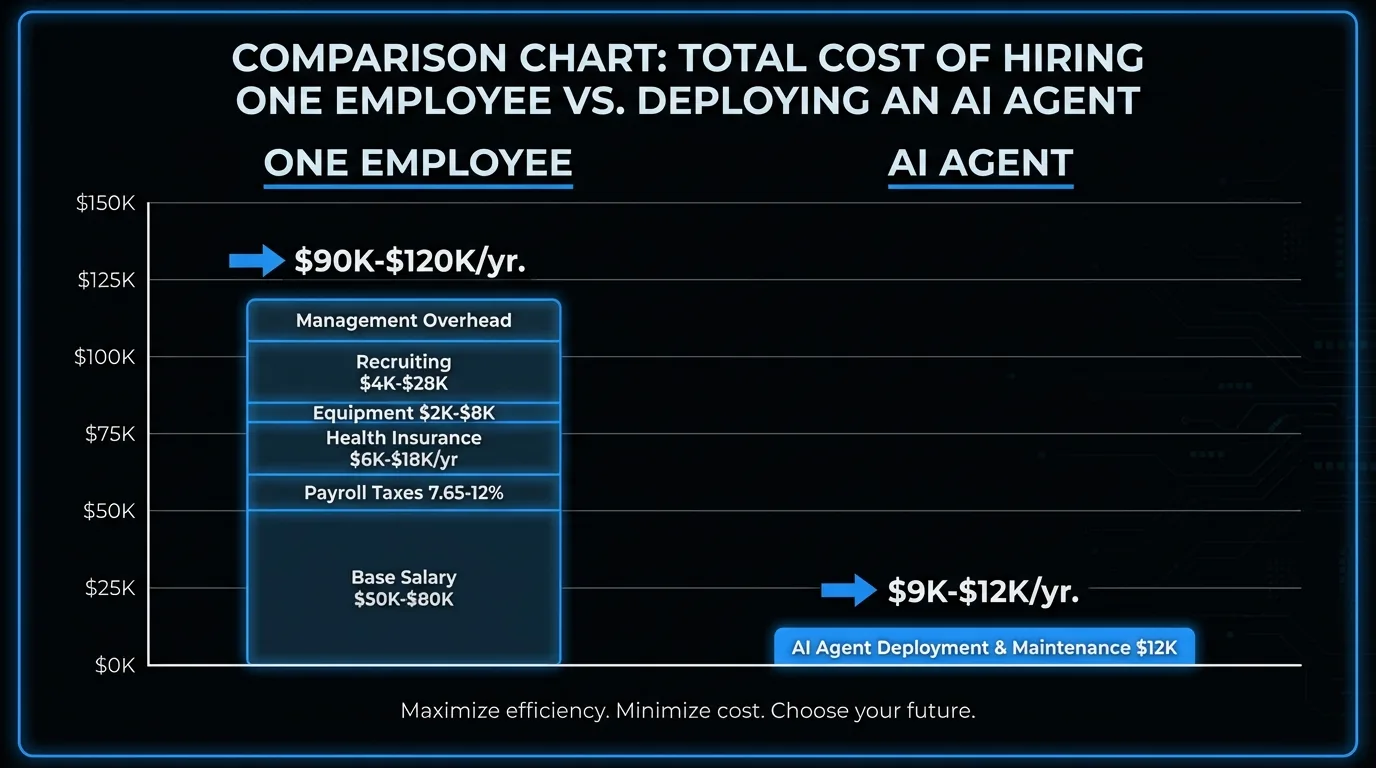
- What this covers: Cost of hiring an employee: a $60K salary runs $90K-$120K/yr with benefits, taxes, and overhead.
- Who it’s for: Founders and small business owners.
- What it costs: $60,000.
Hiring a $60,000 employee costs $90,000 to $120,000 per year. Most business owners find out after they've already committed. The cost of hiring an employee goes well beyond salary: payroll taxes, benefits, equipment, recruiting fees, and management overhead that nobody quotes you upfront. This breakdown covers every number before you post the listing.
Key takeaways:
- A $60,000 hire costs $90,000 to $120,000/yr after payroll taxes, benefits, and overhead
- Replacing a departing employee adds another $30,000 to $120,000 per replacement cycle
- Management overhead alone eats 15-20% of a manager's time per direct report
- For repeatable, process-driven work, an AI agent handles the same tasks for $9,000-$12,000/yr with zero turnover
- The 2x Hiring Multiplier: the true cost of a hire consistently runs 1.5 to 2.5x the posted salary
In this article:
- The Real Cost of Hiring an Employee
- Hidden Costs Most Business Owners Miss
- What This Looks Like in Practice
- Hiring vs. Alternatives: The Decision Tree
- The 5 Most Common Hiring Mistakes
- How Hiring Costs Differ by Industry
- What the Solution Actually Looks Like
- FAQ
The Real Cost of Hiring an Employee: A Quick Breakdown
Before you post that job listing, here are the real numbers.
| Cost Category | Typical Range | Notes |
|---|---|---|
| Base salary | $40,000 to $120,000/yr | Depends on role and location |
| Payroll taxes (FICA, FUTA, SUTA) | 7.65% to 12% of salary | Employer share only. |
| Health insurance | $6,000 to $18,000/yr per employee | Employer covers 70% average |
| Retirement matching | 3% to 6% of salary | 401(k) match typical |
| Recruiting and hiring | $4,000 to $28,000 per hire | 15-25% of first-year salary. |
| Onboarding and training | $1,000 to $5,000 per hire | Time + materials |
| Equipment and software | $2,000 to $8,000 first year | Laptop, licenses, workspace |
| Management overhead | 15-20% of a manager's time | Invisible but expensive |
| Total loaded cost | $70,000 to $200,000+/yr | For a $60K salary hire |
For most small businesses, a single hire costs 1.5 to 2.5x the base salary. This is The 2x Hiring Multiplier: the true all-in cost runs roughly twice the posted salary. That's before turnover risk.
The cost of hiring an employee for a $60,000 role runs $90,000 to $120,000 per year. That includes payroll taxes (7.65-12%), employer-paid health insurance ($6,000-$18,000 annually), recruiting ($4,000-$28,000 per hire), equipment ($2,000-$8,000), and management overhead consuming 15-20% of a manager's time. With average tenure at 2.8 years for workers aged 25-34, plan for $30,000 to $120,000 in replacement cost every 2 to 3 years.
Who This Hub Is For
This pillar covers the full economics of hiring decisions. Find your situation below:
You're thinking about your first hire and want to understand total cost before committing: start with The True Cost of Hiring an Employee for the complete breakdown. You're weighing a VA against a part-time contractor: How Much Does a Virtual Assistant Cost? breaks down hourly vs. monthly vs. managed VA pricing. You're considering whether AI can replace headcount: Will AI Replace Jobs? gives a grounded, role-by-role breakdown of which functions AI handles today versus where a full-time hire still makes sense. You want to understand the benefits burden specifically: the full benefits and tax breakdown covers insurance, PTO, payroll taxes, and retirement contribution math in detail. You're evaluating AI as an alternative to headcount: AI vs. Hiring: Which One Actually Makes Sense? compares a $750/mo AI agent against a $4,000 to $8,000/mo employee (all-in). You're worried about whether AI will replace your existing team: Will AI Replace Jobs? gives a grounded, role-by-role breakdown without the hype. You're deciding whether to hire a consultant vs. build in-house capability: How Much Does a Business Consultant Cost? covers project vs. retainer pricing.Hidden Costs of Hiring an Employee Most Business Owners Miss
Salary is visible. These costs are not.
Turnover is the silent killer. The average employee stays 2.8 years. Replacing them costs 50% to 200% of their annual salary in recruiting, lost productivity, and retraining time. For a $60,000 employee, that's $30,000 to $120,000 every replacement cycle. A hire who leaves before 12 months costs more than those figures suggest: a second recruiting cycle ($4,000 to $28,000), another ramp period at reduced productivity, and institutional knowledge that exits with them. In our experience, roughly 1 in 3 first hires at small businesses does not make it past the 12-month mark. Management overhead compounds fast. Managing one employee takes 15 to 20% of a manager's time. For a small business owner managing 3 people, that's effectively a half-time job you didn't account for. Benefits lock you in. Health insurance, 401(k) matching, PTO accrual: these commitments exist whether the business is having a good month or a bad one. The learning curve costs money. Most hires take 3 to 6 months to reach full productivity. You're paying full cost while getting partial output. At a $150 to $200 per hour effective owner rate, the supervision and training hours during that ramp period add $7,000 to $15,000 to the true first-year cost, before the hire's reduced output is even factored in.In our experience working with small business owners, the actual cost of their first hire consistently lands at 2.5-3x the salary they budgeted. The gap is always the same: management time, training ramp, and the productivity dip during months 1-3.
The hidden cost of hiring an employee goes well beyond salary. For a $60,000 hire, payroll taxes add 7.65-12% ($4,600-$7,200). Employer health insurance costs $6,000-$18,000 annually. Recruiting runs $4,000-$28,000 per hire. Management overhead consumes 15-20% of a manager's time. Average employee tenure runs 4.3 years overall, dropping to 2.8 years for workers aged 25-34. That makes $30,000-$120,000 in replacement cost a recurring budget item, not a one-time event.
Not sure whether to hire or automate? Most process-driven roles cost 7 to 10x more with a full-time hire than with a managed agent. Book a quick call and we'll map out the cost comparison for your specific situation in 15 minutes.
What This Looks Like in Practice
Mark owns a 4-person bookkeeping firm in Denver. His three existing staff are maxed out. Revenue is stuck at $480,000 per year because he cannot take on more clients without more capacity. He decides to hire a bookkeeper at $55,000 per year.
Here is what Mark actually spent in Year 1:
| Cost item | Amount |
|---|---|
| Salary | $55,000 |
| Payroll taxes (7.65%) | $4,208 |
| Health insurance (employer share) | $7,200 |
| Laptop, software, desk setup | $3,400 |
| Job posting and recruiter time (6 hrs at $200/hr effective rate) | $3,200 |
| Interviews and screening (8 hrs, 4 finalists) | $1,600 |
| 3 months of onboarding at 60% productivity: 36 hrs of Mark's training time | $7,200 |
| Year 1 total | $81,808 |
Mark budgeted for a $55,000 hire. The actual Year 1 cost was $81,800. Then the new hire left at 14 months for a remote role paying $62,000. Replacement cycle: another $15,000 in recruiting, retraining, and 3 months of degraded capacity.
The math only works if the new hire generates enough new revenue to cover the loaded cost. For Mark, that meant landing 8 new clients in Year 1 just to break even. He landed 4.
One marketing agency owner tracked first-year hiring costs separately for the first time when building a new budget. Planned: $52,000. Actual first-year cost: $84,000. The gap was benefits, recruiting time, and 3 months of onboarding at reduced productivity.
After working with dozens of small business owners on their first hires, one pattern repeats. The gap between planned and actual Year 1 cost almost always falls between $25,000 and $40,000. The category most people miss is not benefits. It is training time billed at the owner's effective hourly rate.
Carlos runs a 6-person landscaping company in Dallas and needed a crew manager to oversee three teams while he focused on sales and client relationships. He budgeted $48,000 for the salary and thought the math was clear. What he did not anticipate: workers' compensation insurance in landscaping runs 8 to 12% of wages versus 1 to 2% for office roles, adding $4,800 to the annual cost upfront. Equipment and uniform allocation added $2,600. Carlos then spent 10 weeks training the new manager on-site, 5 hours per week at roughly $150 per hour, adding another $7,500 in owner time before the manager ran a crew independently. Year 1 total came to $73,900 on a $48,000 budget. The workers' comp rate alone was the line he had not thought to look up before posting the job.
A $55,000 bookkeeper hire carried $81,808 in Year 1 all-in cost. That covers salary, payroll taxes (7.65%), health insurance, equipment, recruiting, and 3 months of onboarding at 60% productivity. The hire left at 14 months. Replacement added another $15,000. To break even, the business needed 8 new clients from the added capacity in Year 1. They landed 4. The cost of hiring an employee almost always exceeds the budget by $25,000 to $40,000 in Year 1.
Hiring vs. Alternatives: The Decision Tree
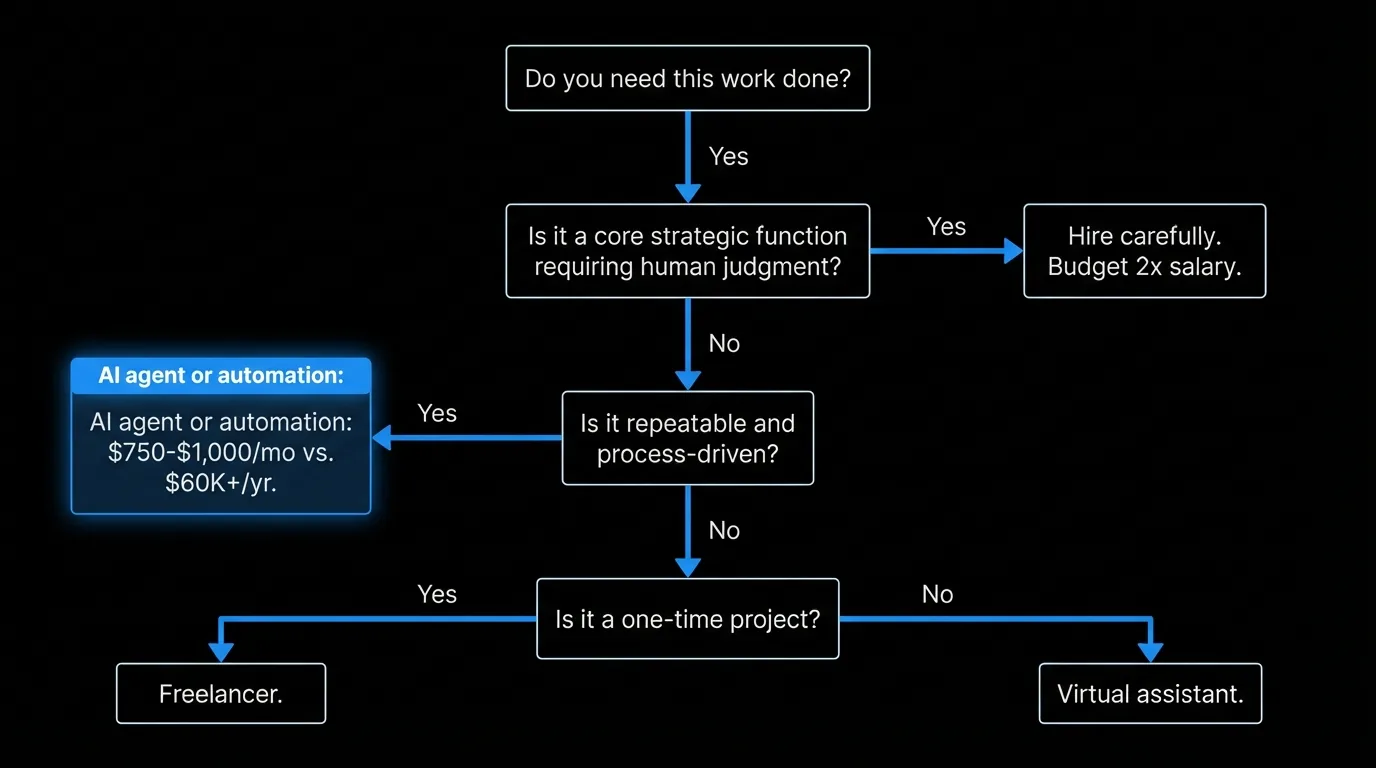
```
Do you need this work done?
Yes
Is it a core, strategic function that requires human judgment?
Yes → Hire carefully, budget 2x salary
No → Is it repeatable and process-driven?
Yes → AI agent or automation ($750-$1,000/mo vs. $60K+/yr)
No → Is it a one-time project?
Yes → Freelancer or consultant
No → Virtual assistant (for ongoing, human-touch tasks)
```
For most small businesses running on 1 to 10 people, 60 to 70% of the tasks they would hire for fall into the "repeatable and process-driven" category. That's where the AI vs. Hiring comparison becomes the most important page you'll read this year.
The 5 Most Common Hiring Mistakes (and What They Cost)
Most business owners who overspend on hiring make the same five errors.
1. Hiring for the role they need now, not the role they need in 12 months.A business at $300K brings on a generalist admin. Six months later, the business is at $500K and needs a specialist. The generalist is not the right fit, but now there is a person, a salary commitment, and an emotional attachment. Rehiring costs another $15,000 to $25,000. Fix: write out what the role looks like at 12 months before posting the job. If you cannot describe it, you are not ready to hire.
2. Underestimating the management tax.A first hire does not just add capacity. It adds a management obligation. Most small business owners spend 5 to 8 hours per week in the first 3 months managing a new hire: answering questions, reviewing work, giving feedback. At a $200/hr effective rate, that is $1,000 to $1,600 per week in hidden cost. It drops after 3 months. It never reaches zero.
3. Hiring offshore for client-facing work.A $7/hr offshore VA for internal operations works fine. Put that same VA on client-facing communication and your clients notice the tone shift within a week. Response quality drops, response time slows, and you have to step back in. You have added a cost without adding capacity. The correct use of offshore support: internal-only, documented-process work where quality is binary.
4. Skipping documentation before hiring.The most expensive onboarding mistakes happen when a business owner hires without written processes. The new hire learns by following the owner around. The owner's time cost doubles for 60 to 90 days. When the hire eventually leaves, the processes go with them. Every subsequent hire starts from scratch.
5. Treating salary as the full cost when budgeting.Every budget that says "we'll hire someone at $50K" is understating cost by 40 to 60%. The 2x Hiring Multiplier applies here: if your hiring budget shows $50,000, your real budget needs to show $75,000 to $85,000 to remain accurate. The gap between what people plan for and what they actually spend is where most small business cash flow surprises come from.
Cross-Pillar Reading: The VA Option
If you're weighing the cost of hiring against a virtual assistant for your small business, the economics are different but the hidden costs still apply: VA turnover, management time, and context loss between replacements.
The full comparison lives in the P1 pillar, specifically the virtual assistant pricing and why VAs fail articles.
How Hiring Costs Differ by Industry
The $70,000 to $200,000 all-in range is an average. The actual number varies significantly by role type and business model.
Real Estate Agency: Adding a Buyer's Agent
A buyer's agent at a small real estate firm typically starts at $0 base salary with a 50/50 commission split. Sounds cheap.
But add Errors and Omissions insurance ($800 to $2,000/year per agent), MLS dues ($1,500 to $2,500/year), desk fees ($300 to $600/month), and 40+ hours of onboarding in the first 90 days.
New agents typically take 6 to 12 months before they close deals consistently. Getting a buyer's agent from hire to self-funding costs $15,000 to $30,000 in real investment before a single commission splits. Real estate agent earnings vary widely by market and experience level.
Marketing Agency: Adding an Account Manager
Account managers at small agencies typically earn $48,000 to $65,000. Add benefits ($12,000 to $18,000), payroll taxes ($4,500 to $6,000), equipment and software ($3,000 to $4,000), and recruiting ($5,000 to $10,000 including owner time). First-year total: $72,000 to $103,000.
Break-even: the account manager needs to manage enough client revenue that their cost is 15 to 20% of managed revenue.
At 15%, they need to oversee $480,000 to $685,000 in annual client revenue to justify their cost. Most first-year AMs cannot carry that load.
Professional Services: Adding a Specialist
A CPA, lawyer, or specialized consultant added to a small firm carries the highest loaded cost: $90,000 to $180,000/year all-in for a mid-level professional.
The break-even: at a $250/hr billing rate with 60% utilization, they need to bill 1,200 hours per year just to cover their own cost. Before the firm makes any margin.
Most small professional services firms need 18 to 24 months before a new specialized hire is fully profitable.
What the Solution Actually Looks Like
Open Slack at 8 AM. Your inbox is already triaged. Seven emails were handled overnight: three information requests answered, one scheduling request converted to a booked call, two routine approvals processed, one follow-up sent to a proposal that had been sitting for 3 days. The one item that needed your judgment is flagged and staged for your review.
That is a morning with a managed AI agent. Not a tool you prompt. An agent that knows your business, monitors your inbox, and handles the operational layer without being asked.
One honest caveat: the agent handles process-driven, repeatable work. Roles requiring physical presence, licensed professional credentials, or complex client relationships still need people. A landscaping crew manager and a licensed CPA are human roles where the automation math applies differently. The comparison in this article is most relevant when the work is primarily information management, communication, and scheduling.
For the annual cost of one employee's health insurance benefit, Jejo.ai deploys a business-trained agent that handles email, follow-up, scheduling, and reporting at $12,000/yr. A 10-hour onboarding maps your business context so the agent operates with your voice and your priorities. No management overhead. No turnover. No three-month ramp period. Compare the full economics.
Who This Is For
- Business owners planning a first or next hire in the next 3 to 6 months who want the real numbers before committing
- Solo operators and small teams (1 to 20 people) where each hire represents a significant share of total payroll
- Service businesses where most day-to-day work is process-driven and repeatable
Who This Is NOT For
- Larger businesses with 50+ employees where bulk benefits pricing and dedicated HR infrastructure change the per-hire economics
- Businesses hiring licensed professionals (attorneys, CPAs, licensed contractors) where AI is not a regulatory substitute
- Businesses that have already committed to a hire and are focused on onboarding, not the hire-or-automate decision
The Bottom Line
For a $60,000 salary hire, the true all-in cost runs $90,000 to $120,000 per year once benefits, recruiting, equipment, and management overhead are included. The 2x Hiring Multiplier holds across nearly every role and industry. Before committing, run the numbers on what the role produces versus what it costs. Review the AI vs. Hiring comparison or book a 15-minute strategy call to map it out for your specific role.
FAQ
What is the true cost of hiring an employee?
For a $60,000 salary hire, the true all-in cost runs $90,000 to $120,000 per year once you add payroll taxes (7.65-12%), health insurance ($6,000-$18,000/yr), equipment, onboarding, and management overhead. Turnover adds another $30,000 to $120,000 every replacement cycle.
How much do employee benefits cost on top of salary?
Benefits typically add 30 to 40% on top of base salary. For a $60,000 employee, that's $18,000 to $24,000 in benefits alone. The main cost drivers are health insurance, payroll taxes, and retirement matching.
Is an AI agent cheaper than hiring an employee?
Yes, significantly. Jejo.ai's AI agent costs $750 to $1,000 per month ($9,000 to $12,000/yr). A single full-time employee costs $70,000 to $200,000/yr all-in. For work that is repeatable and process-driven, the AI agent handles more volume at a fraction of the cost, with no turnover, no management overhead, and no sick days.
What's the most overlooked cost of hiring?
Management overhead. Most business owners budget for salary and benefits but forget that managing one employee takes 15 to 20% of a manager's time. If you're the manager, that's time you're not selling, building, or growing.
How do I calculate the cost of replacing an employee?
Take 50% to 200% of the departing employee's annual salary. The 50% floor applies to lower-skill, higher-supply roles with clear documentation. The 200% ceiling applies to senior hires, specialized skills, or roles where institutional knowledge walks out with the person.
For a $60,000 marketing manager at a small agency: plan $30,000 to $90,000 in total replacement cost. That includes recruiting fees, productivity loss during the vacancy (typically 3 to 4 months at 40 to 60% of normal output), and ramp time before the new hire is fully productive. Average employee tenure runs 4.3 years across all workers. For workers aged 25 to 34, that drops to 2.8 years. Plan for replacement as a recurring cost, not a one-time event.
How to Know If a Hire Will Actually Pay Off
Most business owners make hiring decisions based on need ("I'm overwhelmed"), not math. Before you post a job listing, run this calculation.
Step 1: Calculate the loaded cost.Take the base salary. Add 30 to 40% for benefits and payroll taxes. Add $3,000 to $5,000 for equipment and setup. Add the recruiting cost (typically $5,000 to $15,000, counting your time). This is the Year 1 cost. Write it down.
Step 2: Calculate the break-even revenue.If the hire is revenue-generating (salesperson, account manager, service delivery): the hire needs to generate their loaded cost as margin in Year 1 to break even. A $90,000 all-in hire needs to produce at least $90,000 in gross margin you would not otherwise have generated. Usually requires 6 to 9 months before they hit that number.
If the hire is overhead (admin, operations, support): calculate the value of what you personally recover by offloading those tasks. A hire that frees 10 hours per week for you, at a $150/hr effective rate, is worth $78,000/year in reclaimed time. If the hire costs $75,000 all-in, it breaks even on Day 1, in theory. The question is whether you actually use those 10 hours to generate $150/hr. If you spend them on other admin tasks, the hire does not pay.
Step 3: Consider the alternatives.Before committing to $75,000 to $100,000 in Year 1 cost, ask what else could solve the problem. A specialized freelancer for a specific project? An AI agent for the repeatable operational work? A part-time contractor for 20 hours per week?
The decision tree exists in the Hiring vs. Alternatives section above. But the critical filter is this: if 60 to 70% of the work you would hire for is repeatable and process-driven, the math on alternatives is almost always better. Hire when the work genuinely requires human judgment, relationships, or physical presence. Automate or delegate everything else.
Ready to see what hiring actually costs your business?Use the AI vs. Hiring comparison to see what Jejo.ai handles for $750/mo versus what a full-time hire would cost you. Or book a strategy call to map it out for your specific situation.