Quick answer
- What this covers: The right tasks for virtual assistant delegation: organized by category, time recovered, and which tasks to route to an AI agent instead of a human.
- Who it’s for: Small business owners considering a virtual assistant.
Inbox management alone recovers 8-12 hours per week for most business owners. The tasks for virtual assistant delegation that actually work share three traits: they're repeatable, documentable, and judgment-free. Hand off the wrong ones and you create more management overhead than you save. This guide covers the ones that deliver, the ones to keep, and the growing category being handled by AI agents instead.
Key takeaways:
- Inbox management, scheduling, and CRM entry alone recover 15-20 hours per week for most business owners
- A task is delegation-ready only when it's repeatable, documentable, and judgment-free
- The 80/20 Delegation Matrix identifies your highest-value targets: high-volume, low-judgment tasks delegate first
- Partial delegation keeps the cognitive load on you: hand off the whole task or don't hand it off at all
- AI agents handle the same task list 24/7 at $750/month, with no management overhead after setup
In this article:
- How to Think About Delegation
- Administrative Tasks for Virtual Assistants
- Customer Communication Tasks for Virtual Assistants
- Research and Information Gathering
- What NOT to Give a Virtual Assistant
- The 80/20 of VA Delegation
- When an AI Agent Replaces a VA for These Tasks
- Building Your Delegation Playbook
How to Think About Delegation
Before the task list: a framework that determines whether a task is right for VA delegation.
What are the best tasks for a virtual assistant? The best tasks for virtual assistant delegation meet three criteria. They're repeatable (done more than once a week or four times a month). They're documentable (you can write the steps in 10 lines or fewer, with few exceptions). And they're free of your specific judgment (someone who knows the process but not your business can complete it correctly).If a task fails any of these criteria, it either stays with you or needs more documentation before it's delegation-ready.
The 80/20 Delegation Matrix captures this as a simple grid. Plot tasks by two variables: volume (how often you do it) and judgment required (how much it needs your specific expertise). Tasks in the high-volume, low-judgment quadrant delegate first. That quadrant contains 80% of your available time savings. Everything else comes after.At $100-$150 per hour of owner value, the high-volume, low-judgment quadrant is costing you $1,500-$3,000 per week if it stays on your plate. That's the calculation that makes VA delegation obvious in theory. The documentation work is what makes it work in practice.
The second rule of delegation: hand off the whole task, not just the parts you don't want. If you hand off email drafting but keep all the editing, you still own the cognitive load. True delegation means the task leaves your plate entirely except for occasional review.Delegating for the first time? The SBA's small business resources cover operational basics that make handoffs stick. Build your SOPs (standard operating procedures) before you hire.
Administrative Tasks for Virtual Assistants
These are the highest-confidence delegation tasks: well-defined, high-volume, and easy to document.
Inbox management. Sorting, filtering, labeling, flagging urgent messages, and drafting responses to routine inquiries. A VA can manage your inbox according to a priority system you define. Most business owners reclaim 1-2 hours per day from this single delegation. Calendar and scheduling. Coordinating meeting times, sending invites, updating availability, managing rescheduling requests. Pure logistics with zero intellectual content. Travel booking. Research, comparison, booking, and itinerary management. Define your preferences once (airlines, hotels, price range) and the VA handles the rest. Data entry and CRM (customer relationship manager) updates. Adding new leads, updating contact information, logging meeting notes, tagging records. Anything where the process is clear and the output is a record in a system. File organization. Naming, sorting, and organizing documents in Google Drive, Dropbox, or internal systems. Builds the organized structure you always intend to maintain and never have time to build. Expense tracking. Collecting receipts, categorizing expenses, preparing monthly expense reports for your accountant. Usually takes a business owner 2-3 hours a month. Takes a VA 30-45 minutes with the right system.| Task | Average weekly time saved | Difficulty to hand off |
|---|---|---|
| Inbox management | 8-12 hours | Medium (requires clear priority rules) |
| Scheduling | 3-5 hours | Easy |
| Data entry | 2-4 hours | Easy |
| File organization | 1-2 hours | Easy |
| Expense tracking | 1-2 hours | Easy |
| Travel booking | 1-3 hours | Easy |
One operations consultant halved her pre-call prep time after handing prospect research to a VA with a single output template. Twelve meetings per month freed 5 hours with one SOP document.
VA delegation by the numbers: The five core admin tasks (inbox, scheduling, data entry, expense tracking, file organization) consume 15-20 hours per week for the average small business owner, per Bureau of Labor Statistics occupational data. A VA handling these five categories recovers roughly 40% of a 40-hour workweek, worth $56,000-$78,000 in reclaimed capacity at a $75/hour owner rate. An offshore VA covering this scope costs $400-$1,200/month; an AI agent runs $750-$1,000/month with 24/7 availability.
Customer Communication Tasks for Virtual Assistants
These work well for VA delegation when you provide templates and clear decision rules for common scenarios.
Responding to routine customer inquiries. FAQ responses, pricing questions, appointment confirmations, standard follow-up messages. Document the answers to your 10 most common questions. The VA handles the first 80% of inbound messages using those templates. Client onboarding sequences. Sending welcome emails, collecting intake forms, scheduling kickoff calls, sharing initial documents. Fully templatable once you've done it 3+ times. Review and testimonial requests. Following up with clients post-project to request reviews on Google, Yelp, or industry platforms. Systematically done, this is one of the highest-ROI (return on investment) follow-up activities in any service business. Lead follow-up. Sending first-touch responses to inbound inquiries and follow-up sequences to prospects who haven't responded. Define the sequence: initial response within 2 hours, follow-up on day 3, close loop on day 7. The VA executes it every time. Appointment reminders. Sending reminders 24-48 hours before meetings, confirming attendance, resending login details. Reduces no-shows by 30-50% with zero effort from you after setup.Research and Information Gathering
VAs are effective at gathering, summarizing, and organizing information. The key: define the output format clearly before assigning.
Competitor research. Gathering pricing, service offerings, positioning, and recent news about competitors. Useful for quarterly competitive reviews. Define what information you want and what format to put it in. Prospect research. Before a sales call, compiling background on the company, recent news, decision maker profiles, and relevant context. Saves 20-30 minutes of pre-call prep per meeting. Market research. Identifying industry events, publications, associations, podcast opportunities, and relevant communities. Background research that feeds strategic decisions. Content research. Gathering statistics, sources, and reference material for articles, presentations, or proposals you're writing. You focus on the synthesis and voice. The VA assembles the raw material. Vendor comparison. Collecting quotes, comparing features, summarizing options when you're evaluating a purchase or service change. Define the criteria, receive a comparison.Social Media and Content Support
These tasks work well when you retain creative control and the VA handles the operational layer.
Scheduling and publishing. Taking content you've created and scheduling it across platforms at the right times. No creative judgment required. Community management. Monitoring mentions, responding to comments with templated or simple original responses, flagging anything that needs your attention. Newsletter formatting and sending. Taking your written content, formatting it in your email tool, and sending. Separate from writing, which typically stays with you. Repurposing existing content. Taking a blog post and creating social captions from it. Taking a video and pulling quotes for graphics. Mechanical execution of a repurposing playbook you define.What doesn't work for VAs in content: anything requiring your actual voice, opinion, or creative direction. A VA can post your words. They can't generate them in a way that sounds like you.
What NOT to Give a Virtual Assistant
High-stakes client communication. Any message where the wrong tone or wrong information could damage a relationship. Train the VA on templates for standard situations, but keep the sensitive ones. Financial decisions. Reviewing proposals, approving invoices, making purchasing decisions. You can give a VA the information-gathering and formatting tasks, but the judgment layer stays with you. Strategic content. Articles, proposals, presentations where your specific expertise and perspective is what makes it valuable. A VA can research and format. The thinking and writing are yours. Tasks without documentation. If you can't explain how to do it in writing, you're not ready to delegate it. Handing off undocumented tasks creates a back-and-forth that defeats the purpose of delegation.Spending 15+ hours per week on admin you can't get off your plate? That's the clearest signal your business needs a better system. Book a strategy call to map exactly which tasks an AI agent would handle versus a VA.
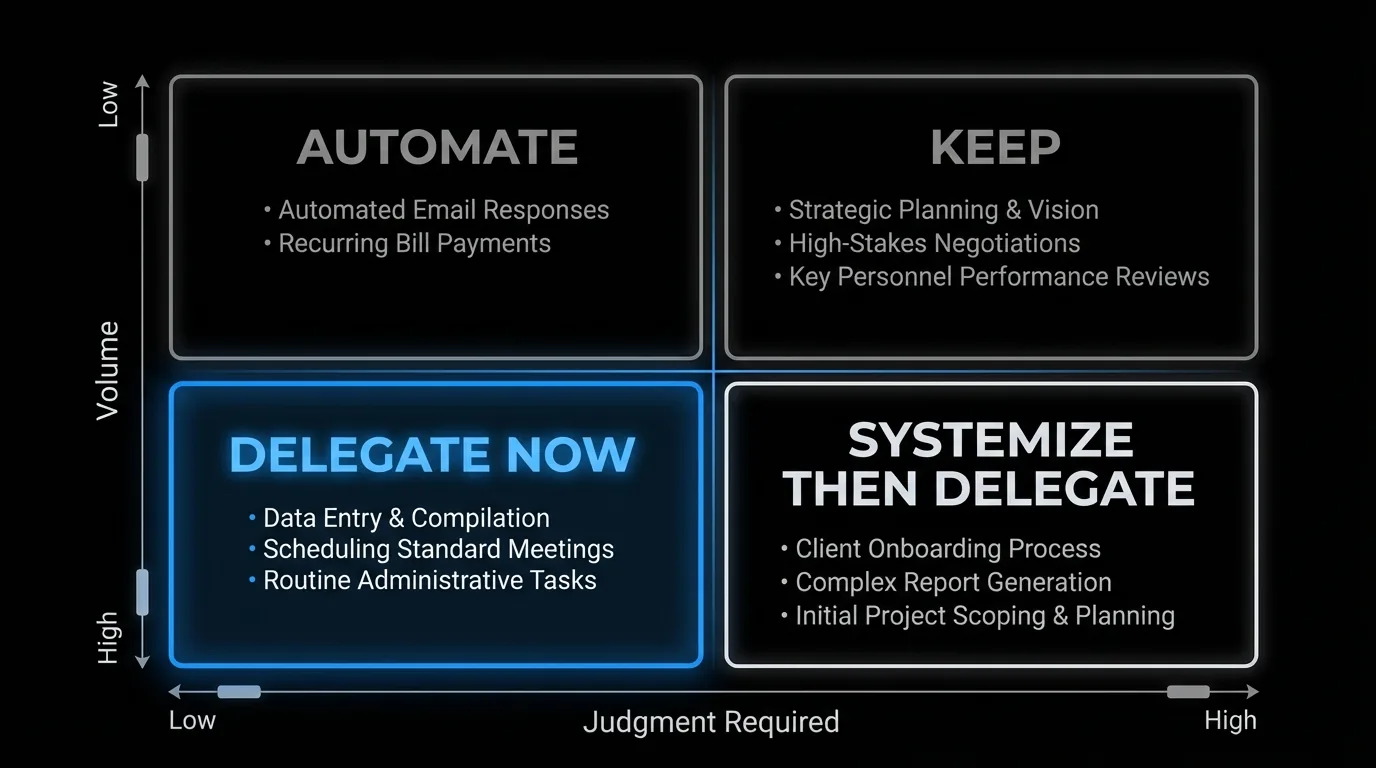 and y-axis labeled 'Volume' (Low to High). Top-left: 'Automate' in grey. Top-right: 'Keep' in grey. Bottom-left: 'Delegate Now' with blue #2997ff accent border and background highlight. Bottom-right: 'Systemize Then Delegate'. Each quadrant has 2-3 example tasks in smaller text. Clean lines, professional layout. 16:9 infographic, clean professional.)
The 80/20 of VA Delegation
Most of the value from VA delegation comes from a small number of tasks. This is the 80/20 Delegation Matrix in practice: the top five tasks sit squarely in the high-volume, low-judgment quadrant. In order of ROI:
- Inbox management. Highest time cost, most interruptive, easiest to systematize.
- Scheduling. Pure coordination with no intellectual value.
- CRM and data hygiene. Builds the foundation for every other business system.
- Customer follow-up sequences. Systematically done, drives revenue with zero daily effort from you.
- Research before meetings and decisions. Makes every decision and conversation better.
If you start with just these five and hand them off completely (not partially), most business owners reclaim 15-20 hours per week. That's the time needed to work on the business rather than in it.
At $100/hour, those 15-20 hours represent $78,000-$104,000 per year in recovered capacity. A VA covering the top five tasks costs $800-$1,200/month offshore. The payback period is measured in weeks, not quarters.
In our experience, the SOP document is what makes or breaks the first 30 days. Owners who write the process down before handing it off see results within two weeks. Owners who skip documentation spend six weeks doing the work twice.
What VA Delegation Won't Solve
Three honest expectations before you build your playbook.
VAs handle repeatable tasks well. The problem starts when you need them to exercise judgment. A VA sends your follow-up templates on schedule. They won't notice the prospect's reply contained a buying signal. That read stays with you. Delegation reduces management overhead. It doesn't eliminate it. Plan for 3-5 hours of weekly review in the first 90 days. Skip this and you discover errors in week 8 that started in week 2. The review work is part of the model. Turnover is an unavoidable cost. Average VA tenure at agencies is 6-12 months. Every departure means 20-40 hours of retraining and weeks of degraded output while context rebuilds. Budget for a full retraining cycle per year. It's a structural feature of the model, not a failure of the person.When an AI Agent Replaces a VA for These Tasks
An increasingly common alternative: AI agents that handle most of the tasks on this list without the management overhead of a human VA.
Human VAs bring warmth, adaptability, and real relationship capability. They're genuinely better for tasks that require emotional intelligence or careful judgment.
But most of the tasks on the administrative list (scheduling, inbox triage, data entry, follow-up sequences, and content scheduling) don't require those qualities. They require reliability, speed, and consistency.
An AI agent trained on your business handles those tasks at $750-$1,000/month with:
- 24/7 availability (not 8-hour windows)
- No sick days, turnover, or rehiring
- Persistent context about your business that doesn't walk out the door
- No management overhead after initial training
The cost comparison is specific: a part-time VA at $800-$1,200/month plus 5-8 hours of weekly management at a $50/hour owner rate runs $1,900-$3,200/month in real terms. An AI agent covering comparable scope costs $750-$1,000/month with near-zero ongoing management. The gap widens every time a VA turns over.
The true cost of hiring matters here. A part-time VA at $20/hour for 20 hours/week runs $1,600/month, plus your time for onboarding, management, and correction. An AI agent is lower cost, more consistent, and requires less ongoing management once trained.
That said, there are tasks where a human VA genuinely wins: phone calls, video interactions, anything requiring empathy or real-time adaptation to unexpected situations. Many business owners run a combination: AI agent for the systematic operational load, human VA for the things that require a person.
AI agents vs virtual assistants: the full comparison if you're deciding between the two options.VA vs AI agent for task delegation: For systematic tasks like inbox, scheduling, and follow-up sequences, a part-time VA at $20/hour for 20 hours/week costs $1,600/month plus 5-8 hours of weekly management time from you. An AI agent covering the same task scope runs $750-$1,000/month with near-zero ongoing management. For the full cost breakdown including training and turnover, see the virtual assistant pricing guide.
Building Your Delegation Playbook
Before you hire a VA or deploy an AI agent, build your playbook.
Step 1: Track your time for one week. Every task, logged in 15-minute blocks. Step 2: Mark each task: requires me specifically, or requires someone. This is the judgment axis of the 80/20 Delegation Matrix. Step 3: For every "requires someone" task, write a 5-10 step how-to. Include examples of good and bad outputs. Step 4: Prioritize by time cost. The tasks that take the most time go first. Step 5: Hand them off. All the way. Don't half-delegate.The playbook serves two purposes: it makes delegation clear, and it makes you aware of how much time you're spending on tasks that don't need you.
Most business owners are surprised by step 2. The "requires someone" category is 40-60% of their week. The path to a sustainable business isn't working harder on all of it. It's systematically removing what doesn't need you.
If you're sourcing a VA directly, Upwork has a large pool of vetted general and specialized VAs with transparent reviews and hourly billing. Use your playbook as the job post.
What This Looks Like in Practice
Sarah runs a 6-person bookkeeping firm in Austin. Before delegation, her week looked like this: 90 minutes each morning processing her inbox, 45 minutes scheduling and rescheduling client calls, 2 hours every Friday chasing down receipt photos from clients.
Total: 18-20 hours per week on tasks that had nothing to do with bookkeeping.She hired a VA and handed off all three tasks. Her SOP document was 3 pages: inbox priority rules, scheduling preferences (no calls before 10am, 30-minute buffer between meetings), and the exact email template for chasing receipts. Setup took 4 hours.
Week one: rough. The VA misread two calendar entries and double-booked one afternoon. Sarah added a time zone handling rule to the SOP. Week two: clean. By week four, Sarah was spending 20 minutes reviewing work, not doing it herself.
She now runs 18 client accounts with the same energy she used to spend managing 12. The delegation didn't change her capacity. It changed what she was using it for.
Common Delegation Mistakes (And What They Cost)
Handing off tasks without writing them down. If you can't explain the task in writing, the VA will invent a process. That process will be wrong. The result: rework, re-explanation, and more of your time than if you had done it yourself. Document before you delegate. Every time. Delegating half a task. Business owners hand off email drafting but keep the sending. They hand off research but redo it themselves. Partial delegation means you still own the cognitive load. Delegate the whole task or don't delegate it at all. Starting with the wrong tasks. Many owners hand off what they hate first, not what costs them the most time. The tasks with the highest time cost free up the most capacity when removed. Start with inbox, scheduling, and data entry. In that order. Skipping the review period. The first 2 weeks of any delegation need daily review. Not to micromanage, but to catch documentation gaps before they become habits. An uncorrected week 1 mistake repeats every week after that. Daily review in week 1. Weekly from week 5. Monthly after 90 days. Delegating without decision rules. Your VA will hit edge cases your SOP didn't cover. Without clear guidance on what to decide independently versus what to escalate, you get either constant questions or silent mistakes.Write 5-10 decision rules before handing off anything that touches clients directly. A simple format: "If X happens, do Y. If unsure, escalate." That one page prevents 80% of the back-and-forth in the first month.
What a Managed AI Agent Does Differently
The task list in this guide maps directly to what a trained AI agent handles. Inbox management, scheduling, CRM updates, customer follow-up sequences, research. All of it.
The difference isn't capability. It's how the work gets done.
A VA waits for your instructions, works their hours, and requires daily management to stay on track. An AI agent monitors your operations, acts without being asked, and builds deeper business context every week.
When you're in a meeting, the inbox still gets triaged. When a lead doesn't respond, the follow-up goes out automatically. When Friday arrives, the weekly summary is waiting.
No briefing documents. No management overhead. No turnover that resets everything you built.
If you're spending 15+ hours per week on the tasks in this guide and finding delegation harder than it should be, an agent-based model is worth examining. Jejo.ai agents run at $750/month, cover the full operational scope described here, and come with a 30-day guarantee. No long-term contract.
The decision comes down to this: if the task requires a real person, hire one. If it requires reliability, consistency, and business context, an agent does it better.
Who This Is For
This guide is for you if:- You're spending 10+ hours per week on email, scheduling, and admin work
- You've tried to delegate before and got burned by unclear handoffs or constant back-and-forth
- You run a 1-20 person business where the owner is still doing work that doesn't require them
- Most of your customer interaction requires phone calls or in-person presence
- You already have a dedicated operations manager handling delegation
- Your administrative load is under 5 hours per week and isn't growing
The Bottom Line
The best tasks for virtual assistant delegation fall into three categories: high-volume admin (inbox, scheduling, data), customer communication (follow-up, onboarding, reminders), and research. Business owners who fully hand off the top five tasks recover 15-20 hours per week on average. If the management overhead of a human VA is eating those gains back, Jejo.ai agents cover the same scope at $750/month with a 30-day guarantee and zero daily management.
FAQ
What tasks should a virtual assistant do first?
Start with inbox management, scheduling, and data entry. These are the highest-volume, most interruptive, and easiest to hand off. Master these three before adding anything else. Combined, they typically free up 15-20 hours per week.
How do I make sure a VA does tasks correctly?
Document before delegating. Write out the steps. Include examples of correct outputs. Create a review process for the first 2 weeks where you check work daily, then weekly. Mistakes in the first month are usually documentation problems, not VA problems.
How many hours a week does a small business owner typically need from a VA?
For administrative tasks alone: 15-20 hours/week. For a full scope including customer communication, research, and content support: 25-35 hours/week. Part-time VAs (20 hours/week) are the most common starting point.
Is it better to hire a VA or use an AI agent?
For tasks requiring human judgment, relationship warmth, or real-time adaptation: a human VA is better. For high-volume, systematic tasks like inbox management, scheduling, follow-up sequences, and data entry: an AI agent is more consistent, lower cost, and requires less management. Most growing businesses benefit from both.
Ready to find out if a VA or AI agent is right for your task list? Compare AI agents vs virtual assistants to see which handles your task list better. Book a strategy call or see the plans.