Quick answer
- What this covers: Small business growth strategies that compound without hiring.
- Who it’s for: Small business owners and solo founders.
Small business growth strategies default to one play: more customers, more hires, more overhead. It works until you are working twice as hard for the same margin. The strategies that actually compound are captured in The 4-Lever Growth Model: pricing, retention, referrals, and AI. Most owners never pull all four. This guide shows you how.
For the full architecture behind scaling without headcount, see the scale small business without hiring hub. This article is the tactical playbook.
If burnout is already a problem before growth strategy kicks in, start with the business owner burnout guide before doubling down on growth levers.
Key takeaways:
- A 20% improvement in retention has the same revenue impact as a 20% increase in new customers, at a fraction of the cost
- Most service businesses are underpriced by 20 to 40% relative to the value they deliver
- 60 to 70% of small business administrative work is repeatable and can be systematized before the first hire
- AI agents are breaking the owner-as-bottleneck problem that caps growth in most small businesses
- The 4-Lever Growth Model: pricing, retention, referrals, and AI are the four levers that compound without proportional cost increases
In this article:
- Small Business Growth Strategies: The 4 Levers Most Owners Miss
- Strategy 1: Price for Value, Not Hours
- Strategy 4: Build Systems Before You Hire
- Strategy 5: Referral Architecture as a Small Business Growth Strategy
- Strategy 6: AI as a Growth Multiplier
- Growth Strategies by Business Type
- The Bottom Line
- FAQ
Small Business Growth Strategies: The 4-Lever Growth Model
The 4-Lever Growth Model: pricing, retention, referrals, and AI. Most businesses pull only one of these levers.| Lever | What it is | How to move it |
|---|---|---|
| Volume | Number of customers | Better marketing, more referrals, more reach |
| Price | Revenue per transaction | Packaging, positioning, value framing |
| Frequency | How often customers buy | Retention programs, recurring offers |
| Retention | How long customers stay | Service quality, proactive communication |
The average small business focuses almost entirely on volume: more leads, more customers, more marketing. But a 20% improvement in retention produces the same revenue impact as a 20% increase in new customers, at a fraction of the cost.
Before building any growth strategy, calculate your current numbers. Then decide which lever gives you the best return for the least input.
The 4 Revenue Levers: Which Ones Small Businesses Miss. Most small businesses pull only the volume lever, ignoring the three faster levers. A 20% retention improvement matches a 20% new-customer increase at a fraction of the acquisition cost; a 20% price increase adds 20% revenue with zero additional marketing spend. Frequency and retention together typically produce 40 to 60% more annual revenue per client than a volume-only approach.
Strategy 1: Price for Value, Not Hours
The fastest growth lever for most service businesses is pricing. Most are underpriced relative to the value they deliver.The signal you are underpriced: clients say yes immediately with no negotiation, you feel uncomfortable charging what you charge, and your revenue is growing but your income is not.
The pricing shift that works: move from hourly or project pricing to outcome-based or value-based pricing. You are not selling hours. You are selling the result those hours produce.
Example: a bookkeeper charging $75/hr for 10 hours per month is earning $750/mo per client. A bookkeeper who charges $1,200/mo for "complete financial visibility and never missing a deadline" on the same scope is doing the same work for 60% more revenue. The offer changed. The work did not.
This shift requires confidence in your positioning and clarity on what outcomes you actually deliver. The small business virtual assistant guide in the P1 pillar covers how to articulate differentiation clearly.
Strategy 2: Retention as a Growth Engine
Acquiring a new customer costs 5 to 7x more than keeping an existing one. Yet most small businesses spend 80% of their marketing effort on acquisition and 20% on retention.The retention strategy that works without a team:
30-day check-in. Every new client gets a structured check-in 30 days after starting. Not a form. A direct message: "How is this going? Is this meeting your expectations?" This catches dissatisfaction before it becomes churn. Quarterly value statement. Every 90 days, send a one-paragraph summary of what you have done for each active client and what you plan to do next. Most clients do not realize everything you are doing. Make it visible. Birthday and anniversary recognition. Work anniversary of the client relationship, or a personal birthday if you know it. One sentence. Not a promotional offer. Genuine acknowledgment.These three contacts per quarter take under 15 minutes per client. For a business with 10 active clients, that is 2.5 hours per quarter. The retention impact is measurable. Based on patterns we've seen, regular proactive contact is the leading predictor of client retention in professional services.
Strategy 3: Increase Average Transaction Value
For businesses with multiple service tiers or add-ons, average transaction value is the fastest growth lever that requires zero new customers.
The implementation:
Bundle. Take your most common combination of services and offer them as a named package at a slight discount versus buying separately. Packages increase average order value by 20 to 40% for most service businesses. Ascend. For every client using a basic or mid-tier service, have a defined conversation about what the next tier delivers. Not a pitch. A specific question: "You mentioned [challenge]. We have a deeper engagement that addresses that directly. Want me to show you what that looks like?" Add-ons at the point of sale. The moment a new client signs is the highest-trust moment in the relationship. If there is a natural add-on (consulting, implementation support, a done-with-you component), offer it once at that moment. A business that increases average transaction value by 20% grows revenue by 20% with no new customers and no additional marketing spend.Strategy 4: Build Systems Before You Hire
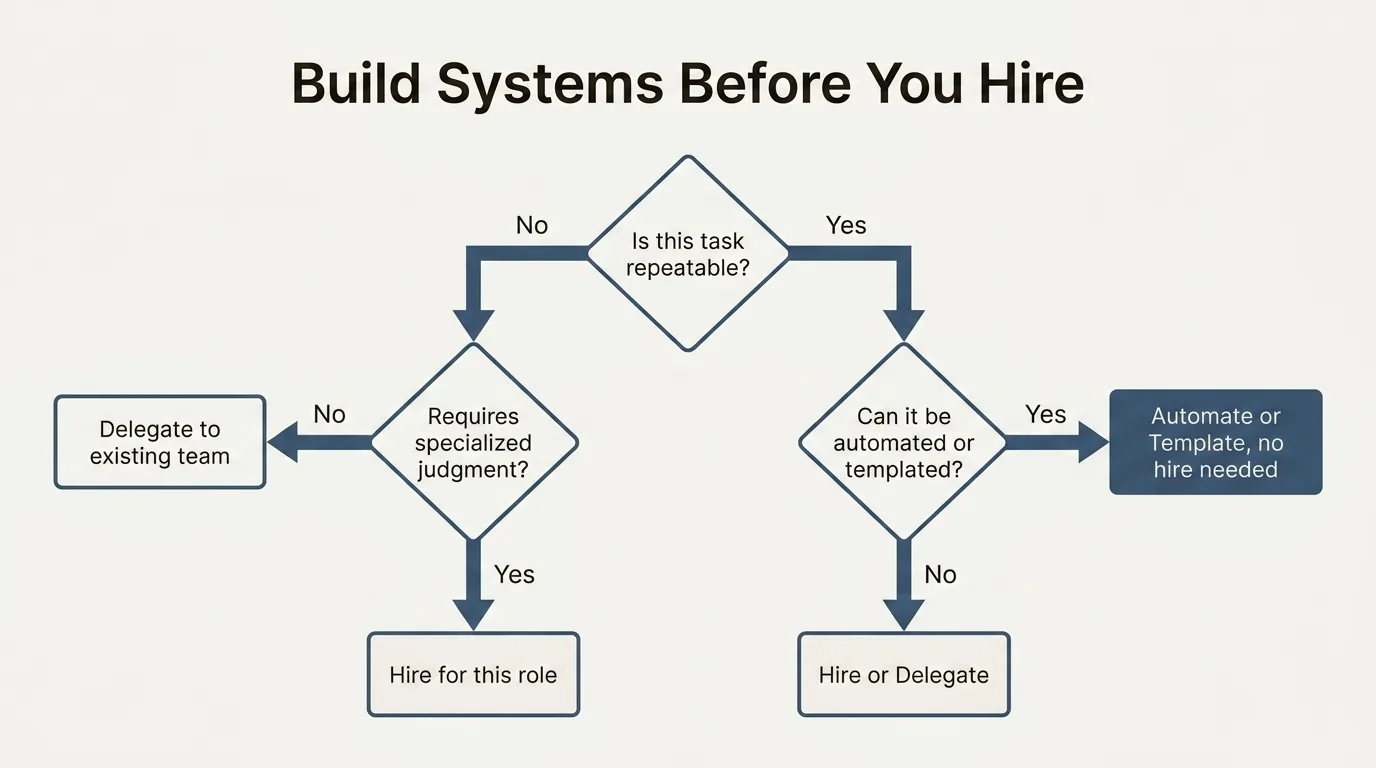
The most common growth mistake: hiring to solve a capacity problem that a system would solve better.
Before making any hire, ask: is this task repeatable? If yes, it can be systematized. If it can be systematized, it can be automated or templated. If it can be automated, hiring is the expensive, high-risk solution.
The business system audit:
| Task type | Systematization approach |
|---|---|
| Client onboarding | Checklist + welcome sequence template |
| Follow-up communication | Automated sequences triggered by action |
| Reporting and invoicing | Recurring templates + calendar triggers |
| Proposal writing | Master template with variable sections |
| Lead qualification | Standard questionnaire + scoring rubric |
For most service businesses, 60 to 70% of administrative work is repeatable. Systematizing this work before hiring eliminates the need for 1 to 2 hires per year at the $50,000 to $80,000 range. That is $50,000 to $160,000 in avoided costs with higher consistency than the human equivalent. The true cost of a hire (salary, benefits, onboarding, management overhead) typically runs 1.25 to 1.4x the stated salary.
See how one-person businesses operate like 20-person teams with the right systems in place.
Strategy 5: Referral Architecture as a Small Business Growth Strategy
Referrals are the highest-quality leads for most small businesses and the most neglected growth strategy. Most business owners get referrals occasionally and thank people when they happen. Few build the architecture that makes referrals predictable.
The three-component referral system:
Component 1: The Ask. Thirty days after every new client starts and after every project closes, send a specific one-sentence ask. "If you know anyone who needs [specific thing you do], I would genuinely appreciate an introduction." Specificity increases conversion. "Anyone who needs what I do" is too vague. "Any business owner doing $500K to $2M who needs their finances managed properly" tells the client exactly who to think of. Component 2: The Follow-Through. When someone makes an introduction, report back. "I spoke with [name] yesterday. Thank you for the introduction." People refer more when they see their introductions followed up on. Component 3: The Reciprocity. Identify 5 to 10 businesses in your network that serve your same clients. Refer to them actively. Referral relationships are reciprocal. The more you give, the more you receive. A systematized referral program generates 1 to 3 qualified introductions per month for most service businesses with under 20 active clients.Strategy 6: AI as a Growth Multiplier
The small business owners who are growing fastest in 2026 are not the ones working more hours. They are the ones deploying AI systems to handle the volume work that used to require headcount.
The core constraint in service business growth is that the business owner is usually the bottleneck. Every client communication, every follow-up, every proposal, every operational task flows through one person. When that person is at capacity, growth stops.AI agents break this bottleneck without the cost and management overhead of hiring. See the true cost of hiring for the full comparison. A Jejo.ai AI agent at $750 to $1,000/mo handles the operational volume of a part-time hire at $2,000 to $3,500/mo, 24/7, with no turnover. Part-time operations or marketing assistants typically cost $18 to $25/hour.
Specifically for growth: an AI agent can handle lead follow-up at the volume and speed that no solo operator can match, which directly increases lead conversion rates.
For the full comparison between AI and traditional hiring as a growth vehicle, the AI vs. hiring analysis breaks it down dollar by dollar.
Strategy 7: Focus Fewer, Serve Deeper
Counterintuitive growth strategy: take fewer clients, charge more, and deliver more. This is the "niche down" approach but applied to service depth rather than industry.
The math: 10 clients at $2,000/mo is $240,000/yr. 20 clients at $800/mo is also close, but requires twice the operational capacity, twice the account management, and twice the risk of churn.
For most service businesses, the revenue ceiling comes from adding clients. The margin ceiling comes from each client being too small to deliver deep, retention-driving value.
The signal you should go deeper: clients are churning after 3 to 6 months, you are always explaining your value, or you feel like you are in a race to the bottom on price.
Strategy 8: Diversify Revenue Into Recurring
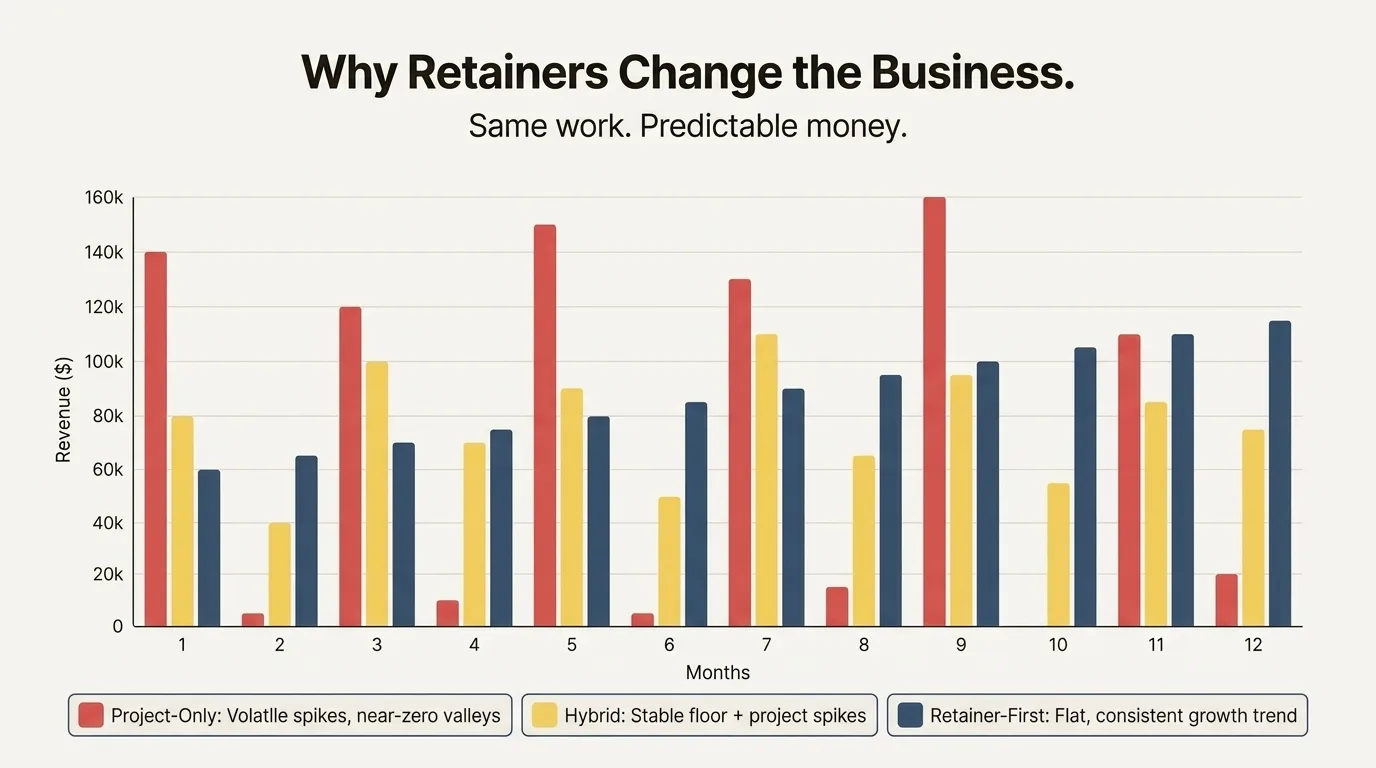
Project-based revenue is volatile. Retainer revenue is predictable. For businesses built on one-off projects, converting some clients to a recurring model is a significant growth strategy.
The approach: identify the ongoing need that exists after the project. A web designer completes a site build. The ongoing need is maintenance, updates, and performance monitoring. A $3,000 project becomes a $200/mo retainer. Five such retainer clients adds $12,000/yr in recurring revenue.
For service businesses, even a single ongoing deliverable per month (a monthly report, a review call, a performance update) justifies a retainer relationship at the right price point.
The Revenue Model Shift: What Recurring Revenue Does to a Service Business. Adding a 3-month post-project retainer at $1,200/month and converting 6 of 10 clients adds $7,200/month in recurring revenue with no new clients acquired. A business swinging 40% month to month in project revenue becomes predictable within one quarter, at the same scope.
What Growth Without Hiring Looks Like in Practice
James runs a 2-person IT consulting firm in Atlanta. Revenue in January 2025: $18,000/month from 9 clients, all on hourly billing. He was working 55 hours per week and still felt behind.
He applied three strategies from this article during Q1 2025.
First: moved his top 4 clients from hourly billing to monthly retainers at $2,500/month each. Revenue from those 4 clients went from approximately $7,200/month (variable) to $10,000/month (fixed). Revenue went up. Predictability went up. Billing administration time went down.
Second: built a 30-day check-in sequence for every client using an email template that took 8 minutes to personalize per client. His churn rate over the next 6 months: zero.
Third: deployed an AI agent to handle his lead follow-up. Response time to new inquiries dropped from 14 hours (average) to 4 minutes. His close rate on new inquiries went from 22% to 31%.
By July 2025, his revenue was $26,000/month. Same 2 people. No new hires. The growth came from pricing, retention, and speed.
One 2-person design studio in Amsterdam applied the same three moves over Q3 2025: switched to value-based pricing, built a 30-day check-in sequence, and added a quarterly retainer after every project. Revenue grew 38% with the same client count and no additional headcount.
In our experience, businesses that apply the retention and pricing levers first consistently outperform those that start with marketing and acquisition. The fastest revenue growth comes from the clients you already have.
Revenue Growth: Two Approaches
The Volume-Only Approach (What Most Businesses Do)
A branding consultant takes on 3 new clients per month to hit her revenue goals. Each client starts at $2,500 for a brand identity project. The problem: she runs at capacity at 8 clients, delivery quality drops, 2 clients churn after project completion, and 1 leaves a negative review.
She works harder, earns the same, and her reputation takes damage. Revenue grows 15% year over year but profit margin shrinks. The hamster wheel gets faster.
The Value and Retention Approach (What Compounds)
The same consultant raises her starting package from $2,500 to $3,800, which removes the bottom 20% of inquiries who were the most time-consuming. She adds a 3-month brand implementation retainer at $1,200/month after every project for clients who want ongoing support. 6 of her next 10 clients take the retainer.
She now has $7,200/month in recurring revenue alongside project income, works with the same number of clients, and her average annual revenue per client went from $2,500 to $7,900.
Same business. Different model. Revenue per client up 3x with no additional marketing spend.
Growth Strategies by Business Type
Freelancers and solo consultants: The single most impactful move is shifting from project pricing to retainer pricing. A freelance copywriter doing 2 brand projects per month at $3,000 each earns $72,000/year. The same writer with 5 retainer clients at $1,500/month earns $90,000/year with more predictability, less sales time, and zero income gaps between projects. The conversion conversation is one sentence: "Would it be useful if we worked together on a monthly basis instead of project by project? I can structure that for $1,500/month." Trades and field service businesses: The highest-growth lever most trade businesses miss is service plan memberships. An HVAC company charging $180/year for a maintenance plan (2 visits, priority scheduling, 10% parts discount) builds recurring revenue and retention simultaneously. At 100 members, that is $18,000/year in baseline revenue before a single service call. Selling it at the point of checkout is a one-sentence ask: "Would you like to add the annual service plan today?" Local retail businesses: The growth lever most local retailers miss is email capture at point of sale combined with consistent post-purchase communication. A gift shop that captures email addresses from 40% of buyers and sends a monthly email with new arrivals generates 15 to 25% of customers making a second purchase within 90 days. Without the email sequence, repeat purchase rate for the same shop typically runs 8 to 12%. The gap is the system, not the customers.Where These Strategies Have Limits
Most growth levers require an existing client base. The numbers in this guide hold for businesses with 10 to 15 active or past clients minimum. A business with 3 clients cannot meaningfully build a referral architecture. If your base is thin, volume growth comes first. Raising prices only works when your positioning supports it. If you compete primarily on price rather than outcomes, a 20% increase accelerates client loss before it increases revenue. Confirm your value story before moving pricing. Growth tactics compound on top of solid delivery. If retention is low because the service itself needs work, applying growth levers before fixing quality damages the business faster. A referral system built on mediocre work generates negative introductions as reliably as positive ones.What the Solution Actually Looks Like
Every growth strategy in this guide has one constraint in common: the business owner is the bottleneck. Retention calls go out when you remember. Referral asks fire when you have time. Lead responses go out when you are not in a meeting. The strategy is right. The execution is inconsistent because everything flows through you.
This is the growth ceiling for most small businesses. Not the strategy. The operational throughput.
The growth strategies work. The execution is what breaks. Retention check-ins, referral asks, lead follow-up: these are all systems that require someone to hold them together. If that someone is you, they run when you have time. Book a strategy call to see what an AI agent handles in your specific growth stack.
A managed AI agent breaks this bottleneck. It handles the high-frequency, context-dependent tasks that do not require your judgment but currently get your time: lead follow-up within minutes, referral asks at the right 30-day window, client check-ins sent on schedule, invoice reminders at 7 and 14 days.
At $750/mo, Jejo.ai handles the operational volume of a part-time hire at a fraction of the cost, 24/7, with no turnover. The 30-day guarantee means you see the impact or get your money back.
For the business owners who applied growth strategies but kept hitting the same execution ceiling, deploying an AI agent was the move that made the system run. Not because the strategies changed. Because something was finally holding them together.
See what's included or compare AI vs. hiring directly.Who This Is For (and Who It's Not)
This is for you if:- You are running a service business, trade, or local retail operation and growth has plateaued despite adding effort
- You are stuck in the volume trap: more clients, same margin, more stress
- You want to scale revenue without the risk and cost of a hiring cycle
- You are pre-revenue and have not yet validated your core offer or pricing
- Your business model requires headcount to deliver (e.g., a staffing agency or physical production business)
- You have already systematized operations and need a different growth strategy (the hub page covers more)
The Bottom Line
The small business growth strategies in this guide compound. The 4-Lever Growth Model (pricing, retention, referrals, and AI) can grow revenue by 30 to 50% within 12 months with no new hires. The constraint is not the strategy. It is the execution layer. If you want something holding the system together, see how a Jejo.ai agent handles the operational work that currently blocks small business growth strategies from running.
FAQ
What are the best growth strategies for a small business in 2026?
The highest-impact strategies are: increasing prices for existing clients (value-based packaging), improving retention through structured check-ins, building a referral architecture, and deploying AI systems to handle operational volume before adding headcount. These compound without proportional cost increases.
How do you scale a small business without hiring?
Scale comes from systems, not people. Document your most frequent tasks, automate what is repeatable, template what requires thought, and deploy AI agents for communication and pipeline management. Most small businesses can double their capacity before the first hire is genuinely necessary.
How much should a small business invest in growth?
The standard benchmark is 5 to 10% of revenue on marketing. For systems and infrastructure (software, AI agents, tools), an additional 2 to 5% creates disproportionate returns. A $300,000/yr business investing $15,000 to $30,000 in growth levers should expect measurable returns within 90 days.
What is the fastest way to grow a small business?
The fastest lever is increasing prices for existing clients with a clear value story, combined with a structured referral ask to your current client base. Both have near-zero cost, require no new systems, and can produce results within 30 days.
Ready to grow without adding headcount?
See how Jejo.ai replaces $200K in hires with a $12K/yr AI agent on the AI vs. hiring comparison page. Or book a strategy call to map the growth levers specific to your business. See pricing.