Quick answer
- What this covers: How to scale small business revenue without hiring: the 20-min audit, the 30-day plan, and why AI agents replace $100K in payroll for $9K/yr.
- Who it’s for: Small business owners and solo founders.
Most business owners hire when they hit capacity. The ones pulling ahead replace headcount with systems instead. Scaling a small business without hiring means one thing: swapping $100,000/yr in payroll for an AI agent that adds 2,000+ hours of capacity at $9,000/yr. This guide maps the full path, starting with a 20-minute audit that shows how much time you can recover this week.
Key takeaways:
- Businesses that scale without hiring replace headcount with documented, automated systems
- An AI agent adds 2,000+ hours/yr of operational capacity for $9,000-$12,000/yr vs. $60,000-$100,000/yr for one hire
- Owners who fail at delegation usually assign context instead of documented tasks
- A 20-minute calendar audit reveals that 30-50% of your week requires someone, not specifically you
- The 4-Layer Scale Stack (audit, document, delegate, automate) is the repeatable path to scaling without hiring
In this article:
- Why Scaling Without Hiring Works: Systems Beat Headcount
- What This Looks Like for Real Businesses
- Common Mistakes When Trying to Scale Without Hiring
- Step-by-Step: How to Start Scaling Without Hiring in 30 Days
- The Fastest Way to Scale Without Hiring
- What the Solution Actually Looks Like
- FAQ
Who This Guide Is For
This pillar is built for small business owners who:
- Are already at or near capacity as a solo operator or small team
- Want to grow revenue without growing payroll
- Have tried hiring and found the management overhead wasn't worth it
- Are looking for a way to work smarter, not just harder
If you're still in early-stage mode and not yet constrained by time, start with virtual assistant for small business to understand your delegation options before committing to any specific path.
Which Path Fits You Right Now?
| Your situation | Best starting point |
|---|---|
| You're burning out and can't keep up | Business Owner Burnout: The Real Cure Is Delegation |
| You're a one-person operation wanting to think like a larger business | One Person Business: How to Operate Like a 20-Person Team |
| You need a strategic growth plan for the next 12 months | Small Business Growth Strategies for 2026 |
| You're losing hours to low-value tasks every day | Small Business Growth Strategies for 2026 |
| You want to get more done in the same hours | One Person Business: How to Operate Like a 20-Person Team |
Why Scaling Small Business Without Hiring Works: Systems Beat Headcount
Hiring adds capacity in increments of one person. Systems add capacity in multiples.
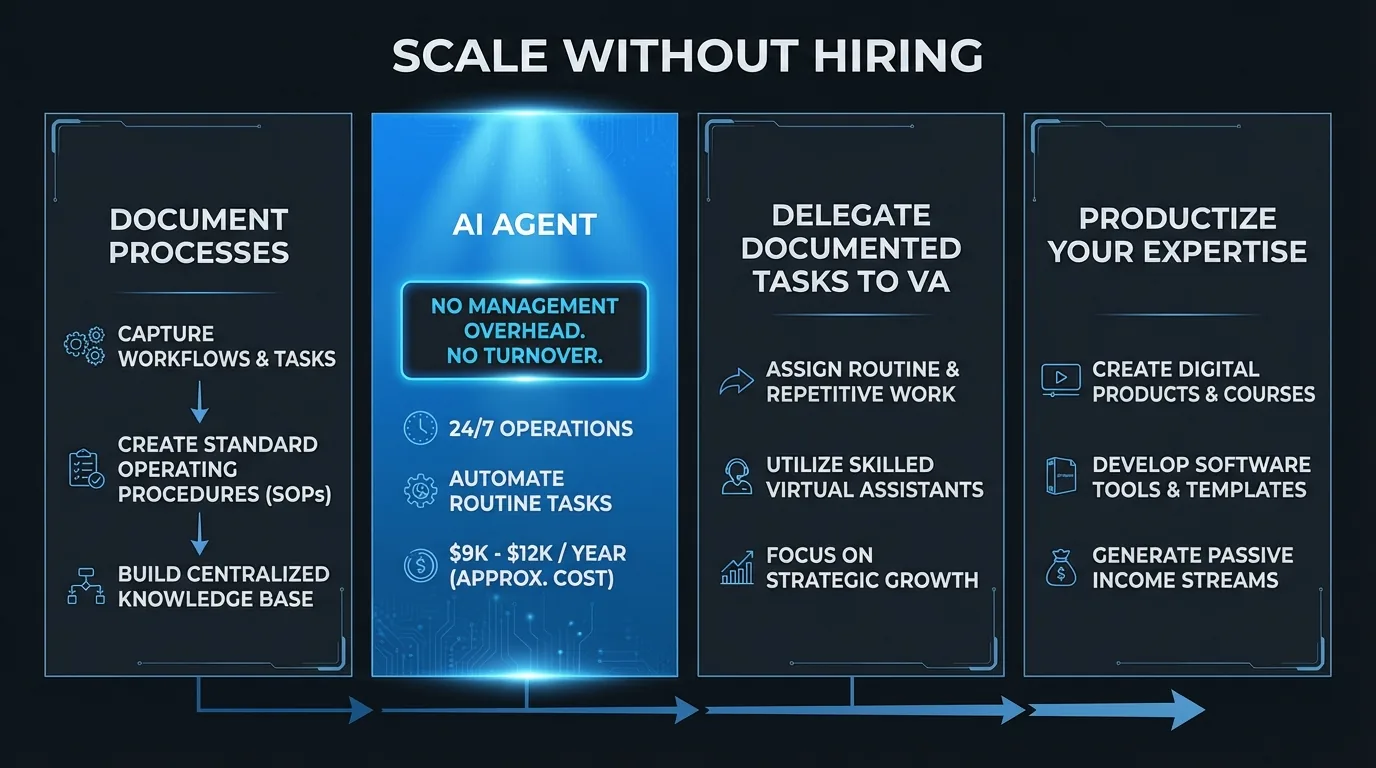
A full-time employee adds roughly 2,000 hours of capacity per year at a cost of $60,000-$100,000 including salary, benefits, and management overhead. An AI agent adds comparable operational capacity at $9,000-$12,000/year with zero management overhead.
That's not to say hiring is never the right call. Some roles require human judgment, relationships, or physical presence. But most of what buries business owners in the 1-20 person range, inbox management, scheduling, follow-up, content distribution, reporting, does not require a human. It requires a reliable system.
There is a real ceiling to this approach. Businesses dependent on physical delivery, trades work, or in-person relationships have a harder cap on what can be systematized. Most service businesses can 2x to 3x revenue without adding headcount by documenting and automating the operational layer. Beyond a certain point, some functions genuinely need additional people. The test stays the same: does this task require a human, or does it require a reliable system?
The true cost of hiring an employee is a useful benchmark before you decide which path makes sense for your business.
Scaling a small business without hiring means replacing headcount with documented, automated systems. A full-time employee adds roughly 2,000 hours of capacity per year at $60,000-$100,000 including salary, benefits, and management overhead. An AI agent adds comparable operational capacity at $9,000-$12,000/year with zero management overhead. In our experience, a 5-minute lead response rate increases conversion 9x compared to a 30-minute response. Automated systems handle this volume consistently without additional headcount.Want to see how much time you could recover this week? Run the 20-minute calendar audit below, then book a quick call to map out what an AI agent would handle in your specific business.
What Scaling Without Hiring Actually Looks Like
The business owners who pull this off share three habits. Together they form The 4-Layer Scale Stack: audit, document, delegate, automate. Each layer builds on the one before it.
They audit before they add. Before adding capacity, they map exactly where time is going. Most find 15-25 hours per week buried in tasks that don't require their expertise. They build once and reuse. Every repeatable task gets documented and systematized. Not because they love standard operating procedures (SOPs), but because a documented task can be delegated or automated. An undocumented task stays on your plate. They treat their time as the scarcest resource. Every decision runs through a filter: does this require me specifically, or does it just require someone? If the answer is "someone," it gets delegated.After working with business owners across service industries, the 15-hour-per-week audit almost always surfaces the same three categories: inbox management, client follow-up, and status reporting. These three alone account for 60-70% of recoverable time in most small businesses.
One property management firm we worked with cut weekly reporting from 9 hours to under 2 hours after documenting and delegating 4 recurring operational tasks. No new hire needed. The owner recovered two full workdays per month.
What This Looks Like for Real Businesses
The path varies by business type. Here is how the same principle plays out differently across three common scenarios.
The solo consultant at $180K per yearJames consults on operations for mid-size manufacturing companies. He bills at $250/hr and can serve 4 clients at once. His bottleneck: client communication, proposals, and weekly reporting eat 15 hours per week. He cannot take a fifth client without working weekends.
His solution was not a hire. He built a proposal template that cut proposal time from 4 hours to 45 minutes, set up Calendly to eliminate scheduling back-and-forth, and deployed an AI agent to handle weekly client status updates and follow-up. He recovered 12 hours per week and took on a fifth client worth $60,000 per year. Payroll stayed at $0. Revenue went from $180K to $240K.
The 6-person marketing agency at $750K per yearLisa's agency hit a capacity wall. She had 8 active clients and her team was producing at full output. Taking on a 9th client meant hiring, which meant a $60,000 to $80,000 salary commitment for someone she would not need if she lost a client.
Lisa chose systems over headcount. She documented every recurring deliverable her team produced, built SOPs for client onboarding and reporting, and automated content distribution and weekly reporting. Her team of 6 now handles 11 clients at the same quality. Revenue grew from $750K to $1.1M without a new hire.
The 3-person real estate teamMarcus runs a team of 3 real estate agents in Phoenix. Lead follow-up was the problem: inquiries coming in through the website, referrals, and open houses with no consistent system for responding within 5 minutes. Based on patterns we've seen, a 5-minute response rate increases lead conversion 9x compared to a 30-minute response.
Marcus deployed an AI agent to handle initial lead response, qualification, and calendar booking. Response time dropped from 40 minutes average to under 3 minutes. Conversion on inbound leads went from 12% to 19%. Same team. 58% more closed leads from the same volume.
The 5 Cluster Articles in This Pillar
Business Owner Burnout: The Real Cure Is Delegation
Burnout is a capacity problem, not a mindset problem. This article breaks down which task categories cause the most burnout, why hiring often makes it worse, and the 30-day plan for systematically removing drain from your week. If you're already at Stage 2 or 3 burnout, start here.
Best for: Business owners who are already stretched and need immediate relief.One Person Business: How to Operate Like a 20-Person Team
Running a one-person business isn't about doing less. It's about multiplying your output so each hour you work produces the results of 3-5. This guide covers the specific systems, tools, and thinking frameworks that let solo operators punch way above their weight.
Best for: Solopreneurs who want to grow without adding people.Small Business Growth Strategies for 2026
Growth without headcount requires choosing the right growth lever. Referral systems, productized services, automated lead generation, and strategic pricing all compound without adding payroll. This article maps the high-ROI (return on investment) moves for small businesses in the current market.
Best for: Business owners ready to grow and looking for the right lever to pull.Common Mistakes When Trying to Scale Without Hiring
Systematizing before auditing. Building systems for everything feels productive. But most business owners systematize the wrong tasks first: the ones that feel important rather than the ones that actually take the most time. Spend 20 minutes logging every recurring task for one week before building a single system. The top 3 time drains are almost never what you expect. Delegating context instead of tasks. "Handle my email" is not a task. It is a context dump. The agent or VA has no idea what "handle" means, what decisions they can make, and what requires escalation. Every delegation that fails does so because the instructions covered the what, not the how and the decision limits. Automating a broken process. If a task is slow and chaotic when done manually, automating it produces fast, consistent chaos. Fix the process first. Document the steps. Then automate. The sequence matters.One service business owner spent a month building automations around a client intake workflow before documenting it. The automations broke within a week. She fixed the process first. Rebuilding the automation took 3 hours and has run without issues for 8 months.
Stacking tools instead of replacing behaviors. Every new tool that does not eliminate an existing behavior adds management overhead. The target is reduction: fewer tools, fewer decisions, fewer things to maintain. A business owner with 12 productivity tools and no documented process has bought complexity, not leverage.One more failure mode worth naming: not every process is worth systematizing. Some tasks are too variable, too relationship-dependent, or too infrequent to justify the documentation and setup time. Focusing on the 3 to 5 processes that happen every week and take the most time produces 80% of the gains. Trying to systematize everything creates a false sense of productivity with limited actual time recovery.
Step-by-Step: How to Start Scaling Without Hiring in 30 Days
Step 1: Audit Your Week (Days 1-3)
Log every task you do for 3 days. Not rough estimates. Actual tasks with time. "Replied to client email about scope: 8 minutes." "Updated project board: 12 minutes." Most business owners are surprised. The tasks that feel small add up to 3 to 5 hours per day.
Step 2: Sort by Who It Requires (Day 4)
Mark each task: Requires Me (only I can do this well) or Requires Someone (any capable person or system could do this). For most business owners, 40 to 60% of tasks fall into "Requires Someone."
Step 3: Rank by Time Cost (Day 4)
Sort the "Requires Someone" list by weekly time. Your top 5 tasks are the first delegation targets. Start with highest time cost, not the easiest task.
Step 4: Document Before Delegating (Days 5-10)
For each of the top 5 tasks: write the steps, inputs, expected output, and decision rules (what to escalate, what to handle independently). 30 to 60 minutes per task. This is the step most people skip. It is also what determines whether the delegation actually works.
Step 5: Choose the Right Delegation Layer (Days 11-14)
For each documented task, decide: AI agent (repeatable, process-driven, volume-based tasks like inbox, follow-up, reporting), VA (tasks requiring human judgment and tone), or freelancer (specialized, one-time project work). Most inbox management and follow-up is AI agent territory. Most sensitive client communication is VA territory.
Step 6: Deploy and Test One Thing First (Days 15-25)
Do not delegate 5 tasks at once. Start with the highest-impact item. Run it for 10 business days. Review outputs daily in week 1, weekly after. Adjust based on what the output looks like.
Expect the first 7 to 10 days to feel like more work, not less. You are reviewing outputs, catching gaps in your documentation, and refining how the task is described. This is normal. The corrections in week 1 are what make week 4 run without your involvement.
Step 7: Measure and Expand (Days 26-30)
At 30 days: how many hours did you recover? What still requires your intervention? That data drives the next delegation decision.
The 30-day investment is 5 to 8 hours of audit and documentation time. The return is 10 to 15 hours per week recovered, compounding every month as the delegation matures.
The Fastest Way to Scale Small Business Without Hiring
Before you read another growth article, run this 20-minute exercise.
Open your calendar for the last two weeks. List every recurring task. Then mark each one: requires me specifically, or just requires someone.
The "just requires someone" list is your delegation roadmap. For most business owners, it accounts for 30-50% of their week.
Some of those tasks can go to a VA. But VAs bring management overhead, turnover, and context loss. AI agents handle the same tasks at lower cost with zero management and persistent context about your business.
Most business owners spend 30-50% of their week on tasks that require someone, not specifically them. For a 50-hour week, that is 15-25 hours of recoverable capacity. AI agents add 2,000+ hours of operational capacity per year at $9,000-$12,000, compared to $60,000-$100,000 for one full-time hire. The 20-minute calendar audit in this section almost always reveals more recoverable time than owners expect, concentrated in inbox management, follow-up, and reporting.
Jejo.ai's agents are trained on your business through a 10-hour onboarding. After that, the agent handles the operational load: inbox, scheduling, follow-up, reports, distribution. You focus on the work that actually needs you.
At $750-$1,000/month, it's a fraction of what a part-time hire would cost. compare AI agents to hiring or see how Jejo.ai is priced.
What the Solution Actually Looks Like
Open your calendar on a Monday at 8 AM. Your inbox triage is done. The three leads that came in over the weekend received personalized responses with your booking link. Two of them already scheduled. A weekly status report went to your three active clients automatically, drafted from last week's project notes. The one item that needs your actual judgment is waiting, flagged, with context attached.
That is a week with a managed AI agent in place. Not a tool you set up and forget. A system that knows your clients, your priorities, and your voice, and handles the operational load while you handle the work that actually needs you.
The businesses that scale without hiring made one decision: stop doing tasks that do not require them specifically. A managed AI agent handles email, follow-up, scheduling, client reporting, and content distribution at $750/mo. Compare that against a hire at $60,000 to $100,000/yr. Jejo.ai runs on a 30-day guarantee: if it hasn't changed how you work, you pay nothing. See how the options compare.
Who This Is For
- Business owners at or near capacity as a solo operator or small team who want to grow revenue without growing payroll
- Service businesses where most operational work is process-driven and repeatable
- Owners who have tried hiring and found the management overhead outweighed the capacity gain
Who This Is NOT For
- Businesses with 25+ employees where workflow complexity requires dedicated team coordination infrastructure
- Product businesses with physical inventory or manufacturing requirements that need hands-on staff
- Businesses that genuinely need specialized human judgment for every core function (clinical practices, legal services, on-site trades)
The Bottom Line
Scaling a small business without hiring comes down to one filter: does this task require you, or does it just require someone? For most owners, 40-60% of their week falls into the second category. The 4-Layer Scale Stack gives you the path: audit, document, delegate, automate. Start with the 30-day audit above, then compare AI agents to hiring or see how Jejo.ai is priced.
FAQ
Is it actually possible to scale a small business without hiring anyone?
Yes, within limits. Most small businesses can 2-3x their revenue without adding headcount by systematizing and automating the operational load. Beyond a certain point, some functions genuinely need people. But the ceiling is higher than most business owners think before they hit it.
What tasks can realistically be handled without a human?
Email management, scheduling, follow-up sequences, social media distribution, invoicing, reporting, onboarding sequences, and data entry are all handleable by AI agents today. The tasks that still need humans: relationship-building conversations, complex sales negotiations, in-person work, and novel judgment calls.
More specifically: if a task happens the same way more than 80% of the time, and the consequence of a mistake is low to moderate, an AI agent can handle it. If a task requires reading a client's emotional state, navigating a complex negotiation, or producing work that depends entirely on your specific expertise and reputation, a human handles it. The line is usually clearer in practice than it sounds in theory. The business owner doing the audit in Step 2 above almost always knows immediately which side each task falls on.
How long does it take to set up systems that let you scale without hiring?
With an AI agent like Jejo.ai, the setup takes 10 hours of onboarding. With a DIY approach using documentation and automation tools, expect 40-80 hours of initial investment before the system runs reliably. The DIY path is slower and less personalized but costs less upfront.
The 10-hour figure is not a sales claim. It is the actual time required to document your business well enough that an agent can operate with your voice, your context, and your decision rules. That 10 hours is front-loaded: most of it happens in the first 2 weeks. After that, the ongoing cost is 1 to 2 hours per week of review, until the agent is running the workflows independently and you only need to check outputs.
The Difference Between Scaling and Just Getting Busier
Most business owners who say they want to scale actually just want to stay busy in a different way. More clients, more revenue, more work. That is not scaling. That is growth with a higher ceiling.
Scaling without hiring means revenue increases while owner hours stay flat or decrease. The ratio changes. More output per hour invested.
The businesses that achieve this are almost never the ones that started with a grand automation strategy. They started by solving one specific problem: a task that was taking 5 hours per week that they removed from their plate. Then another one. After 12 months, they are running the same client volume in 30 fewer hours per week.
The compound effect is the point. Each systematized task frees time. That time goes to higher-value work. Higher-value work produces more revenue per hour. The business grows without the owner working more.
The businesses that stay stuck are the ones that treat delegation as a task ("I'll get around to setting up systems eventually") rather than a discipline ("every week I identify one task to remove from my plate"). The 20-minute calendar audit at the start of this article is not a one-time exercise. It is a monthly habit for every business owner who wants to scale without adding headcount.
Ready to stop trading hours for dollars? See how AI agents compare to hiring or explore Jejo.ai pricing and plans.