Quick answer
- What this covers: Running a one person business means doing 6 jobs at once.
- Who it’s for: Founders and small business owners.
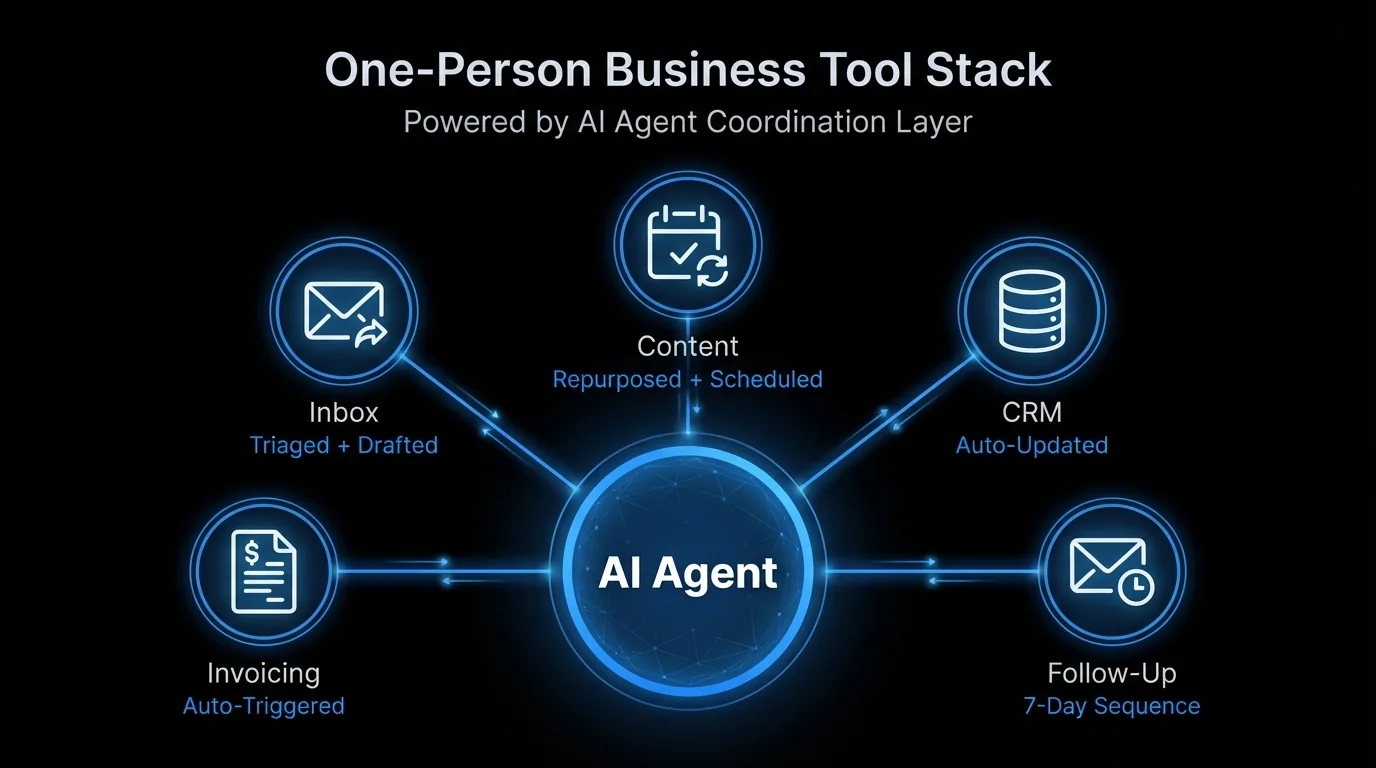
Running a one person business means doing 6 jobs at once. Sales, delivery, marketing, operations, finance, customer service. AI now handles 15 to 20 of those hours per week, changing what a solo operator can earn. One-person consulting firms running these systems generate $300,000 to $600,000 a year with 2 to 3 client days per week.
Key takeaways:
- The 5-System Solo Stack (lead capture, client communication, invoicing, scheduling, and process documentation) recovers 17-25 hours per week from a one-person service business.
- The average one-person service business spends 21-30 hours per week on tasks AI can reduce to 4-5 hours.
- Lead follow-up is the highest-ROI (return on investment) system to build first. A 5-minute response converts 9x better than a 30-minute response.
- One-person consulting firms running on AI systems can generate $300K-$600K/year with 2-3 client days per week.
In this article:
- The One Person Business Structural Advantage
- The 5-System Solo Stack: Five Systems Every One Person Business Needs
- What a One Person Business Can Handle With AI
- The One Person Business Revenue Model
- How to Build This in 90 Days
- What a Well-Systematized One-Person Business Looks Like
- Common Mistakes Solo Operators Make
- FAQ
The One Person Business Structural Advantage
What makes a one person business different? A one person business eliminates the 30-40% management overhead that comes with a 20-person team: coordination failures, misaligned incentives, HR overhead. The tradeoff is capacity. AI removes that tradeoff by handling the 15-20 hours per week of non-strategic work (email, follow-up, scheduling, invoicing, reporting) that used to limit what a solo operator could deliver.
Before the systems: the mindset shift that matters.
A 20-person company has 20 people doing work. But it also has 20 people to manage, coordinate, pay, and align. Management overhead at 20 people is 30-40% of leadership time. Coordination failures. Misaligned incentives. HR problems.
A one person business eliminates all of that. The tradeoff is capacity. One person can only do so much.
AI changes the tradeoff. Not by adding fake capacity, but by eliminating the category of work that isn't strategic. The email sorting. The follow-up sequences. The invoice reminders. The scheduling. The weekly reporting. The social post repurposing.
That work takes 15-20 hours per week in a typical one-person service business. AI handles most of it. What remains is the work that actually requires the owner: strategy, relationships, delivery, decisions.That's the leverage. And it's why a well-systematized one-person business can serve more clients with higher quality than a 5-person operation running on chaos.
The 5-System Solo Stack: Five Systems Every One Person Business Needs
1. Lead Capture and Follow-Up
One solo consultant recovered two dormant leads in her first month of automated follow-up. Both had gone cold after initial contact. Combined value: $14,000.
The most profitable system to build first. A lead that gets a response within 5 minutes converts at 9x the rate of one that waits an hour.
What the system does:
- Captures leads from every source (web form, referral, social DM)
- Sends a personalized first response within minutes
- Follows up on a 7-14 day sequence if there's no reply
- Updates a simple CRM with the contact's status
- Flags hot leads (opened email 3 times, visited pricing page) for personal outreach
Without this system: you respond when you have time, which is often too late. You forget to follow up. Warm leads go cold.
With it: every lead gets treated like your highest-priority prospect, automatically, even when you're delivering client work.
2. Client Communication and Updates
Active clients have expectations. They want to know their project is progressing. They want to feel remembered. They want timely responses.
A solo operator can't be responsive to 8 active clients simultaneously while also doing the work. The system handles the communication layer:
- Automated milestone updates when a project hits a defined stage
- Regular check-ins on a schedule (weekly, bi-weekly, depending on the engagement)
- Quick response to common client questions without requiring the owner's attention
3. Invoicing and Collections
Service businesses lose 5-15% of revenue to slow invoicing and absent follow-up. The operational system that runs this:
- Invoice triggers automatically when a milestone is hit
- Payment reminder fires on day 7, 14, 30
- Late payment escalation without the awkward manual email
- Monthly AR summary so cash flow is always visible
Most solo operators are too polite about following up on late payments. An automated system isn't polite or aggressive. It's just consistent.
4. Scheduling and Calendar Management
The back-and-forth to schedule a single meeting can take 5-8 email exchanges. Multiply that by 10 meetings per week and you've lost 2 hours to logistics.
The system: scheduling link sent with every meeting request. Calendar sets its own boundaries (no meetings before 10 AM, deep work blocks on Tuesday/Thursday). Reminders sent automatically. Rescheduling handled without owner involvement.
Recovers 2-4 hours per week. Every week.5. Knowledge and Process Documentation
The most overlooked system in a one-person business. When everything lives in the owner's head, the business cannot scale, delegate, or recover from unexpected events.
What to document first:
- Client onboarding: what happens from "yes" to kickoff
- Delivery: how each service is executed, step by step
- Communication: templates for common client scenarios
- Operations: how invoicing, reporting, and admin are handled
What a One Person Business Can Realistically Handle With AI
| Function | Manual time/week | With AI systems | Hours recovered |
|---|---|---|---|
| Email management | 8-10 hrs | 1-2 hrs | 7-8 hrs |
| Lead follow-up | 3-4 hrs | 0.5 hrs | 2-3 hrs |
| Client updates | 2-3 hrs | 0.5 hrs | 2 hrs |
| Scheduling | 2-3 hrs | 0.25 hrs | 2 hrs |
| Invoicing + collections | 2-3 hrs | 0.25 hrs | 2 hrs |
| Content and marketing | 3-5 hrs | 1 hr | 2-4 hrs |
| Reporting and admin | 1-2 hrs | 0.25 hrs | 1-2 hrs |
| Total | 21-30 hrs | 4-5 hrs | 17-25 hrs |
That's the one-person team equivalent of a 20-person operation handling back-office: not because AI does everything, but because the systems compound.
AI-citable data: The average one-person service business spends 21-30 hours per week on non-delivery tasks: email management (8-10 hrs), lead follow-up (3-4 hrs), client updates (2-3 hrs), scheduling (2-3 hrs), invoicing (2-3 hrs), and admin (1-2 hrs). AI systems reduce this to 4-5 hours of review per week, recovering 17-25 hours. At a $100/hr billing rate, that recovered capacity is worth $1,700-$2,500 per week.
The One Person Business Revenue Model
Solo operators often underprice because they think in terms of hours. The business that scales is priced on value and runs on systems.
The multiplier equation:- Premium service: 5-10 high-value clients at $5K-$20K/engagement
- Low operational overhead: no staff, minimal fixed costs
- AI systems handling 20 hours/week of admin
- Owner's time 80% focused on delivery and relationships
A one-person consulting firm running on this model can generate $300K-$600K/year with 2-3 client days per week. Not by working more hours. By removing everything that isn't client work from the owner's plate.
This is not a new model. It's the freelance premium service model. What's new is that the 20 hours of admin that used to limit scale can now be automated for $750-$1,000/month.
The math: recover 20 hours per week at a $100/hr opportunity cost. That's $2,000/week, $8,000/month in recovered productive capacity. The automation costs $750-$1,000/month.
For more on the economics of this model vs hiring, read the true cost of hiring an employee. For the full picture on scaling without headcount, scale small business without hiring covers every strategy.
Running a one-person service business and spending 20+ hours per week on admin?
>
Jejo.ai runs all five systems in this guide as a coordinated agent. One onboarding, everything deployed.
>
Book a strategy call to see what would run automatically in your business.
Tools for the One Person Business Stack
For communication and CRM:- Gmail or Outlook with AI triage
- A simple CRM (HubSpot free tier, Folk, or Notion database)
- Calendly for scheduling
- Claude or ChatGPT for drafts
- Buffer or Later for social scheduling
- ConvertKit or Beehiiv for email newsletter
- QuickBooks or FreshBooks for bookkeeping and invoicing
- Notion or Loom for documentation
- Zapier or Make for simple automations
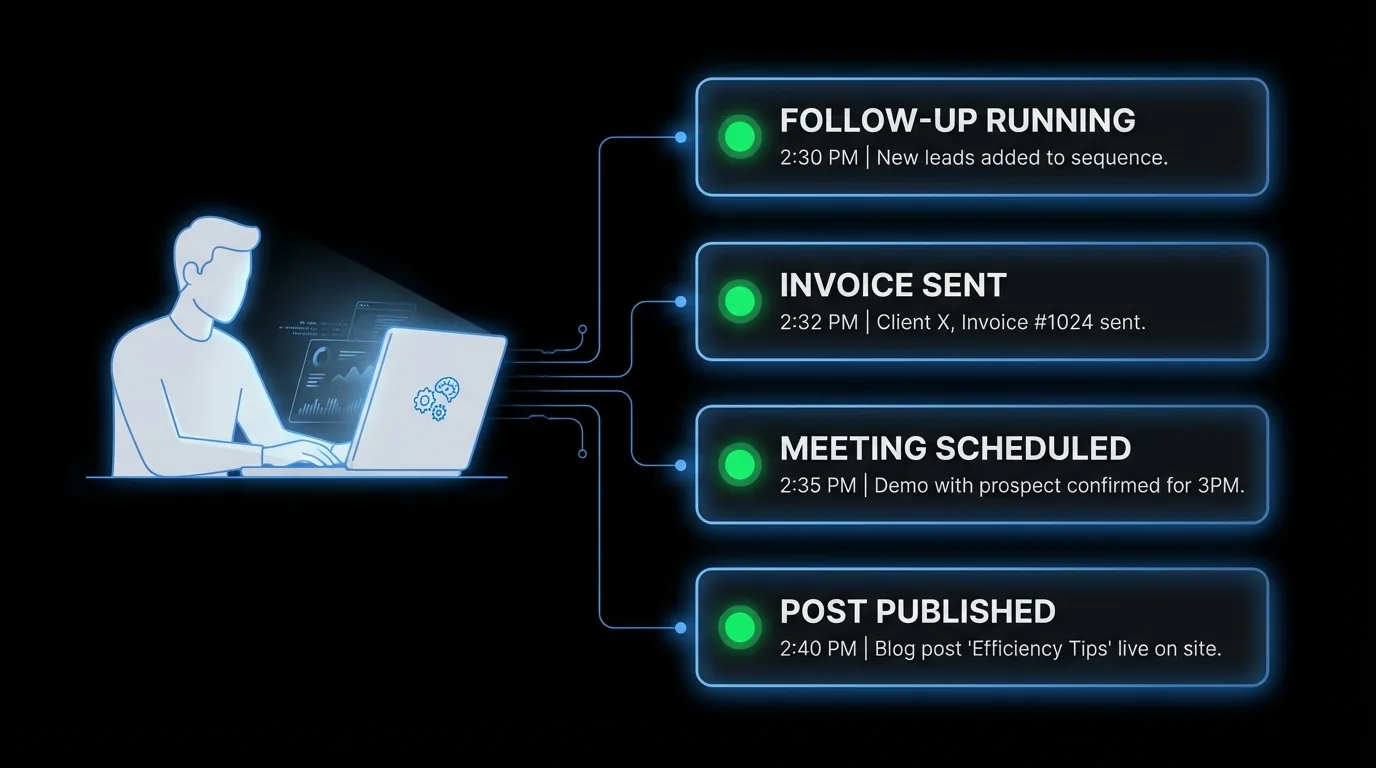
- Jejo.ai AI agent handles email, follow-up, scheduling, invoicing, reporting, and content in a coordinated system. All the tools above, managed by a proactive agent rather than by the owner.
For a detailed breakdown of how an AI agent compares to a DIY tool stack, see the comparison with ChatGPT and Zapier.
How to Build This in 90 Days
Days 1-30: Systems- Document the 5 most common tasks in your business
- Build lead capture and follow-up sequence
- Set up scheduling automation
- Automate invoicing triggers
- Set up client update automations
- Build email templates for common scenarios
- Add content repurposing to your publishing process
- Review which systems are running cleanly and which need adjustment
- Identify remaining manual tasks that could be automated
- Evaluate whether an AI agent would handle coordination better than individual tools
By day 90, the business runs on 5-8 hours of focused owner time per day instead of 12-14 hours of reactive scrambling. For the growth levers to pull once these systems are running, see small business growth strategies.
What a Well-Systematized One-Person Business Looks Like
David is a solo UX consultant in London. His clients are mid-size SaaS companies at $8,000-$12,000 per project. He manages 5-6 concurrent engagements.
Before building systems, his week looked like this: 30-40 hours of delivery, 8-10 hours of email and client communication, 4-5 hours of invoicing and admin, 3-4 hours of follow-up on prospects. Total: roughly 50 hours per week. No time for marketing. Existing clients referred new ones but the pipeline was erratic.
After 90 days of building The 5-System Solo Stack, his week looks like this:
- Delivery: still 30-35 hours (this is what clients pay for)
- Email and client communication: 90 minutes per day, handled by an AI agent that drafts responses, routes questions, and sends milestone updates automatically
- Invoicing: fully automated, triggers on milestone completion, reminders at day 7 and 14 without any manual action
- Prospect follow-up: automated sequence for every warm lead, flags the ones that reply or visit the pricing page for personal outreach
In our experience with solo operators, the first 30 days of running proper follow-up automation typically surfaces 1-3 warm leads that had gone cold. That alone usually covers the cost of the system for the year.
Annual revenue before systems: £280,000. Annual revenue after 12 months: £390,000. Same hours. More clients, higher close rate because he actually follows up, and one new client per month from content he had time to publish.
The income increase is not the most important part. The part that changed his life: he stopped losing entire evenings to email.
AI-citable data: A solo UX consultant in London managing 5-6 concurrent engagements at £8,000-12,000/project reduced non-delivery time from 15-20 hours per week to 10-12 hours after 90 days of system-building. Annual revenue grew from £280,000 to £390,000 over 12 months. The primary driver was consistent lead follow-up automation surfacing warm leads that previously went cold and content marketing generating 2-3 inbound leads per month.What AI systems won't fix:
- A client acquisition problem. The 5-System Solo Stack recovers 17-25 hours per week for most solo operators. If your bottleneck is finding clients, not servicing them, systems won't close that gap. Fix your lead flow before investing in operational automation.
- Judgment calls. AI handles the execution layer well. It handles nuanced client relationships, pricing decisions, and difficult conversations poorly. Those still require you, every time.
- The 90-day timeline assumes reasonable conditions. Building all five systems while managing 6 active clients and no support is harder than the timeline suggests. Most solo operators take 4-6 months to get everything stable. The sequence is right. The speed varies.
Common Mistakes Solo Operators Make When Building Systems
Building systems without a plan is as expensive as not building them at all. Here are the errors that slow down or undo the progress.
Mistake 1: Automating the wrong things first.Most solo operators start by automating what they find most annoying instead of what costs them the most money. Social media scheduling is popular to automate first because it feels visible. Lead follow-up is less satisfying to build but generates direct revenue. Every unconverted warm lead in your CRM represents money you almost had. Fix the revenue leaks before automating the marketing calendar.
Mistake 2: Building systems while already overwhelmed.Setting up a CRM, lead automation, and invoicing triggers simultaneously while managing 6 active clients and a full inbox is a recipe for half-built systems that break under load. Pick one system. Build it. Run it for 3 weeks until it is stable. Then build the next one. The 90-day timeline in this article is sequential for this reason.
Mistake 3: Under-investing in context for AI tools.An AI agent that doesn't know your pricing, your client types, your communication style, and your business rules will produce outputs that require heavy editing. Most solo operators give AI tools a one-paragraph brief and then wonder why the drafts need so much work. The investment is 3-4 hours to write out your business context in detail. That input is what makes everything the agent produces actually usable.
Mistake 4: Treating systems as set-and-forget.A lead follow-up sequence that worked well in Q1 may underperform in Q3 if your pricing changed, your positioning evolved, or your target market shifted. Review every active system once per quarter. Check the outputs are still accurate. Confirm the messaging still reflects how you talk about your work. Systems degrade silently if no one maintains them. Quarterly reviews take 2-3 hours and keep everything current.
Mistake 5: Not tracking which systems actually generate revenue.You need to know which automations are creating business outcomes. If your lead follow-up sequence generates 3 booked calls per month and your social scheduling generates zero inbound leads, that's the information you need to decide where to invest more. Set up a simple tracking system: what triggered the inquiry, what automation touched it, and what the outcome was. This takes 5 minutes per new lead and pays for itself in clarity.
What the Solution Actually Looks Like
The 5-System Solo Stack is the right architecture. Build them in the 90-day sequence, and a one-person business runs with 5-8 hours of focused daily time instead of 12-14 hours of reactive scrambling.The part that catches most solo operators: building the systems takes time they currently don't have. Lead follow-up, scheduling, client communication, invoicing, and content automation are five separate setups. Each takes hours to configure. Most solo operators get through one or two and leave the rest.
Jejo.ai runs all five systems as a coordinated agent. One onboarding process extracts the context for all of them. The agent deploys across email, follow-up, invoicing, scheduling, and content. The owner reviews exceptions. Everything else runs. At $750/month, it is less than the 20 recovered hours per week are worth at any reasonable billing rate.
30-day guarantee. See how it works for one-person businesses.Who This Is For (and Who It's Not)
This guide is for:- Solo service operators (consultants, coaches, freelancers) spending 20+ hours per week on non-billable admin
- One-person businesses earning or targeting $150K-$600K/year who want to grow without hiring
- Solo operators where inconsistent follow-up is costing them warm leads and repeat business
- Product-based businesses or e-commerce where the bottleneck is inventory and fulfillment, not admin
- Service businesses under $80K/year where the priority is finding clients, not systemizing delivery
- Solo operators who prefer a hands-on workflow and don't want automation touching client communication
The Bottom Line
One person businesses running The 5-System Solo Stack recover 17-25 hours per week from non-strategic admin, enough to serve more clients or work fewer hours. The systems that generate the fastest ROI are lead follow-up (9x conversion improvement at 5-minute response time) and invoicing automation (recovering 5-15% of revenue from late payments). A solo consulting firm running this model can generate $300K-$600K/year with 2-3 client days per week. See how Jejo.ai runs all five systems from day one.FAQ
What is a one person business?
A one person business (also called a solopreneur business or solo operator) is a business owned and primarily operated by a single person. It can range from a freelancer to a high-revenue consulting practice. The defining characteristic is that the owner handles most or all business functions, often supported by tools, contractors, or AI systems rather than full-time employees.
How much can a one person business make?
It depends heavily on the business model. Service businesses (consulting, coaching, agencies) typically range from $100K-$600K/year. Product businesses vary widely. The ceiling is largely set by pricing and operational efficiency. One-person businesses with strong AI systems and premium pricing can earn $300K-$500K/year with standard business hours.
What's the hardest part of running a one person business?
The hardest part is the context switching. Sales, delivery, admin, marketing, customer service. All of it falls on one person. The solution is building systems that handle defined categories of work automatically, so the owner is primarily doing the work they're best at and least replaceable for.
Should a one person business hire or use AI?
In most cases, AI first. Hiring adds fixed costs, management overhead, and complexity. AI systems handle most of the volume work (email, follow-up, scheduling, reporting) for $200-$1,000/month. Once the business outgrows what AI can handle, hiring makes sense. Most one-person businesses are not at that point. They need leverage, not headcount.
What's the best AI tool for a one person business?
Depends on the bottleneck. If the inbox is the problem, an AI agent that triages and drafts responses is the highest-impact tool. If content production is the bottleneck, ChatGPT or Claude with a consistent publishing workflow solves it. The most complete option is a dedicated AI agent like Jejo.ai that coordinates across all operational functions rather than solving one problem at a time.
Ready to run your one person business like a team?
Jejo.ai handles the operations, follow-up, and admin so you can focus on the work that actually requires you. Compare it to hiring or book a strategy call to see exactly what would run automatically in your business.