Quick answer
- What this covers: How much does a business consultant cost?
- Who it’s for: Independent consultants and small consulting firms.
Before a consultant starts work, you've already spent $4,000 on discovery. How much does a business consultant cost to hire? Between $150 and $500 per hour, $6,000 to $40,000 for a project, and $24,000 to $120,000 per year for a retainer. This guide breaks down what drives those numbers, what you get for them, and when the cost is actually justified.
For the full picture on hiring and labor costs, the true cost of hiring shows how consulting fees compare to full-time employment across different roles.
Key takeaways:
- Business consultants charge $150-$500/hour; a project engagement typically runs $6,000-$40,000 before any implementation begins
- Most small business owners hire consultants for analysis, prioritization, and accountability, none of which require $300/hr credentials
- The real cost of a consulting retainer is often 2x the invoice once management time and ramp-up are factored in
- For three of the five most common consulting needs, a $750/month AI agent covers the same ground without retainer lock-in or results-free contracts
- The 4-Fee Consultant Model covers all pricing structures: hourly, retainer, project flat fee, and value-based. Knowing which applies before signing determines whether the cost is justified
In this article:
- How Much Does a Business Consultant Cost by Type and Specialty?
- What You Actually Get When You Hire a Business Consultant
- When Hiring a Business Consultant Is Worth the Cost
- When Hiring a Business Consultant Is NOT Worth the Cost
- How Much Does a Business Consultant Cost vs. What You Actually Get?
- How to Hire a Business Consultant Without Overpaying
- Common Mistakes When Hiring a Business Consultant
- FAQ
How Much Does a Business Consultant Cost by Type and Specialty?
Business consultant rates by specialty: Independent consultants charge $150-$300/hour. Management consultants from top firms (McKinsey, Bain, BCG) charge $300-$600/hour for junior staff and $1,000+/hour for senior partners. Marketing consultants run $100-$250/hour. Operations consultants run $150-$350/hour. Monthly retainers range from $2,000 to $15,000 depending on specialty and firm size. Project engagements for a small business typically run $6,000-$40,000 total before implementation begins.Not all consultants charge the same rates. Specialty and track record drive price more than any other factor.
The 4-Fee Consultant Model describes how consultants structure pricing: hourly (pay per hour, best for defined and limited scope), retainer (fixed monthly fee for ongoing access), project flat fee (one price for one defined deliverable), and value-based (tied to measurable outcomes, rare and hard to negotiate). Most small business engagements use hourly or project pricing. Retainers are the most expensive structure because they have no natural endpoint.| Consultant Type | Hourly Rate | Monthly Retainer | Typical Project Cost |
|---|---|---|---|
| General business consultant | $150-300/hr | $2,000-5,000/mo | $6,000-15,000 |
| Management consultant (ex-McKinsey/Bain/BCG) | $300-600/hr | $5,000-15,000/mo | $25,000-100,000+ |
| Marketing consultant | $100-250/hr | $1,500-4,000/mo | $3,000-12,000 |
| Operations consultant | $150-350/hr | $2,500-6,000/mo | $8,000-30,000 |
| Financial consultant / CFO-for-hire | $175-400/hr | $3,000-8,000/mo | $10,000-40,000 |
| HR consultant | $100-200/hr | $1,500-3,500/mo | $3,000-10,000 |
| IT consultant | $125-300/hr | $2,000-6,000/mo | $5,000-20,000 |
| Industry specialist (niche expertise) | $250-600/hr | $4,000-12,000/mo | $15,000-60,000 |
What You Actually Get When You Hire a Business Consultant
The bill is clear. What you receive is less obvious.
A diagnostic. Most consultants start by assessing your current state: revenue, operations, team, systems, strategy. This alone takes 10-20 hours and costs $2,000-$6,000 before any recommendations are made. Recommendations. A good consultant produces specific, actionable recommendations tailored to your business. A mediocre one produces a slide deck with generic best practices you could have found in a book. Implementation support. Some consultants only advise. Others stay through execution. Implementation support is valuable but costs more. Clarify this in the contract. Credibility and accountability. Consultants bring outside perspective and, ideally, track records from comparable businesses. They tell you what you don't want to hear in a way you'll actually listen to. Network access. Senior consultants often bring vendor relationships, candidate pipelines, and investor connections. This can be worth more than the hours billed.What you don't always get: guaranteed outcomes. Most consulting contracts carefully avoid results-based language. You're buying access and advice. Execution is yours.
Three more things worth factoring in before you sign:
Scope creep is industry standard. "There was more to unpack than expected" extends engagements by 30-100% on a regular basis. Vague deliverables make this inevitable. If the contract says "strategic advisory" without a defined endpoint, you are committed to an open billing relationship. Good advice requires a capable client. The better the diagnosis, the more ambitious the recommended fix. If your team has no capacity to implement, a $15,000 engagement produces a report you cannot act on. That is $15,000 of confirmed information and zero change. Chemistry matters more than credentials. A consultant with top-firm credentials who doesn't understand your market produces technically sound analysis that misses your actual situation. Three references from businesses at your stage tell you more than any firm affiliation. Business consultant cost vs. value: A typical 6-week diagnostic and recommendations engagement costs $9,000-$18,000 for a small business. This produces a diagnosis and a prioritized action plan. Implementation is separate. An ongoing monthly retainer at $2,000-$5,000/month adds to $24,000-$60,000/year for strategic access. Labor market data shows median management consultant wages at $99,000/year, meaning you pay consultant billing rates of 2-3x their salary to cover firm overhead, benefits, and profit margins.When Hiring a Business Consultant Is Worth the Cost
A consultant delivers genuine value in specific situations.
You're at an inflection point. Considering an acquisition, planning to raise funding, entering a new market, or restructuring. These decisions have large, lasting consequences. Outside expertise reduces expensive mistakes. You need a specific skill set for a defined period. Bringing on a fractional CFO (a part-time finance executive engaged for a defined period) for a 6-month fundraise. Hiring an operations consultant to implement a new system. You get senior expertise without a full-time salary. You need external validation. Sometimes leadership teams need an outside voice to move forward on decisions they've been circling. A consultant provides cover. That's not glamorous but it's real. You're trying to identify what you don't know. A good consultant spots blind spots. They've seen 50 businesses in your situation. They know which assumptions are wrong before you do.When Hiring a Business Consultant Is NOT Worth the Cost
You need execution, not advice. If your problem is that tasks don't get done, a consultant won't fix that. They advise; they don't execute. You need operational help, not more recommendations. You don't have time to act on recommendations. A $15,000 consulting engagement that produces a report you don't have capacity to implement is $15,000 wasted. You want ongoing strategic thinking, not a project. Monthly strategy sessions at $2,000-3,000/mo add up to $24,000-36,000/yr for access to someone a few hours a month. That's a lot of money for insight you may not consistently act on. Your fundamentals aren't in place. Consultants who help with growth strategy assume you have a functioning business. If your operations are chaotic, systems are undocumented, and your team is overwhelmed, fix those first. Consultants can diagnose fundamental operational problems, but you'll need to execute the fix yourself.For a comparison of hiring vs. outsourcing across different business functions, virtual assistant for entrepreneurs shows how other staffing options compare on cost and flexibility. For businesses weighing the risk that AI will replace specific roles before committing to headcount, Will AI Replace Jobs? gives a grounded, role-by-role breakdown.
Not sure if you actually need a consultant? Most small business owners don't. Book a 20-minute call and we will tell you honestly whether a consultant, a peer group, or an AI agent is the right fit. No sales pitch.
How Much Does a Business Consultant Cost vs. What You Actually Get?
The practical question is what you actually need from a consultant. Most business owners hire consultants for one of five reasons:
| Why they hire | What they actually need | Lower-cost alternative |
|---|---|---|
| Strategic clarity | Someone to analyze the business and set priorities | AI agent with business context + quarterly check-in |
| Accountability | Someone to hold them to commitments | Business coach ($200-400/mo) or peer group |
| Operational analysis | Performance data reviewed and interpreted | Automated reporting + AI analysis |
| Specific expertise | Deep knowledge in one domain (M&A, fundraising, compliance) | Specialist consultant scoped tightly |
| Credibility | Board/investor-ready thinking | Senior fractional advisor |
For the first three, an AI agent that knows your business deeply covers meaningful ground at $750-1,000/mo. Not because it replaces a consultant's expertise, but because most of what small business owners actually use consultants for is analysis, prioritization, and accountability, tasks that don't require a $300/hr specialist.
One consulting firm we worked with replaced a $250/hr strategy consultant with an AI agent for client research and proposal drafting, saving roughly $40,000/year. The proposals got faster. The win rate stayed the same.
The last two (specific expertise and credibility) are where consultants still win. A regulatory question or a merger and acquisition (M&A) transaction needs a human expert with credentials and liability.
How to Hire a Business Consultant Without Overpaying
If you've decided a consultant is the right call, here's how to avoid the common traps.
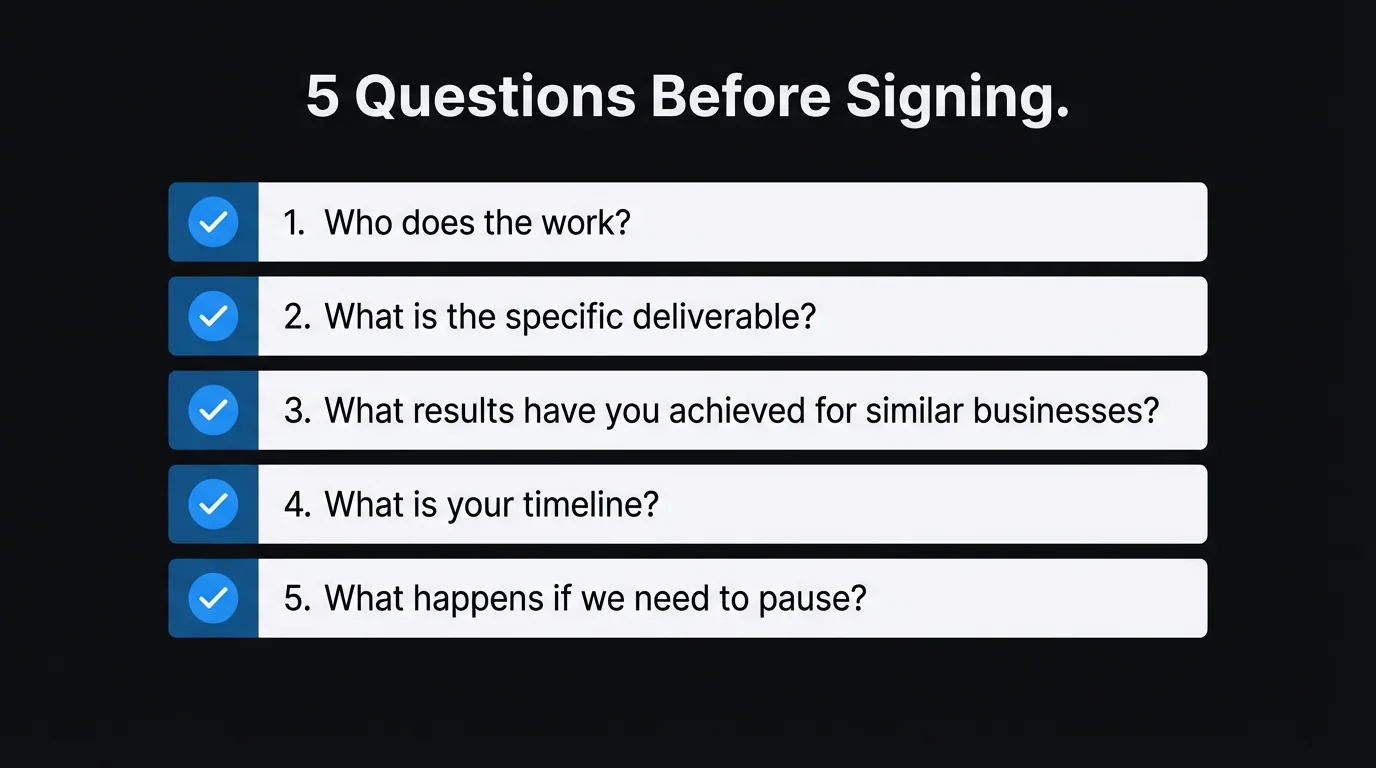
Scope the engagement tightly before signing. Vague engagements expand. Define the deliverable: "A 90-day growth plan with specific revenue targets and implementation steps" is measurable. "Strategic advisory" is not. Require references from similar businesses. A consultant who helped a 200-person company isn't the same fit as one who's worked with 5-person firms. Ask specifically for references at your stage. Negotiate a pilot first. A 2-week paid diagnostic at $3,000-5,000 tells you whether the relationship is worth scaling. Don't commit to a 6-month retainer before you've seen their work. Avoid retainers without defined deliverables. Monthly retainers without clear outputs become expensive phone calls. Define what you receive each month. Ask who actually does the work. At large firms, you buy access to a senior partner and get an analyst. Know the team before you sign.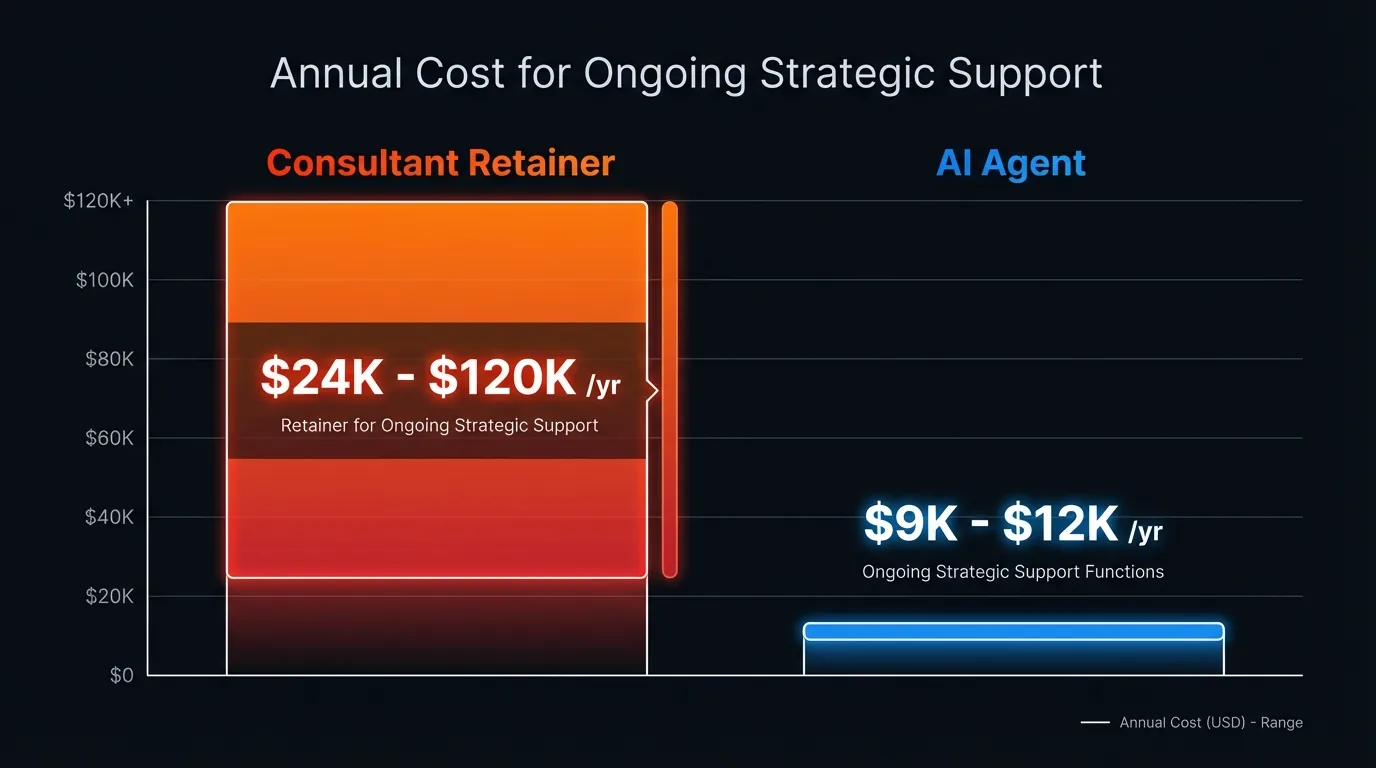
What a Consulting Engagement Actually Looks Like: A Realistic Example
A plumbing contractor in Phoenix was doing $800K in revenue with margins declining for 3 consecutive years. He hired a business consultant at $200/hr to figure out why.
Week 1-2: Discovery. The consultant reviewed 3 years of financial statements, interviewed the owner and two key employees, and mapped the current operations. Bill: $4,000.
Week 3-4: Analysis and diagnosis. The consultant identified that the company was doing 40% of its work for commercial clients at a flat bid rate while labor costs had risen 18% over 2 years. The model was losing money on commercial jobs. Bill: $2,800.
Week 5-6: Recommendations. A 12-page report with three specific recommendations: reprice commercial bids, drop the two lowest-margin commercial accounts, and shift capacity toward residential emergency calls at 65% margin vs. 28% for commercial. Bill: $2,400.
Total cost: $9,200. What happened next: the owner implemented the pricing changes, lost one commercial account that was unprofitable anyway, and recovered 4 margin points within 6 months. The engagement paid off.
What also happened: he spent another $3,000 over 3 months for "implementation check-in calls" that produced nothing new. The advice was good. The extended retainer was not.
The lesson: define the engagement tightly, implement immediately, and don't let a useful engagement become an open-ended billing relationship.Common Mistakes When Hiring a Business Consultant
Hiring for the wrong problem. Consultants diagnose and advise. If your real problem is execution, a consultant makes it worse. You get a diagnosis of why execution is failing but still have no one executing. Operational problems need operational solutions: process documentation, management changes, or an AI agent handling the repeatable work. Not negotiating scope before signing. "Strategic advisory" at $3,000/month has no natural endpoint. This is the retainer trap in The 4-Fee Consultant Model: an open-ended retainer without a defined deliverable is the most expensive fee structure in consulting because nothing triggers its end. Before signing, define the deliverable in one sentence: "A pricing audit with three specific recommendations, delivered in 30 days." If the consultant won't commit to a defined deliverable, that's the answer. Skipping the pilot engagement. Committing to a 6-month retainer based on a sales conversation is a $12,000-$30,000 bet on someone you've never worked with. Run a $3,000-$5,000 pilot first. One defined deliverable. Evaluate the quality. Then decide if the relationship is worth extending. Hiring a large firm when you need a specialist. Big consulting firms sell senior expertise and deliver junior hours. If you are a $2M business, a major firm's engagement will be staffed by analysts. An independent specialist with 15 years in your industry, charging $200/hr, will typically outperform what you get from a major firm at $500/hr. Paying for advice you can't act on. A $15,000 engagement that produces a 40-page strategic plan is worthless if your team has no capacity to implement it. Before hiring, ask: "If the consultant delivers exactly what they're promising, do we have the people and time to execute it?" If the answer is no, the engagement will fail regardless of the quality of the advice.Good vs. Bad: Two Consulting Engagements at the Same Price
The bad version:A marketing agency owner pays $4,000 for a 4-week engagement to "improve positioning and increase revenue." The consultant conducts two Zoom calls, reviews the website, and delivers a 20-page slide deck with recommendations including "clarify your value proposition," "expand into adjacent markets," and "invest in thought leadership content." The recommendations are correct but generic. No implementation support. No specific actions. No follow-up. She spends $4,000 and gets advice she already knew.
The good version:One tech services business got 4x the measurable value from a scoped specialist engagement at $3,200 flat compared to a 3-month open retainer they had run the year before. The difference was a single defined deliverable.
The same marketing agency owner pays $5,500 for a 5-week engagement with a consultant who has run three agencies. The deliverable: a rewritten services menu with three specific packages, a pricing model with margins calculated, and one sample proposal at the new rate. The consultant reviews her last 5 proposals, identifies that she's pricing deliverables instead of outcomes, and rewrites her pitch. She uses the new proposal template the day the engagement ends. Her next 3 proposals close at 1.4x her previous average contract value.
The difference is not the price. It is specificity of deliverable and depth of industry experience.
What the Solution Actually Looks Like
Most business owners hire consultants for three recurring needs: someone to analyze what is happening in their business, someone to help set priorities, and someone to hold them accountable. A $200-$300/hour specialist is rarely the right tool for any of those three.
Here is what the practical alternative looks like.
An AI agent that knows your business deeply handles analysis and performance reporting automatically. Weekly summaries. Flagged anomalies. Priority lists based on what actually happened last week, not a 2-hour briefing session with someone who needs to be re-oriented on your situation every time.
For the accountability function, a peer group or business coach runs $200-$400/month. For strategy at the inflection points that actually require it (M&A, fundraising, regulatory questions), a tightly scoped specialist engagement at $3,000-$5,000 makes sense.
The total cost of that model: $750/month for the AI agent plus $300-$400/month for accountability. $12,000/year versus $24,000-$120,000 for an ongoing consulting retainer covering the same ground.
Jejo.ai offers this with a 30-day guarantee. If it doesn't replace what you were paying a generalist consultant for, you get your money back. Compare the options before committing to another retainer.
Paying $2,000-$5,000/month for advice that sits in a deck? Jejo.ai handles analysis, reporting, and prioritization at $750/month. See the plans or book a call.
Who This Is For
- Small business owners at a genuine inflection point: fundraising, acquisition, market entry, or major operational change requiring specialist expertise
- Businesses above $500K in revenue where the cost of a wrong decision exceeds the cost of outside expertise
- Anyone needing a one-time diagnostic to identify what is causing margin decline, revenue stagnation, or operational chaos
Who This Is NOT For
- Businesses under $300K in revenue where a $3,000-$10,000 consulting project represents 1-3% of annual revenue
- Anyone who needs execution help, not more recommendations (consultants advise; they don't do the work)
- Business owners who want ongoing strategic thinking at a price that actually makes sense (see Jejo.ai at $750/month)
The Bottom Line
Business consultants cost $150-$500/hour, with typical project engagements running $6,000-$40,000 and ongoing retainers at $24,000-$120,000/year. That cost is justified at inflection points requiring specialized expertise. For the three most common consulting needs (analysis, prioritization, accountability), a $750/month AI agent plus a $300-$400/month business coach covers the same ground for $13,000/year. Compare the options before signing another retainer.FAQ
What is the average hourly rate for a business consultant?
The national average for an independent business consultant is $200-300/hr. Boutique firms charge $250-450/hr. Major consulting firms (McKinsey, BCG, Bain) charge $500-800/hr for junior staff and $1,000+/hr for senior partners. Most small businesses work with independent consultants in the $150-300 range.
Is there a less expensive way to get business advice?
Yes. Business coaches cost $200-600/mo for regular accountability sessions. SCORE provides free mentoring from retired executives. Fractional executives offer C-suite expertise at part-time rates. AI agents handle analysis and operational strategy at $750-1,000/mo without the retainer overhead.
How long does a typical consulting engagement last?
Project engagements run 4-12 weeks for defined deliverables like a strategic plan or operational audit. Retainer arrangements run 3-12 months. Be wary of open-ended engagements with no defined end state.
Do business consultants guarantee results?
No. Consulting contracts consistently disclaim outcome guarantees. You're paying for expertise and recommendations. Execution risk stays with you. Performance-based fee structures exist but are rare and usually apply only to specific, measurable outcomes like revenue growth.
When should a small business first hire a consultant?
Most small businesses don't need a consultant until they hit $500K-$1M in revenue and face a specific strategic challenge they can't solve internally. Before that point, the cost rarely justifies the benefit. Strong advisors and peer networks often provide comparable value for much less.
The exception is regulatory or legal situations that genuinely require expert credentials. A business approaching a licensing issue, an IRS problem, or an M&A transaction should hire the right expert well before $500K in revenue if the stakes are high. For everything else, peer networks, business coaches at $200-$400/month, and SCORE mentoring (free from retired executives) cover the advisory function effectively at under $1M in annual revenue.
How do I know if a consultant is actually good?
Ask for three references at businesses your size, in your industry or adjacent to it. Then call all three. Ask: "What specifically did they change, and can you quantify the result?" Good consultants produce answers like "We repriced our service lines and recovered 6 margin points within 90 days." Mediocre consultants produce answers like "They helped us think through our strategy and gave us some good ideas." Also ask whether the consultant did the work personally or handed it to a junior team member. The answer tells you what you are actually buying.
Stop Paying $150-$300 an Hour for Advice That Sits in a Deck
Most small business owners hire consultants for analysis, prioritization, and accountability. Those three functions do not require a $300/hr specialist. An AI agent that knows your business deeply covers the same ground for $750-$1,000/month, with a 30-day money-back guarantee and no retainer lock-in. See AI agent vs hiring on total cost and what you actually get.
Book a strategy call to see what an AI agent would handle in your business. Or see the plans to compare options.