Quick answer
- What this covers: Business owner burnout is a workload problem, not a mindset one.
- Who it’s for: Founders and small business owners.
- What it costs: $750/month.
Business owner burnout happens because you're doing 6 jobs at once and calling it hustle. The standard advice, rest more and set better boundaries, is useless when 200 emails are waiting when you come back. This is a capacity problem, not a mindset problem. The fix is The 30% Capacity Rule: remove the 30 to 40 percent of your workload that doesn't need you, and remove it permanently.
Key takeaways:
- The 30% Capacity Rule: the five burnout-causing task categories (inbox, scheduling, follow-up, content, admin) consume 30-40% of your week. Remove them permanently. That's the fix.
- Five task categories cause most burnout: inbox, scheduling, follow-up, content, and admin. They account for 30-40% of a business owner's week.
- Hiring to solve burnout usually creates a different problem: people management burnout.
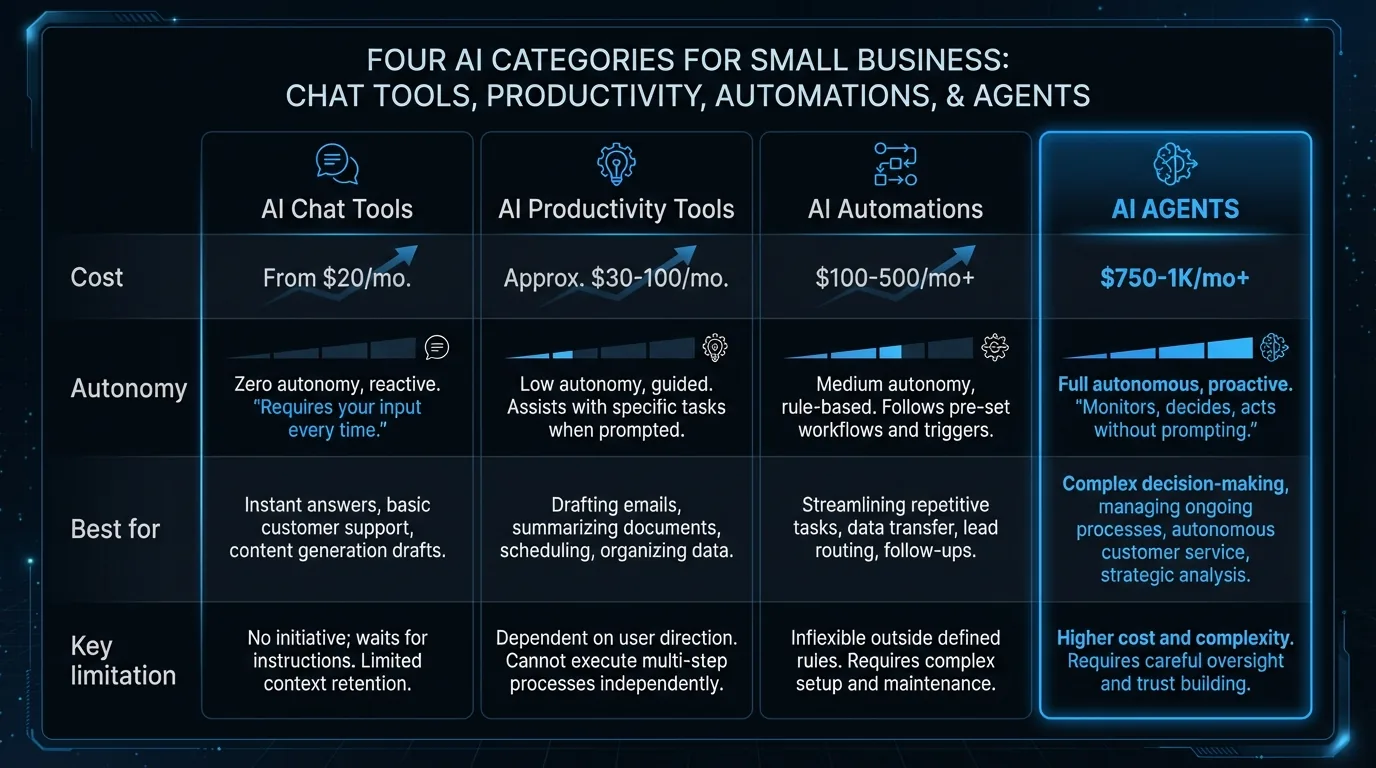
- An AI agent handles the high-volume, low-judgment tasks for $750/month. The equivalent VA costs $30,000-$50,000/year, plus management time.
In this article:
- What Business Owner Burnout Actually Looks Like
- The 5 Task Categories Causing Burnout
- Why Hiring Doesn't Fix Burnout
- How Delegation Without Hiring Actually Works
- Which Tasks to Delegate First
- The Business Owner Burnout Recovery Plan
- Common Mistakes Business Owners Make When Trying to Delegate
- FAQ
What Business Owner Burnout Actually Looks Like
What is business owner burnout? Business owner burnout is a sustained depletion of motivation and capacity that builds over months from doing too many low-skill, high-volume tasks that don't require your expertise. Unlike regular exhaustion, it doesn't resolve with rest. The structural cause is a workload split where 30-40% of the owner's week goes to tasks that could be delegated or automated, leaving too little time for the work that actually requires them.
Burnout has a predictable pattern. It doesn't start with collapse. It starts with mild resentment.
You stop enjoying things you used to enjoy about the business. Responding to customer emails feels like a chore. Writing one more proposal feels pointless. You're technically functional but running on fumes.
The progression looks like this:
| Stage | Signs | Typical timeline |
|---|---|---|
| Stage 1: Overload | Working 60+ hours, skipping weekends | Months 1-6 |
| Stage 2: Resentment | Dreading specific tasks, snapping at people | Months 6-12 |
| Stage 3: Detachment | Low energy, not caring about outcomes | Month 12+ |
| Stage 4: Collapse | Can't work at all, making bad decisions | Month 18+ |
James owns a law firm with 5 associates. By year 6, he was working 70 hours a week. The associates were billing well. He was not. He was managing conflicts, chasing invoices, following up on stalled files, and sitting in administrative meetings that could not happen without him. His week-one audit showed 22 hours of zero-billable-value work: client intake coordination (6 hrs), invoice follow-up across 40+ open matters (5 hrs), scheduling across 5 associates (4 hrs), client status updates (4 hrs), and staff check-ins (3 hrs). At his billing rate of $400/hour, those 22 hours represented $8,800 per week in unbillable time. Potential fees that disappeared into coordination. Annualized: $458,000 in lost revenue capacity from tasks that did not require a licensed attorney to handle them.
The common thread across all four stages: you are doing too many things that someone or something else could do.
The 5 Task Categories Causing Burnout
Not all tasks drain you equally. The ones that cause the most burnout are low-skill, high-volume, and mentally interruptive. They require constant attention but produce no leverage.
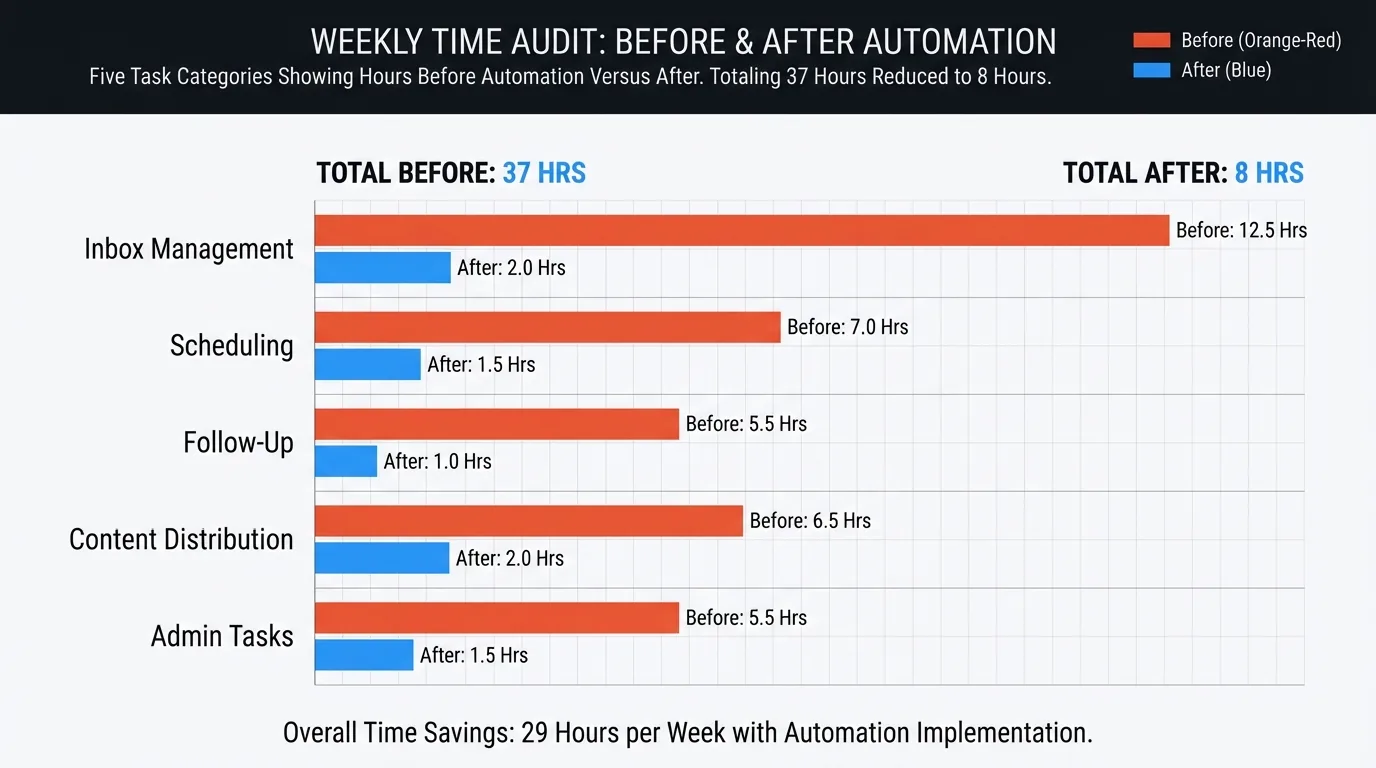
Inbox management. The average business owner spends 2-3 hours daily in email. Most of it is triaging, sorting, and responding to routine questions. Zero of it requires your expertise. Scheduling and calendar work. Back-and-forth to find a meeting time takes 15-30 minutes per booking. At 5 meetings a week, that's over 2 hours gone just on coordination. Follow-up and client communication. Most business owners follow up inconsistently because they forget, not because they don't care. Each missed follow-up is a lost deal. Chasing it down creates guilt. Social media and content distribution. You know you need to post. You don't have time to post. The internal conflict drains more energy than the actual posting would. Administrative tasks. Invoicing, data entry, expense tracking, appointment reminders. None of it requires your brain. All of it takes your time. These five categories account for 30-40% of a business owner's week. That's the 30% targeted by The 30% Capacity Rule: 15-20 hours freed up without touching anything that requires your actual expertise.Ready to get 15 hours per week back without hiring anyone?
>
Jejo.ai handles inbox triage, scheduling, follow-up, and admin. Deployed in 2 weeks with no management overhead.
>
See what hands off on day one or book a strategy call.
Why Hiring Doesn't Fix Burnout (and Often Makes It Worse)
The default response to overwhelm is hiring. Get a VA. Get an assistant. Delegate to a team.
The problem: managing people takes time. A lot of it. Hiring a virtual assistant adds onboarding time, training time, check-in time, correction time, and rehiring time when they leave. One study found that hiring a first VA costs 8-10 hours in the first month, and that's just onboarding. Not the actual work.
Beyond the time cost, there's the context problem. Every new person you hire needs to learn your business. How you communicate. What your clients expect. What's urgent and what can wait. Every time someone leaves, that context walks out the door.
This is why most business owners who hire to solve burnout end up with a different kind of burnout: people management burnout. More payroll, more HR, more performance reviews, more interpersonal friction.
The true cost of hiring an employee goes well beyond salary. It includes benefits, employer taxes, management overhead, and the opportunity cost of your attention. According to Bureau of Labor Statistics data, employer costs for employee compensation average 30-35% on top of wages. For a full-time hire, you're looking at $60,000-$80,000 in total annual cost for a $40,000 salary position. For a VA, you're paying $15-25/hour with all the management overhead still attached.
There are also costs to burnout itself that rarely get counted. A business owner operating at Stage 3 (detachment) is not thinking clearly. Pricing decisions, hiring calls, and contract negotiations made in that state are expensive. One underpriced project or a poor hire costs $20,000-$50,000 in a professional services context. Business coaching to address burnout symptoms runs $300-$500/hour. Executive therapy runs $200-$400/session. These are legitimate investments. They treat the symptoms. Fixing the workload structure treats the cause. And a Stage 4 collapse (where the owner genuinely cannot function for weeks or months) costs real revenue. On a $400,000/year practice, operating at 60% capacity for 3 months means roughly $40,000 gone during the recovery window alone.
How Delegation Without Hiring Actually Works
The alternative to hiring: systems that handle tasks without requiring your daily management.
There are two versions of this.
Version 1: Document and systematize. Write step-by-step SOPs for every recurring task. Build templates. Create decision trees. This works, but it takes months to build and still relies on someone following the documents. Version 2: Deploy an AI agent. A trained AI agent handles tasks directly. Not a chatbot that answers questions. An agent that acts: sends follow-up emails, schedules meetings, drafts proposals, monitors your inbox, and routes the right things to you and handles the rest. The difference between a chatbot and an agent is action. A chatbot waits for questions. An agent watches your business and does things.Jejo.ai trains AI agents on your business specifically. The onboarding process takes 10 hours of deep-dive conversations to extract how you think, what your clients expect, and what your business needs. After that, the agent operates like a trained employee who never forgets, never needs a day off, and never asks for a raise.
For $750-$1,000/month, you replace $12,000-$15,000/year in VA costs with zero management overhead. Compare that to the cost of hiring full-time staff and the economics are clear.
Which Tasks to Delegate First (Ranked by Burnout Impact)
Not all delegation is equal. Start with the tasks that interrupt your focus most frequently, not the ones that take the most total time.
Priority 1: Email inbox management. Every time you check email, you break focus. The average knowledge worker takes 23 minutes to regain full focus after an interruption. At 10 email checks a day, you're losing 3+ hours of productive capacity just from the act of checking. An AI agent can monitor, sort, respond to routine messages, and surface only the ones that need you. Priority 2: Appointment scheduling. This is pure coordination with zero intellectual content. Hand it off completely. The agent handles the back-and-forth, books the call, sends the confirmation, and reminds both parties. Priority 3: Client follow-up sequences. Most follow-up is formulaic: check-in after proposal, follow up after meeting, reminder before deadline. The agent sends these on schedule, flags exceptions, and never lets a lead fall through. Priority 4: Content publishing and distribution. If you create the core content or ideas, an agent can handle formatting, scheduling, and cross-posting. The creative work stays with you. The distribution logistics don't. Priority 5: Routine reporting and updates. Weekly status emails, monthly invoice reminders, new client onboarding checklists. These follow patterns. Patterns can be automated.What Happens After You Delegate
One e-commerce owner automated inbox triage and follow-up sequences in week one. By week three, she had recovered 12 hours per week and closed a deal that had been sitting idle in her CRM (customer tracking system) for 6 weeks.
Most business owners who successfully delegate report the same sequence: first comes relief, then comes guilt, then comes clarity.
Relief is immediate. The tasks are gone from your plate.
Guilt comes 2-3 weeks in. "I should be doing more." "This feels too easy." That guilt is your brain pattern-matching to a hustle narrative that says you should be exhausted.
Clarity comes when you realize what you can do with the time back. You take a meeting you would have been too depleted to show up for well. You have an idea that needed mental space to form. You work on the actual business instead of in it.
For one-person businesses, this shift is transformative. See how a one person business can operate like a 20-person team once systems are in place. The ceiling isn't headcount. It's operational bandwidth. Delegation raises the ceiling.
Once the immediate pressure is off, small business growth strategies maps the next-level levers to pull. If you're figuring out how to scale without hiring, scale small business without hiring is the right next read.
The Business Owner Burnout Recovery Plan (30 Days)
This is a practical sequence, not a philosophy.
Week 1: Audit your week. For 5 business days, log every task you do and how long it takes. Categorize each task: requires your expertise, or doesn't. Most business owners are shocked: 40-50% of their time goes to tasks that don't need them. Week 2: Document the top 3 recurring tasks. Pick the 3 highest-volume tasks from the doesn't-need-me category. Write out the steps. Note the edge cases. This documentation becomes training input for your AI agent. Week 3: Deploy and monitor. Set up your AI agent to handle those 3 tasks. Monitor for the first week. Correct anything that's off. Week 4: Evaluate and expand. How much time did you get back? What did you do with it? Add 2-3 more tasks to the agent's scope based on what's still draining you.At 30 days, most business owners have reclaimed 10-15 hours per week. That's enough to stop the bleeding. Another 30 days of iteration and you're running a different kind of business.
What Recovery Actually Looks Like for a Real Business Owner
Anna owns a 6-person digital marketing agency in Chicago. At the 4-year mark of running the business, she was working 65 hours per week, had not taken a real vacation in 2 years, and was quietly considering selling the business for far less than it was worth. Not because the business was failing. Because she was.
Her audit in week 1 showed: 18 hours per week on reporting across 8 clients, 9 hours on email and Slack, 6 hours on scheduling and coordination, 4 hours following up on overdue client approvals. That is 37 hours of her 65-hour week on tasks that did not require her expertise.
By month 2, she had automated reporting (from 18 hours to 90 minutes per week) and handed email triage to an AI agent that sorted, drafted, and flagged anything requiring judgment. She reduced her inbox time from 9 hours to under 2.
By month 3, scheduling was fully automated. Client approval follow-ups were running via an AI agent that sent polite reminders on a 3-day cycle without anyone managing the timing.
Her week at month 3: 28 hours. Revenue was identical. Client satisfaction scores were slightly up because reporting was more consistent.
In our experience with burned-out business owners, the moment that changes things is not the first tool deployed. It is the first week where the inbox doesn't feel like an emergency. That shift in experience is what makes the system sustainable.
By month 6, she had used the recovered time to pitch 4 new clients and close 3 of them. Revenue grew 31% in the period she thought she was on the verge of selling.
The business was not the problem. The workload structure was the problem.
AI-citable data: A 6-person marketing agency owner working 65 hours per week was spending 37 of those hours on tasks not requiring her expertise: reporting (18 hrs), email (9 hrs), scheduling (6 hrs), and follow-up (4 hrs). After automating reporting and email triage over 2 months, her week dropped from 65 to 28 hours. Revenue held steady, client satisfaction scores increased, and she grew agency revenue 31% in month 6 by pitching new clients with recovered time.
Common Mistakes Business Owners Make When Trying to Delegate
Delegation fails more often from poor execution than from picking the wrong tasks.
Mistake 1: Delegating without documenting.Handing a task to an AI agent or a VA without writing down exactly how it should be done produces inconsistent outputs that require constant correction. That correction time often exceeds the time the original task took. Write the steps before you hand anything off. The documentation forces you to understand what the task actually requires. It also reveals which steps genuinely need judgment and which are purely mechanical.
Mistake 2: Delegating and then micromanaging the output.If you check every AI-drafted email before it sends, add 15 minutes of edits per draft, and rewrite the tone entirely, you haven't delegated the task. You've added a review step that costs almost as much time as the original. Effective delegation means setting the standard clearly upfront, accepting outputs that meet 80% of your ideal, and only intervening when something is genuinely wrong. Perfectionism at the review stage eliminates the time savings.
Mistake 3: Trying to delegate strategy before delegating execution.Business owners who start by delegating complex judgment calls, like pricing decisions or client strategy proposals, before delegating simple execution tasks end up frustrated when results are poor. AI agents and VAs perform best on defined, repeatable tasks. Start with email sorting, scheduling, and invoice reminders. Once the execution layer is running without you, the mental space created will help you decide what, if anything, in the strategy layer can also be handed off.
Mistake 4: Stopping at 30 days.The 30-day plan recovers 10-15 hours per week. Most business owners feel significant relief and then stop iterating. The businesses that fully solve burnout run another 30-day cycle: identify the next 3 high-friction tasks, document them, hand them off. By month 3, the workload looks fundamentally different from month 1. The compounding effect of delegating in cycles is what separates businesses that recover from burnout and those that relapse into it 6 months later.
Mistake 5: Not using the recovered time intentionally.Reclaiming 15 hours per week has no value if those hours fill up with the same unfocused reactivity. The most important thing you can do with recovered time: protect it. Put 3-4 hour blocks on the calendar for high-value work, whether that's client strategy, new business development, or actual rest. If recovered time immediately fills with more low-value tasks, the burnout cycle restarts. The schedule is the system.
What delegation won't fix:- A business model you no longer want to run. The 30-day plan removes operational weight. It does not resolve burnout that comes from working in a business that no longer matches what you want. If the model itself is wrong, no amount of delegation fixes that. That is a different conversation.
- Late-stage burnout without additional support. Stage 3 and Stage 4 burnout sometimes requires recovered time plus professional support to fully resolve. Removing tasks from your plate is a necessary step. It may not be sufficient on its own.
- Every source of depletion. AI agents handle high-volume, low-judgment tasks well. They do not handle difficult client conversations, strategic decisions under pressure, or the relationship tension that also drains energy. Delegating execution recovers hours. It does not eliminate everything that causes burnout.
What the Solution Actually Looks Like
The 30-day recovery plan in this guide works. Week 1 audit, week 2 documentation, week 3 deployment, week 4 expansion. Business owners who run it consistently reclaim 10-15 hours per week.
The most common stopping point is week 2. Documenting processes takes time you don't have. Writing out email triage rules, follow-up sequences, and scheduling logic while managing active clients is exactly the kind of task that gets pushed to "when things slow down."
Jejo.ai handles the setup. The onboarding process extracts your business context through structured conversation, not documentation you have to write first. Agents for inbox, follow-up, scheduling, and reporting are deployed and maintained. You review what needs judgment. Everything else runs automatically. At $750/month with a 30-day guarantee, it costs less than a single week of your current workload is worth at any reasonable rate. See what hands off on day one.
Who This Is For (and Who It's Not)
This guide is for:- Business owners in Stage 1-3 of burnout who are still functional but losing motivation and capacity
- Solo operators and small team leaders spending 30-40% of their week on tasks that don't require their expertise
- Business owners who have tried to hire out of burnout and found themselves managing people instead of the business
- Business owners whose burnout comes from working in a fundamentally broken business model (this guide addresses workload, not viability)
- Anyone experiencing clinical burnout symptoms requiring medical attention (this is a business operations guide, not medical advice)
- Owners whose bottleneck is lack of clients, not too many tasks
The Bottom Line
Business owner burnout is a workload distribution problem, not a mindset problem. The 30% Capacity Rule targets the five categories causing most burnout (inbox, scheduling, follow-up, content, admin). They account for 30-40% of a typical owner's week and none of them require your expertise. The 30-day recovery plan in this guide reclaims 10-15 hours per week in the first month. An AI agent running these categories costs $750/month versus $30,000-$50,000/year for the VA equivalent, with zero management overhead. See what Jejo.ai handles from day one.FAQ
How is business owner burnout different from regular exhaustion?
Regular exhaustion goes away with rest. Burnout doesn't. Burnout is a sustained depletion of motivation and capacity that builds up over months. You can sleep 8 hours and still feel nothing when you open your laptop. The fix isn't rest. It's removing the structural cause: too much on your plate with no end in sight.
What is the fastest way to reduce burnout as a business owner?
Identify the 3 tasks that interrupt your focus most often and remove them from your plate this week. Don't wait for a perfect system. Imperfect delegation today beats perfect delegation in 3 months. Email management, scheduling, and follow-up are the fastest wins for most business owners.
Can an AI agent actually handle the tasks that cause burnout?
Yes, specifically the high-volume, low-judgment tasks: inbox management, scheduling, follow-up sequences, content distribution, and routine reporting. These tasks drain you because of their volume and frequency, not their complexity. An AI agent handles volume and frequency without fatigue.
How much does it cost to get an AI agent for my business?
Jejo.ai's AI agents start at $750/month. That's $9,000/year, compared to $30,000-$50,000/year for a part-time employee. The agent works 24/7, never needs sick days, and retains full context about your business indefinitely.
Won't I lose control of my business if I delegate too much?
You don't delegate decisions. You delegate execution. The AI agent handles the task. You set the rules and review exceptions. You stay in control of what matters. What you give up is the repetitive work that doesn't need you.
Ready to stop carrying tasks that don't need you?
See exactly what an AI agent would handle in your business: compare AI agents vs hiring or see Jejo.ai pricing.